How Does Dworkin's Attack on Hart's Theory of Law Work?
TL;DR
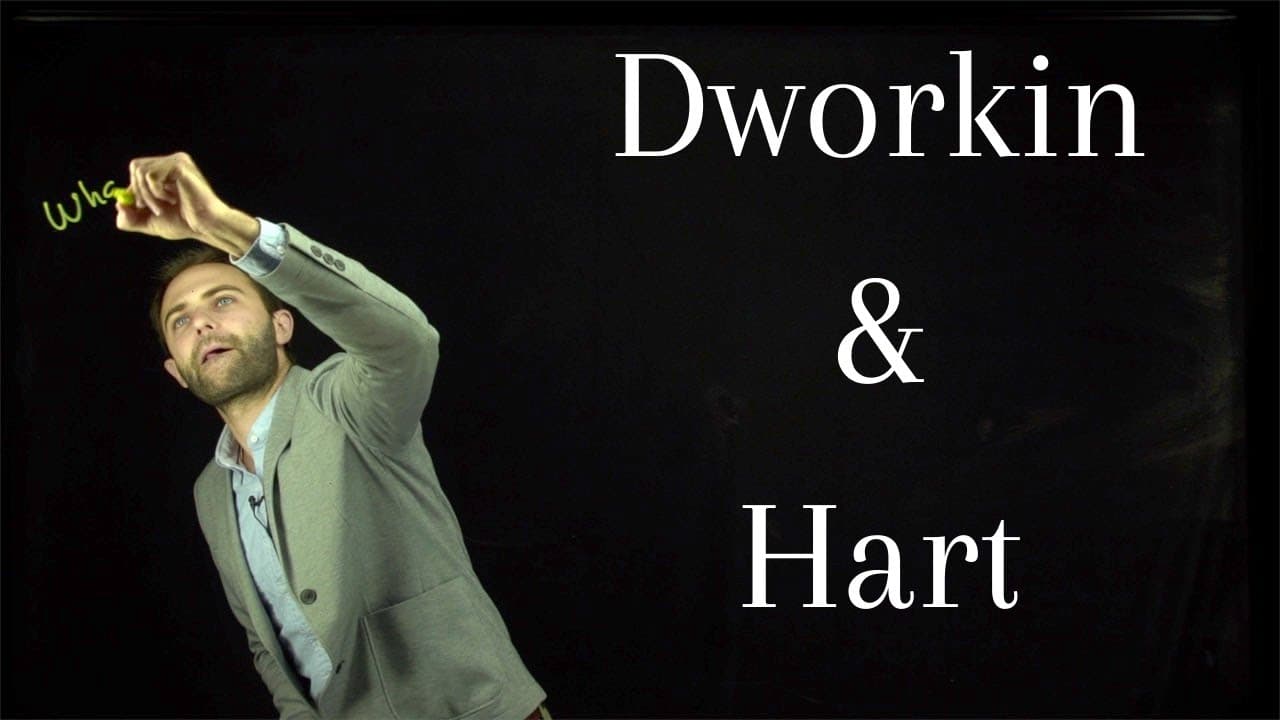
Dworkin attacks Hart's legal positivism by targeting its account of judging. Hart says judges apply rules mechanically in easy cases but exercise discretion, effectively making law, in hard cases at the penumbra of a rule. Dworkin adds a distinction between all-or-nothing rules and weighable principles to challenge this whole theory of law.
Transcript
maybe they say they they say okay the rules are now that for batters who are wearing a red hat they get four strikes so in this course we've spent a lot of time talking about the theory of law of hla heart hart was a legal positivist and we read all about and discussed at great length um his theory of law that centrally involves a rule of recogniti... Read More
Key Insights
- Hart's theory of adjudication is a middle road between formalism and extreme realism. Formalism says judges mechanically apply rules like DMV employees, while extreme realism says judges follow only their own biases and whims.
- The open texture of law is the idea that words are vague, so every rule has cases where its application is unclear. The rule 'no vehicles in the park' leaves roller skates, motorized scooters and a bronze-painted jeep memorial uncertain.
- Hart treats easy cases as core cases where a rule applies in a rote fashion. Judges in these cases do what the formalist describes, simply applying a rule to a particular set of facts.
- Hard cases fall into the penumbra, the periphery of a rule, where Hart says judges have discretion. Here they do whatever they like, which means they legislate and make law.
- On Hart's theory, judges make law in hard cases even though in many legal systems they are not elected or officially given the power to legislate. This is a main point where Dworkin latches on.
- Dworkin's criticism is aimed at Hart's whole theory of law, not just his theory of adjudication. The whole account of legal positivism, including the rule of recognition, comes under attack.
- Rules, for Dworkin, are standards that apply in an all-or-nothing fashion. The baseball rule that three strikes means a batter is out either applies or does not, and an exception simply rewrites the rule.
- Principles, for Dworkin, still apply to a case even when outweighed by other considerations. The principle that no one may profit from their own wrong does not mean the law never lets anyone profit from wrongdoing.
Install to Summarize YouTube Videos and Get Transcripts
Explore YouTube Video Summarizer or Get YouTube Transcript Extractor
Questions & Answers
Q: What is the difference between formalism and realism about adjudication?
Formalism holds that judges are like DMV employees who simply know the rules and apply them formulaically to the facts, with no discretion or creativity involved. Extreme realism holds that judges do whatever they want, deciding cases from their own biases and whims while attaching the trappings of rules. The lecture says no one really holds either extreme view.
Q: What is the open texture of law?
The open texture of law is Hart's idea that words have meanings that are often vague, so for any rule anyone could state or write down, there will be cases where it is unclear how the rule applies. A rule such as 'no vehicles in the park' is clear for a car but uncertain for motorized roller skates, scooters or a memorial jeep.
Q: How does Hart explain what judges do in easy and hard cases?
Hart takes a middle road between formalism and extreme realism. In easy cases, such as someone driving a car through the park, judges simply apply a rule in a rote or automatic fashion, as the formalist says. In hard cases at the penumbra, where the rule's application is unclear, judges have discretion and can do whatever they like.
Q: What is the penumbra of a legal rule?
The penumbra is the periphery or edge of a rule, as opposed to its core. Core cases are those a rule naturally applies to, while penumbral cases are the hard, unanticipated ones, such as someone riding motorized roller skates through the park. Hart says judges have discretion when a case falls in the penumbra.
Q: Why does Hart's theory imply that judges make law?
In hard cases, Hart says judges exercise discretion in situations the rule makers did not anticipate, so they are effectively legislating, or making up rules. This is notable because in many legal systems judges are not elected or officially given the power to make law. Dworkin latches on to this implication when criticizing Hart.
Q: How does Dworkin distinguish rules from principles?
Dworkin says rules are standards for behavior that apply in an all-or-nothing fashion: you either violate the rule or you do not. Principles also apply in cases, but they can be outweighed by other considerations, and even when outweighed they still apply. Hart himself does not make this distinction, and it supports Dworkin's criticism.
Q: What does the baseball example show about rules?
Dworkin's example is the baseball rule that a batter with three strikes is out. An official cannot accept this as an accurate statement of the rule and also decide that a batter with three strikes is not out. If an exception such as a red hat is added, the rule itself becomes different, so a rule either applies or it does not.
Q: Does Dworkin's criticism target only Hart's theory of adjudication?
No. The lecture stresses that Dworkin is not merely criticizing Hart's account of what judges do in various types of cases. His criticism goes to the heart of the matter and attacks Hart's whole theory of law. The lecture also notes it is very controversial whether the criticism succeeds.
Summary & Key Takeaways
-
The lecture first sets out Hart's theory of law, which centres on a rule of recognition that sets the criteria all other rules must meet to be laws. It then explains that Dworkin's criticisms cannot be understood without first understanding Hart's account of how judges decide cases.
-
Hart's account of adjudication sits between formalism and extreme realism. Formalism pictures judges as DMV employees counting documents against rules, while extreme realism pictures judges following their own whims. Hart uses the open texture of law, illustrated by the no-vehicles-in-the-park rule, to find the middle position.
-
Hart says judges apply rules mechanically in easy cases but have discretion in hard penumbral cases, so they legislate. Dworkin attacks this and adds his rules versus principles distinction: rules apply all or nothing, as in baseball's three strikes, while principles can be outweighed yet still apply.
Read in Other Languages (beta)
Share This Summary 📚
Summarize YouTube Videos and Get Video Transcripts with 1-Click
Try YouTube Summary with ChatGPT & Claude or YouTube Transcript Generator
Explore More Summaries from Jeffrey Kaplan 📚
Summarize YouTube Videos and Get Video Transcripts with 1-Click
Try YouTube Summary with ChatGPT & Claude or YouTube Transcript Generator