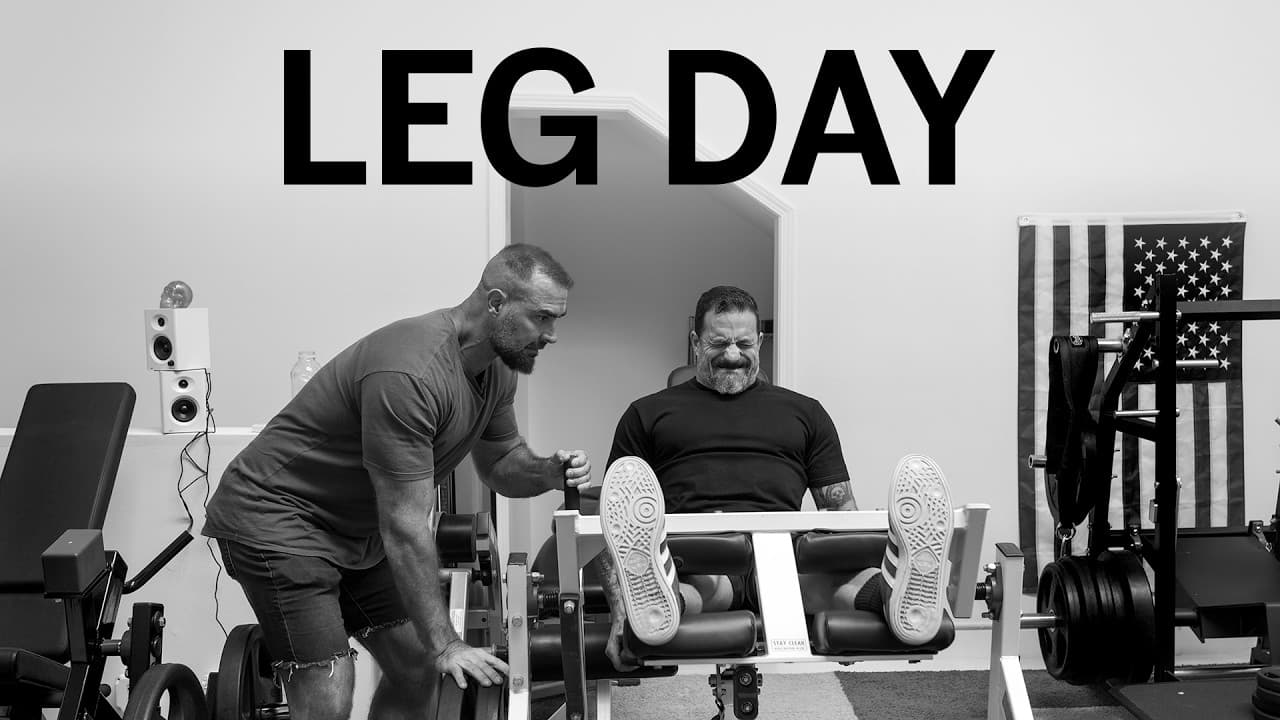
How to train legs for selective hypertrophy and adductors
TL;DR
Focus on mind muscle connection, use varied leg curls, stiff leg deadlifts, belt squats, and adductor work to target weak points. Balance imbalances with unilateral work, progressive overload, and smart volume shifts so you can grow specific muscles without overdoing the rest.
Transcript
[Applause] Hey everybody, I'm here with the glute guy, Dr. Brett Contrarus, who's an expert in all things resistance training. So, getting stronger, hypertrophy, and these days he's best known for selective hypertrophy, how to direct muscle growth to particular muscles. and he's called the glute guy because he's developed a lot of movements and he'... Read More
Key Insights
- Adductors should be trained because they are essential for balanced leg development and can influence overall leg strength and hypertrophy.
- Mind muscle connection is a foundational tool that enhances muscle activation during sets, enabling better hypertrophy when focusing on the target muscle.
- Seated leg curls and other variations can differentially target hamstrings, with seated curls often providing a greater stretch and potential advantage for hamstring growth.
- Stiff leg deadlifts or Romanian deadlifts train hamstrings at longer muscle lengths, which can promote growth and improve posterior chain development.
- Progressive overload should be applied gradually and consistently, emphasizing small increases in load or reps to drive gains without overreaching.
- If a body part lags, train it with more sets or higher volume in a controlled period, while maintaining overall balance and avoiding overtraining other muscles.
- Rotating focus points across training blocks (eg glutes one block, quads another) can optimize overall hypertrophy while preventing stalling.
- Volume management is critical; increasing volume for one muscle requires compensatory adjustments elsewhere to ensure sustainable growth and recovery with respect to the individual’s training plan.
- More videos from this channel:
- More from this channel: Huberman Lab Clips
Install to Summarize YouTube Videos and Get Transcripts
Explore YouTube Video Summarizer or Get YouTube Transcript Extractor
Questions & Answers
Q: A real search query question about the video
How can I train my legs to build selective hypertrophy and strengthen adductors while avoiding imbalance? The video explains addressing weak points by prioritizing targeted exercises such as adductors, hamstrings, and glutes, using a combination of mind muscle connection, heavy and light intensity days, and progressive overload. It also highlights the importance of unilateral work to balance asymmetries and prevent overreliance on a single muscle group.
Q: What is the role of mind muscle connection in leg training?
The mind muscle connection is described as a crucial factor for long term lifting success. By focusing attention on the target muscle during a set, lifters can increase activation and stimulus, which translates to greater hypertrophy over time. Practically, it means visualizing the contracted muscle and maintaining focus rather than being preoccupied with external metrics or mirror checks.
Q: Which leg curl variation is favored for hamstrings growth and why?
seated leg curls are often emphasized because research suggests they may be more effective than lying leg curls for hamstrings growth due to the stretch and emphasis on hip extension mechanics. The technique involves ensuring full range at the top, maximizing hip flexion, and maintaining contact with the pad to enhance engagement of the hamstrings in a lengthened position.
Q: How should one perform a stiff leg deadlift for hypertrophy?
The stiff leg deadlift involves a hinge at the hips with a neutral spine, keeping the bar close to the legs so it skims along the shins. The shoulders are pulled back, chest up, and the movement emphasizes stretching the hamstrings with control. Proper form reduces erector engagement and maximizes hamstring activation during the lengthened portion.
Q: What does progressive overload look like in a technical leg workout?
Progressive overload means starting with a manageable load and gradually increasing it over weeks, for example adding reps or weight in small increments weekly. If you cannot increase both, you can add volume over a block and then pause or alternate to avoid stagnation. The key is consistent, measurable progression rather than sudden, large jumps.
Q: How should you handle asymmetries between legs?
For asymmetries, the recommended approach is to perform more work on the weaker limb, such as two sets for every one set on the stronger leg, to equalize development. This approach helps maintain symmetry while allowing the stronger leg to recover and adapt, ultimately promoting balanced hypertrophy and function.
Q: Why are adductors highlighted alongside glutes and hamstrings in leg training?
Adductors are highlighted because they contribute to overall leg balance, stability, and function, and neglecting them can limit hypertrophy in surrounding muscles. Training adductors supports hip stabilization, improves performance in multi-joint movements, and helps prevent injury by promoting balanced strength across the inner thigh muscles.
Q: What role do belt squats and squat technique adjustments play in selective hypertrophy?
Belt squats provide an effective load on the lower body while reducing spinal loading, allowing emphasis on glute and quad development with varied stance width. Adjusting squat technique, such as stance width, can shift emphasis toward different muscle groups, aiding selective hypertrophy and enabling progression while managing torso and knee stress.
Summary & Key Takeaways
-
The video emphasizes training leg muscles with attention to adductors and selective hypertrophy, highlighting how to address weak points through targeted exercises and technique cues.
-
A key theme is progressive overload and volume management, advising that increasing volume on one muscle requires reducing elsewhere to maintain balance and progress.
-
The discussion includes practical cues on form, tempo, and mind muscular connection to maximize hypertrophy and reduce injury risk.
Read in Other Languages (beta)
Share This Summary 📚
Summarize YouTube Videos and Get Video Transcripts with 1-Click
Try YouTube Summary with ChatGPT & Claude or YouTube Transcript Generator
Explore More Summaries from Huberman Lab Clips 📚
Summarize YouTube Videos and Get Video Transcripts with 1-Click
Try YouTube Summary with ChatGPT & Claude or YouTube Transcript Generator