How to Improve Your Sprinting Form and Speed
TL;DR
Warm up for sprinting with repeated skipping, walking, and progressively faster strides instead of jogging. Stay tall, bring the thighs forward, contact the ground with a stiff, flat foot, and coordinate the shoulders, spine, hips, and arms so sprinting remains an expressive whole-body movement.
Transcript
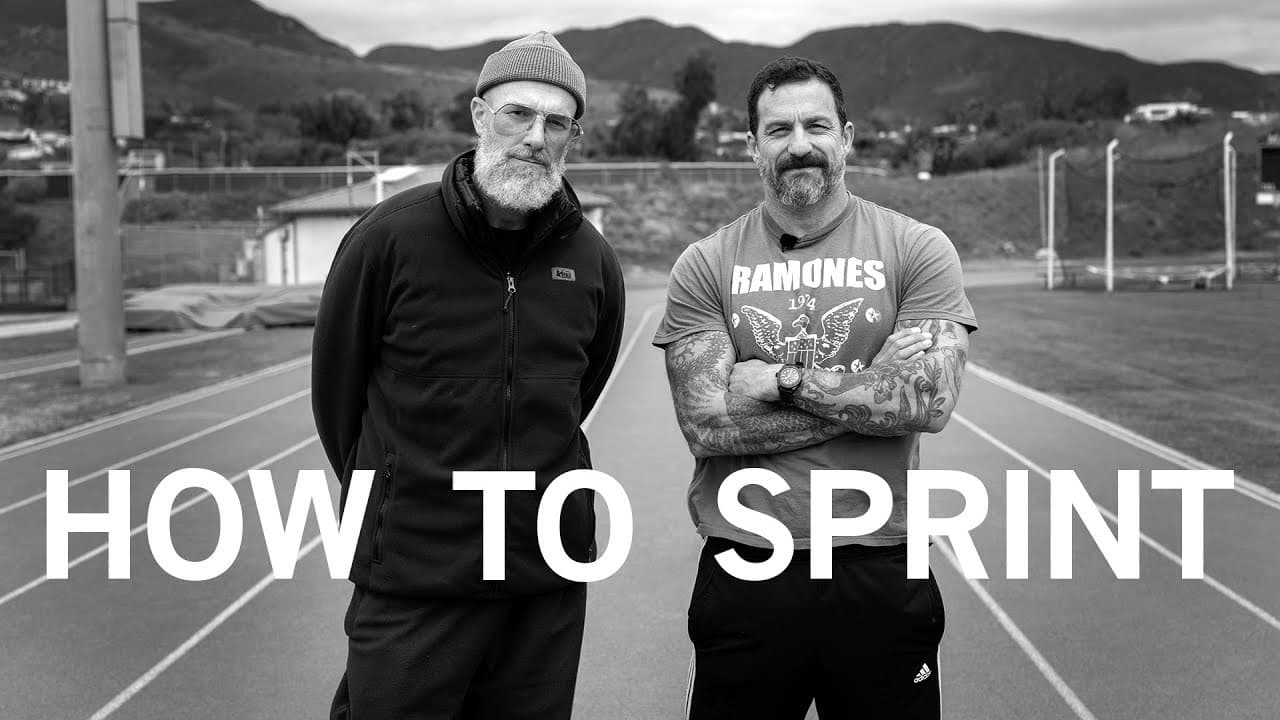
(upbeat music) (upbeat music continues) I'm here at beautiful Malibu High School, and I'm with the one-and-only, Stu McMillan, who is a sprints coach, and is considered one of the premier sprints coaches in the world. He's highly revered, he's highly sought-after because he's the man with the knowledge about how to sprint better and faster. And he ... Read More
Key Insights
- Sprinting is a distinct gait pattern from jogging. Jogging involves rolling through the ankle and knee and moving behind the center of mass, while sprint-oriented movement emphasizes actions in front of the center of mass, a taller posture, and coordinated whole-body expression.
- Skipping is the recommended foundation for a sprint warm-up because its gait resembles sprinting. It coordinates stiffness at the ankle, knee, and hip while encouraging a tall, bouncy position, making it more specific to sprint preparation than an easy jog.
- The initial striding cue is to pull the thighs forward without deliberately reaching the feet outward. The athlete begins at a slow pace with a low knee action and flat ground contact, then gradually increases knee height and range of motion.
- A stiff ankle is important during sprint ground contact because the forces are compared with repeatedly striking a heavy bag. McMillan teaches each contact as a firm pop, pairing flat-footed landing with coordinated stiffness through the body rather than a relaxed, rolling ankle.
- Sprinting is a whole-body activity with an expressive, upright posture. Unlike the comparatively closed and lower-body-dominant posture of jogging, sprinting uses the arms, shoulders, spine, hips, knees, and ankles together to organize force and maintain rhythm.
- The spine moves during sprinting to counter the motion of the hips and shoulders. It rotates, laterally flexes, extends, and flexes as the hips oscillate and the shoulders counter-oscillate, so a rigidly square torso can limit efficient athletic movement.
- Shoulder-blade movement is part of effective sprint mechanics. Scapular pushups and rotating side-plank exercises train the shoulder blades to glide along the ribcage, first with slow repetitions for control and then with faster repetitions that preserve the same movement shapes.
- A dribble is a shortened-range sprint pattern that connects drills to faster running. It preserves the forward thigh action, posture, stiffness, and rhythm of sprinting while using a truncated range of motion, which can later expand as the athlete begins to sprint faster.
Install to Summarize YouTube Videos and Get Transcripts
Explore YouTube Video Summarizer or Get YouTube Transcript Extractor
Questions & Answers
Q: How should you warm up before sprinting?
Warm up with repeated cycles of skipping and walking rather than jogging. Begin with straight legs, relaxed arms, tall posture, and coordinated stiffness through the ankle, knee, and hip. As the body becomes ready, add more height and pop to the skip, perform a few faster runs, and then progress into the sprint session.
Q: Why does the coach recommend skipping instead of jogging?
Skipping resembles the gait pattern used in sprinting because it promotes coordinated stiffness at the ankle, knee, and hip while keeping the body tall and bouncy. Jogging instead involves rolling through the ankle and knee and pushing around the track or grass. Skipping therefore prepares the posture, rhythm, and contact pattern emphasized for faster running.
Q: What is the difference between jogging and sprinting form?
Jogging is described as a closed, efficient gait that occurs mainly behind the center of mass and relies heavily on the lower body. Sprinting is taller, more expressive, and organized in front of the center of mass. It also involves the entire body, including coordinated movement of the arms, shoulders, shoulder blades, spine, hips, and legs.
Q: How should the foot contact the ground when sprinting?
The foot should meet the ground with a stiff ankle and a flat contact that produces a clear popping sound. McMillan compares the action to striking a heavy bag with a firm wrist and fist. The goal is to avoid a relaxed ankle that rolls through contact and instead coordinate stiffness across the body during each step.
Q: What cue helps move the legs correctly during a stride?
The primary cue is to pull the thigh forward while keeping the action in front of the center of mass. The athlete should not consciously reach the foot outward or allow it to remain far behind. Practice begins with a low knee at jogging speed, then the knee rises and the movement range expands as speed increases.
Q: What is a dribble drill in sprint training?
A dribble is a truncated, shorter-range version of the sprinting action. It uses the same general posture, forward thigh recovery, rhythm, and ground-contact qualities but reduces the size of the movement. McMillan introduces it after skipping and slow striding, then explains that actual sprinting uses a larger range of motion built from the same pattern.
Q: Why is spinal movement important for sprinting?
The spine helps manage the interacting motions of the hips and shoulders during sprinting. As the hips move forward, backward, upward, and downward, the shoulders counter that motion. The spine rotates, laterally flexes, extends, and flexes to coordinate these forces, which is why the preparation includes drills that combine spinal movement with hip extension and pelvic control.
Q: Which mobility exercises support better sprint mechanics?
The demonstrated preparation includes elbow-based scapular pushups, rotating side planks, tall-kneeling side bends, half-kneeling rotations, and a split-squat hold. These exercises develop shoulder-blade gliding, spinal rotation and lateral flexion, posterior pelvic positioning, hip extension, and active pressure into the ground. Slow repetitions establish the shapes before faster, flowing repetitions reinforce coordination.
Summary & Key Takeaways
-
McMillan distinguishes sprinting from jogging by their gait patterns, posture, and use of the body. Jogging is comparatively closed and occurs behind the center of mass, while sprinting is tall, expressive, and organized in front of it. The introductory drills teach forward thigh action without deliberately reaching the foot outward.
-
The recommended sprint warm-up replaces jogging with repeated cycles of skipping and walking. Athletes gradually add height, stronger ground contacts, larger arm movements, and faster strides as readiness improves. Dribble steps provide a shortened sprint pattern that helps practice posture, rhythm, forward thigh recovery, and flat-footed contact before full-range sprinting.
-
Mobility drills prepare the coordinated movements needed for sprinting. Scapular pushups and side-plank rotations encourage shoulder-blade motion, while kneeling and split-position exercises combine hip extension, pelvic positioning, spinal rotation, lateral flexion, and extension. The aim is to integrate these patterns before applying them during increasingly expressive strides.
Read in Other Languages (beta)
Share This Summary 📚
Summarize YouTube Videos and Get Video Transcripts with 1-Click
Try YouTube Summary with ChatGPT & Claude or YouTube Transcript Generator
Explore More Summaries from Huberman Lab Clips 📚




Summarize YouTube Videos and Get Video Transcripts with 1-Click
Try YouTube Summary with ChatGPT & Claude or YouTube Transcript Generator