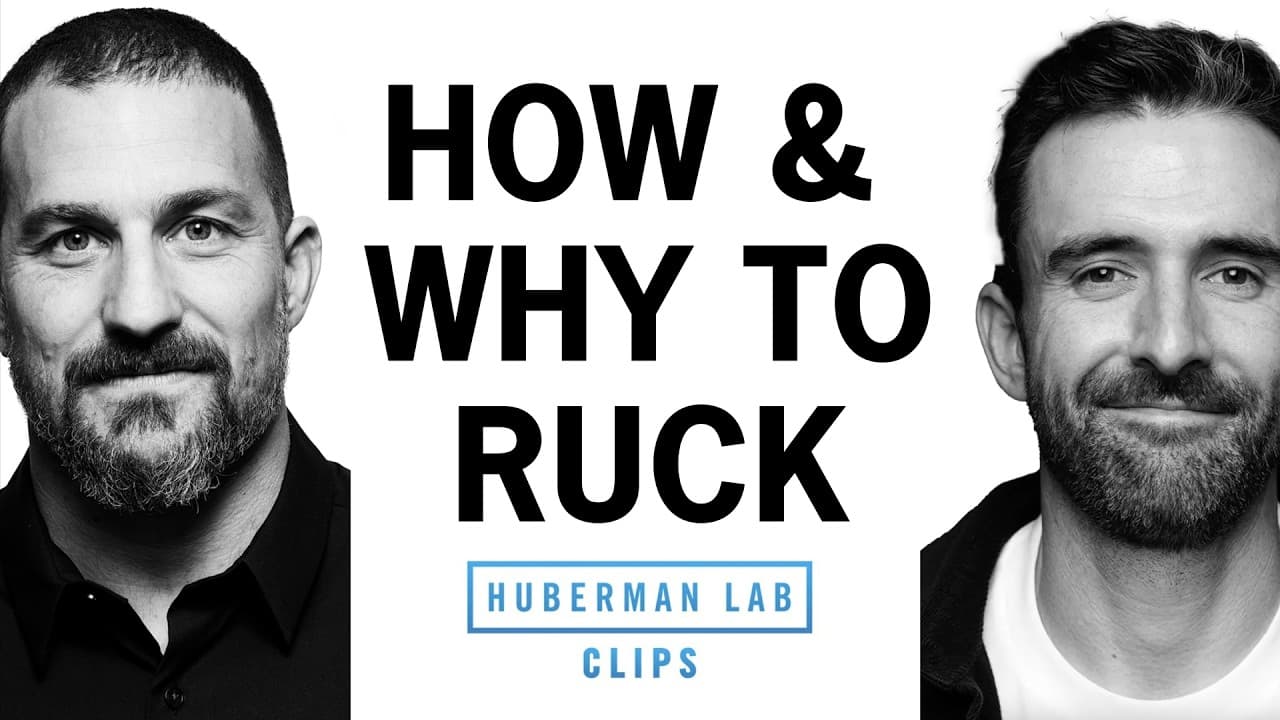
How and Why to Ruck for Weight Loss and Strength | Michael Easter and Dr. Andrew Huberman
TL;DR
Rucking supports weight loss and strength by combining cardiovascular movement with the muscular and skeletal load of carrying weight. Michael Easter explains that weighted walking burns more calories per mile than walking or running, although running may cover more distance in the same time. It can also fill training gaps for people who find walking too easy or cannot run. Read on for benefits, evidence, and beginner guidance.
Transcript
i want to shift us to rocking okay i really dislike rocking but now you got me rocking so tell tell us why rucking and things like it are so valuable and are distinctly different than like quoteunquote hitting the gym so I'll tell you how I sort of came to this realization started writing about this in the first place is that um when we were in the... Read More
Key Insights
- Rucking is an exercise that involves walking with weight in a backpack, combining cardio and strength training.
- Humans evolved to carry weight over long distances, a trait that has shaped our physical capabilities.
- Rucking burns more calories per mile than walking or running due to the added weight.
- Starting with light weights, such as 5-20 pounds for women and 10-30 pounds for men, is recommended to avoid injury.
- Rucking engages stabilizing muscles, improving gait and providing a sense of increased speed and lightness when running without weight.
- Rucking can preferentially burn fat over muscle, as shown in a study involving backcountry hunters.
- The injury rate for rucking is low, similar to walking, making it a safer alternative to running.
- Rucking can offer cognitive and creative benefits, paralleling the mental challenges and breakthroughs experienced in activities like writing.
Install to Summarize YouTube Videos and Get Transcripts
Explore YouTube Video Summarizer or Get YouTube Transcript Extractor
Questions & Answers
Q: How does rucking help with weight loss and strength?
Rucking combines a cardiovascular stimulus from covering ground with strength work from loading the skeletal and muscular systems. Michael Easter describes it as a two-in-one activity that generally burns more calories per mile than walking or running because of the added weight.
Q: What is rucking?
Rucking is walking with weight in a backpack, an activity Michael Easter also calls weighted walking. He prefers those terms because they sound more approachable than the military-associated word “rucking.”
Q: Does rucking burn more calories than running?
When compared over the same distance, rucking generally burns more calories because the person carries additional weight. Running may still cover more distance in the same amount of time, so the comparison depends on whether distance or time is held constant.
Q: Why is rucking different from a traditional gym workout?
Rucking combines cardio and strength work while getting people outside. It can fill a training gap for people who lift weights but do not run, cannot run, or feel that ordinary walking is too easy.
Q: Can rucking promote fat loss while preserving muscle?
A small study of about 12 backcountry hunters in Alaska found that they lost a significant amount of weight, mostly from fat, while gaining a very small amount of muscle. Michael Easter cautions that the study was small, but presents it as evidence that carrying heavy packs may favor fat loss while preserving muscle.
Q: Why does Michael Easter believe humans are suited to carrying weight?
Easter argues that humans evolved not only to run long distances but also to carry animals, food, babies, and tools. He says walking on two legs freed the hands to transport tools and other loads over long distances, helping humans move into unfamiliar environments.
Q: How did Michael Easter become interested in rucking?
The idea occurred to him during an Arctic caribou hunt when he carried a pack weighing more than 100 pounds back to camp. He connected that experience with the question of what humans had to do after persistence hunting: carry the animal back.
Q: What starting weight is recommended for beginner ruckers?
The existing guidance recommends beginning lightly, with 5–20 pounds for women and 10–30 pounds for men, depending on fitness level. Increase the load gradually so the body can adapt and to reduce the risk of overexertion or injury.
Summary & Key Takeaways
-
Rucking, or walking with weight, is a dual-purpose exercise that provides both cardiovascular and strength benefits. By adding weight to a backpack, individuals burn more calories than walking or running alone, engaging stabilizing muscles and improving gait. Starting with light weights is advised to prevent injury, and the activity is accessible to a wide range of fitness levels.
-
Humans have evolved to carry weight over long distances, a capability that has historically contributed to our survival. Rucking taps into this evolutionary trait, offering a low-injury-rate exercise that can preferentially burn fat while preserving muscle. It is a beneficial addition to fitness routines, particularly for those seeking an outdoor alternative to gym workouts.
-
Rucking's cognitive and creative benefits mirror the mental challenges faced in other pursuits, such as writing. The activity encourages focus and persistence, leading to breakthroughs and improved performance. As a form of exercise, rucking is not only effective for physical health but also supports mental well-being and resilience.
Read in Other Languages (beta)
Share This Summary 📚
Summarize YouTube Videos and Get Video Transcripts with 1-Click
Try YouTube Summary with ChatGPT & Claude or YouTube Transcript Generator
Explore More Summaries from Huberman Lab Clips 📚



Summarize YouTube Videos and Get Video Transcripts with 1-Click
Try YouTube Summary with ChatGPT & Claude or YouTube Transcript Generator