What is the difference between Observability, Monitoring, APM
TL;DR
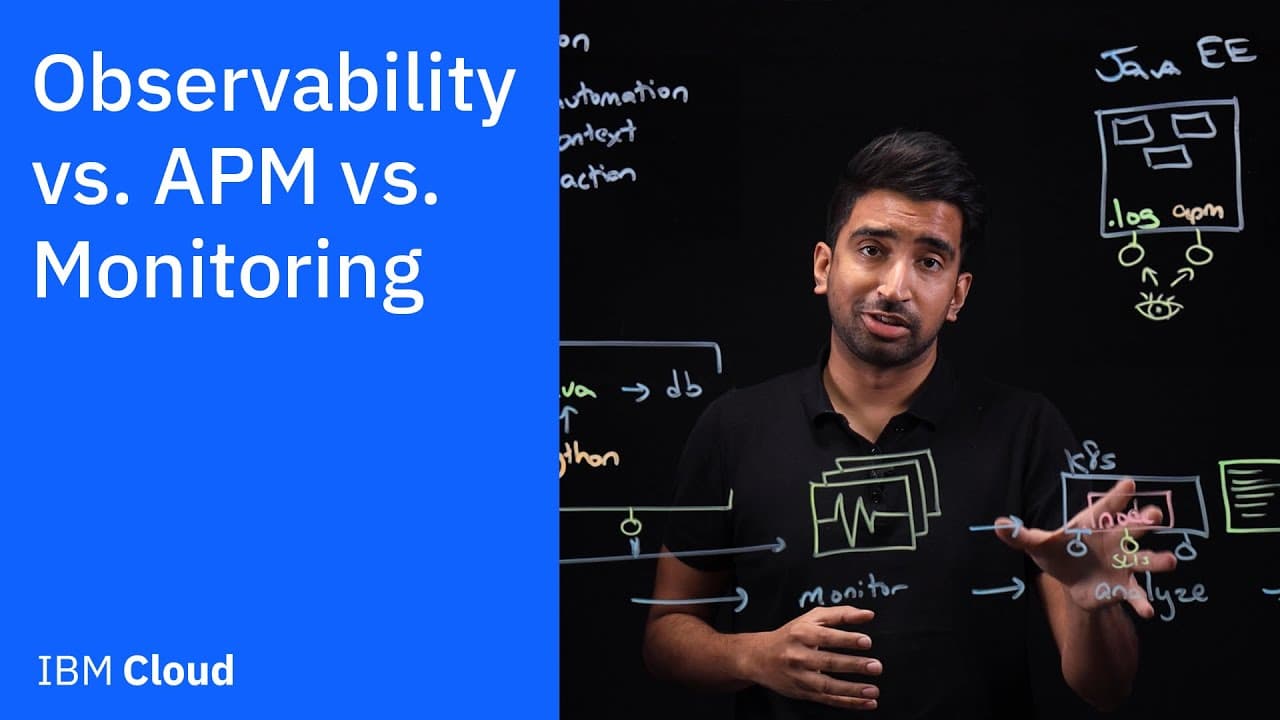
Observability is a holistic approach that combines data from multiple runtimes and services to monitor health, trace issues, and enable action. APM is a traditional tool focused on resource metrics and app performance, while Monitoring emphasizes dashboards and alerts. Observability extends beyond APM by adding context, automation, and end-to-end tracing across cloud native environments.
Transcript
These days I hear the terms Observability, Monitoring, and APM, or Application Performance Management thrown around seemingly interchangeably, but these terms actually mean quite different things. So let's dive in head first and see an example of how exactly these things differ. So to start I'm going to start with kind of a Java EE application,... Read More
Key Insights
- Observability collects data from diverse runtimes to enable cross-service visibility.
- The key to effective observability is combining logs, metrics, and traces with context.
- Automation reduces manual effort by tracing requests across services automatically.
- Context is crucial for understanding how services interact and where problems originate.
- Observability shifts from just measuring to enabling action and fixes.
- Kubernetes and cloud native environments amplify the need for enterprise observability capabilities.
- SLIs and SLOs help teams focus on business-relevant reliability goals.
- An enterprise observability solution should auto-instrument and adapt dashboards as services evolve.
- More videos from this channel:
- More from this channel: IBM Technology
Install to Summarize YouTube Videos and Get Transcripts
Explore YouTube Video Summarizer or Get YouTube Transcript Extractor
Questions & Answers
Q: How do Observability, Monitoring, and APM differ in simple terms
Observability is the broader approach that aims to understand the internal state of a system by collecting and analyzing data from logs, metrics, and traces across multiple runtimes. Monitoring is the practice of watching health indicators and dashboards to detect issues. APM focuses on application performance and resource usage, typically within a narrower scope. Together they form a progression from measurement to insight to action.
Q: What role does automation play in Enterprise Observability
Automation in enterprise observability helps automatically collect data, instrument new services, and update dashboards as the system evolves. It reduces manual steps for tracing requests, ensures instrumentation is in place when new services are added, and supports automatic correlation of events to speed up problem diagnosis and resolution.
Q: Why is context important in Observability
Context allows you to understand not just that something failed, but where and how it happened within the service graph. It enables tracing a request across multiple services, identifying the source of a problem, and understanding dependencies, which is essential for effective debugging and faster restoration of service health.
Q: What is the relationship between Kubernetes and Observability
In cloud native environments, Kubernetes provides runtime data such as resource metrics and orchestration details. Observability builds on this by collecting and correlating data from Kubernetes with application logs and traces, enabling end to end visibility and SLO oriented analysis across containers and services.
Q: How do SLIs and SLOs fit into Observability
SLIs are specific metrics that indicate service performance, such as latency or error rate. SLOs are target levels for those SLIs that define acceptable performance. Observability tools help monitor these indicators, analyze deviations, and guide automated actions or alerts to maintain business reliability.
Q: What makes an observability solution enterprise grade
An enterprise observability solution should offer automated data collection across multiple runtimes, contextualized traces, scalable dashboards, and the ability to correlate data from logs, metrics, and traces. It should also provide automation, context, and actionable insights at scale to support complex architectures and rapid incident response.
Q: How does Observability differ from traditional APM tools
Traditional APM tools focus on resource and performance metrics for applications, often within a single runtime. Observability expands this to a cloud native, multi runtime context with logs, traces, metrics, and analysis. The goal is to understand system behavior end to end, across services, with the ability to take automated corrective actions.
Q: What is the practical benefit of enterprise observability
The practical benefit is faster detection and resolution of issues across complex architectures, reduced manual instrumentation, and better alignment with business objectives through SLO driven monitoring. It enables teams to trace problems end to end, understand dependencies, and automate responses to maintain service reliability.
Summary & Key Takeaways
-
Observability integrates data from multiple runtimes and services to provide a holistic view of system health and behavior.
-
Monitoring focuses on dashboards and health indicators to visualize performance and uptime across components.
-
APM traditionally centers on performance metrics and resource usage, often with a narrower scope than full observability.
Read in Other Languages (beta)
Share This Summary 📚
Summarize YouTube Videos and Get Video Transcripts with 1-Click
Try YouTube Summary with ChatGPT & Claude or YouTube Transcript Generator
Explore More Summaries from IBM Technology 📚



Summarize YouTube Videos and Get Video Transcripts with 1-Click
Try YouTube Summary with ChatGPT & Claude or YouTube Transcript Generator