How does RAD guide AI coding with prototypes
TL;DR
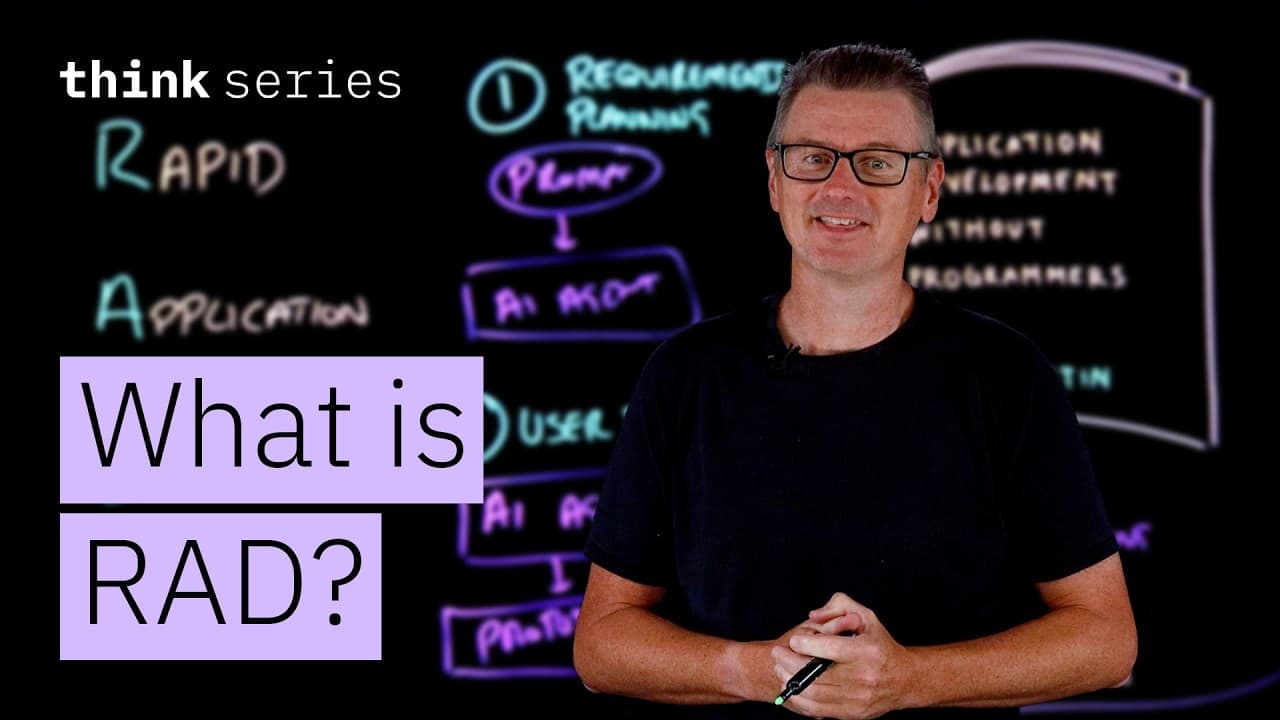
RAD emphasizes lightweight upfront planning, rapid prototyping, iterative construction, and careful cutover to production. In AI coding, the prototype remains a keeper but is complemented by a spec driven approach to inject rules, security, and business logic before production. The result is faster feedback and safer production code.
Transcript
Back in 1982, a computer scientist named James Martin published a book with a title that might sound oddly familiar. Application Development Without Programmers. Martin formalized that idea in 1991 into a software development methodology called Rapid Application Development or RAD. Well, application development... Without programmers is something t... Read More
Key Insights
- RAD was built to speed up development with lightweight planning and frequent user feedback, avoiding heavy upfront specification.
- A prototype is a core keeper in RAD, used as the live basis for the final product and refined through user interaction.
- In AI coding, prototypes are generated by agents, then iterated based on user feedback to converge on a usable product.
- Construction in RAD happens in short cycles with continuous testing and feedback rather than waiting until the end.
- Cut over in RAD is production deployment, but in AI contexts it must consider whether the prototype satisfies all constraints and rules.
- Security concerns are real in AI generated code, with studies noting a significant share of samples having weaknesses.
- Spec driven development replaces static specs with living documentation that guides generation and becomes the basis for tests.
- AI driven prototyping benefits from keeping the prototype but validating it against a written spec to ensure correctness and safety.
- More videos from this channel:
- More from this channel: IBM Technology
Install to Summarize YouTube Videos and Get Transcripts
Explore YouTube Video Summarizer or Get YouTube Transcript Extractor
Questions & Answers
Q: How to apply RAD in AI coding to build a prototype fast
RAD in AI coding starts with lightweight requirements planning where a prompt describes users and rules. The AI agent then creates a working prototype and, through user feedback, the prototype is refined in short cycles. This mirrors the original four RAD phases and keeps development aligned with real user needs while accelerating delivery.
Q: What role does user feedback play in RAD for AI
User feedback is central in RAD, used to validate assumptions early and cheaply. In AI coding, real users interact with the prototype, identify confusing UI or missing rules, and feed corrections back to the agent. This continuous loop ensures the final product matches user needs and reduces costly late changes.
Q: Why is a spec important in AI RAD workflows
A spec translates discoveries from the prototype into formal requirements, including business rules and security constraints. This spec becomes a test to verify that generated code meets rules like preventing self-approval of expenses. It ties the fast prototyping cycle to verifiable, safe production outcomes.
Q: How does RAD differ from traditional waterfall in AI projects
RAD emphasizes speed, iteration, and early user involvement, whereas waterfall relies on upfront planning and sequential phases. In AI projects this means prototyping with AI agents, validating quickly with users, and moving to production only after the prototype meets references in the spec, rather than after long sequential phases.
Q: What safety concerns arise with AI generated code in RAD
AI generated code can include security weaknesses; studies note a significant share of samples with issues. The remedy in RAD is to capture rules in a spec and run tests against the code to verify compliance and security before deployment, ensuring that the final product adheres to defined constraints.
Q: What is the CUT OVER phase in RAD and its AI relevance
Cut over in RAD is deployment to production, data migration, and user training. In AI contexts, this step must consider whether the AI produced prototype meets all rules and security needs. If not, further refinement against the spec is required before production.
Q: How does the prototype relate to the final product in RAD
In RAD the prototype is often kept and evolved into the final product. For AI projects the prototype provides working code that agents improve, but the final product is defined by the spec and validated through testing, ensuring stability and correctness while preserving rapid delivery.
Q: What is vibe coding and its connection to RAD
Vibe coding refers to AI agents generating application code from plain language prompts. This aligns with RAD by enabling fast prototyping and rapid feedback loops. The connection is that RAD phases map onto AI driven prototyping, with spec driven validation ensuring the final product is verified and production ready.
Summary & Key Takeaways
-
RAD is a software development method focused on speed, iterative design, and user feedback, contrasting with waterfall. It maps well to AI development where prototypes are generated quickly by AI agents and refined through real user input. The keepers from prototyping become the basis for production code while specs ensure correctness.
-
Prototype driven development plus specs reduce risk in AI generated software by making business rules and security testable before deployment. This mirrors the original RAD idea of keeping the prototype and evolving it toward a final product.
-
Spec driven development fills the gap between rapid prototyping and safe production by capturing findings from the prototype as formal requirements and tests, ensuring the produced code aligns with constraints, rules, and security needs.
Read in Other Languages (beta)
Share This Summary 📚
Summarize YouTube Videos and Get Video Transcripts with 1-Click
Try YouTube Summary with ChatGPT & Claude or YouTube Transcript Generator
Explore More Summaries from IBM Technology 📚


Summarize YouTube Videos and Get Video Transcripts with 1-Click
Try YouTube Summary with ChatGPT & Claude or YouTube Transcript Generator