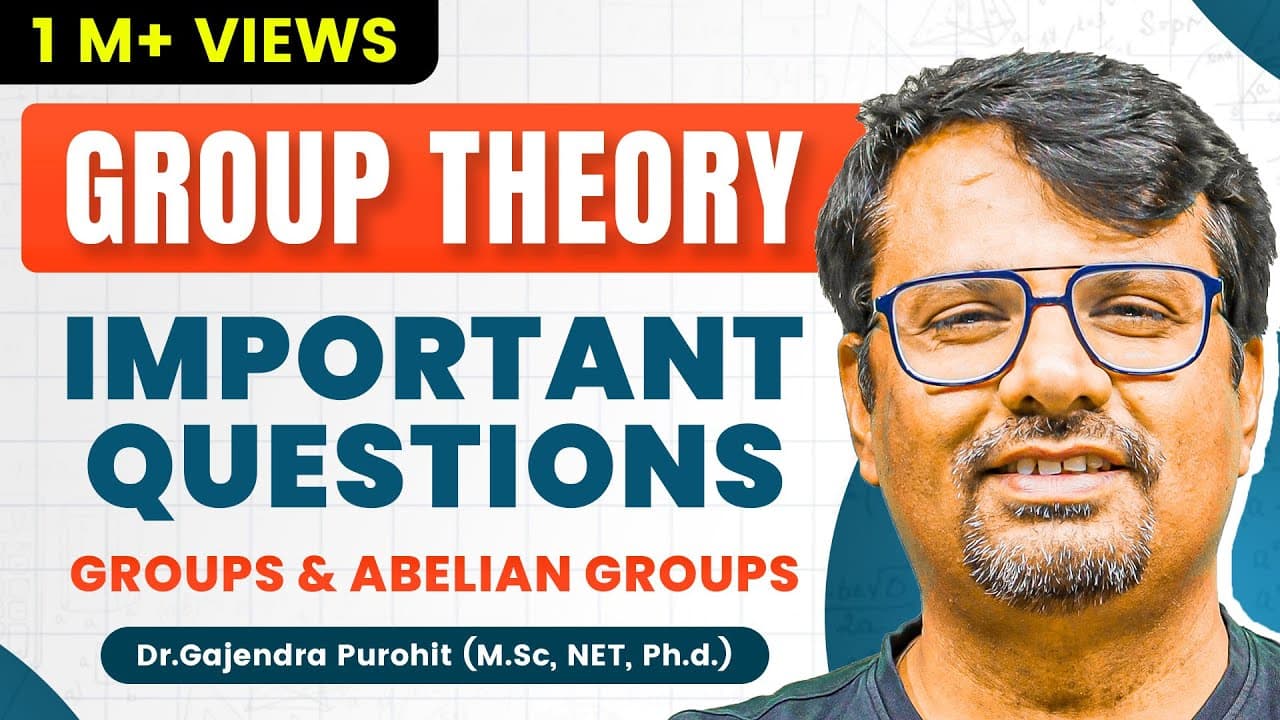
How to Verify Groups and Abelian Groups
TL;DR
Check whether the given set and operation satisfy closure, associativity, the existence of an identity element, and the existence of inverses. If these four group conditions hold and the operation is also commutative, the structure is an Abelian group; an operation table can make the required checks easier.
Transcript
Hello students myself Dr. Gajendra Purohit and you are watching my youtube channel where I upload videos for engineering mathematics, bsc and msc. Students if you are preparing for any competitive then also my channel is very helpful for you. Students I had started a new initiative as group theory was a demand for many students so I had started a... Read More
Key Insights
- A group is an algebraic structure in which closure, associativity, an identity element, and inverses must all be established for the specified set and operation. Failure to satisfy any required property means the structure does not meet the stated group definition.
- Closure is the requirement that applying the given operation to two elements of the set produces an element belonging to that same set. It is the first condition recommended for checking when solving a group-theory example.
- Associativity is a required group property and must be verified for the operation under consideration. The lecture treats this verification as a separate step in a complete examination solution, alongside closure, identity, and inverse checks.
- An identity element must exist for a set with an operation to qualify as a group. Identifying this element is therefore an essential part of solving examples and cannot be omitted from a complete verification.
- An inverse must exist as required by the group definition presented in the lecture. After locating the identity, students should verify the inverse condition as one of the four necessary checks in a group-theory solution.
- An Abelian group is a group that also satisfies the commutative property. Commutativity is checked only in addition to the four ordinary group requirements, so it distinguishes an Abelian group from a group established without that extra condition.
- An operation table can simplify verification of group properties. The lecture specifically recommends using a table to check closure, associativity, the identity element, and inverses when working through examination questions.
- The examples described for the lesson include integer groups, rational groups, cube roots of unity, fourth roots of unity, and the Klein four-group. The lesson uses examples to demonstrate how group and Abelian-group questions should be solved completely in examinations.
Install to Summarize YouTube Videos and Get Transcripts
Explore YouTube Video Summarizer or Get YouTube Transcript Extractor
Questions & Answers
Q: How do you verify that a structure is a group?
Verify four properties for the given set and operation: closure, associativity, existence of an identity element, and existence of inverses. Closure requires the result of operating on two set elements to remain in the set. Each remaining property must also be checked explicitly. The structure is a group only when all four stated requirements are satisfied.
Q: What is the closure property in group theory?
Closure means that when the specified operation is applied to any two elements taken from the set, the resulting element belongs to that same set. The lecture identifies closure as the first group condition to examine. It must be verified together with associativity, an identity element, and inverses before the algebraic structure can be classified as a group.
Q: What properties define an Abelian group?
An Abelian group satisfies the four ordinary group properties, which are closure, associativity, existence of an identity element, and existence of inverses. It must also satisfy the commutative property. Therefore, commutativity alone is insufficient. The structure must first meet every group requirement and then pass this additional condition to be called commutative or Abelian.
Q: How is an Abelian group different from an ordinary group?
Both structures must satisfy closure, associativity, existence of an identity element, and existence of inverses. An Abelian group has one additional requirement: the operation must be commutative. Consequently, the recommended method is to establish the four group conditions first and then test commutativity when the problem asks whether the group is Abelian.
Q: How can an operation table help solve group questions?
An operation table provides an easier way to organize checks for the properties required by the group definition. The lecture recommends using a table while examining closure, associativity, the existence of an identity element, and the existence of inverses. This approach helps students present a complete solution when group and Abelian-group questions appear in examinations.
Q: How should a group-theory answer be written in an exam?
A complete examination answer should check every defining condition rather than merely label the structure as a group. Start with closure, then verify associativity, identify the identity element, and establish inverses. If an Abelian group is requested, also verify commutativity. The lecture emphasizes complete solutions for engineering, basic science, and discrete mathematics students.
Q: What examples are covered for groups and Abelian groups?
The description identifies examples involving integer groups, rational groups, cube roots of unity, fourth roots of unity, and the Klein four-group. These examples are presented as applications of the definitions of groups and Abelian groups. Their purpose is to show how the required properties, including identity and inverse conditions, are checked in examination-style solutions.
Q: What group-theory topics follow these examples?
The planned sequence continues with questions involving modulo multiplication and modulo addition, because such questions are also asked in examinations. Later lessons will address properties of groups and proofs of theorems based on those properties. The series is then intended to proceed to subgroups and cyclic groups, with the topics presented one by one.
Summary & Key Takeaways
-
A group is an algebraic structure consisting of a set and an operation that satisfies four required properties: closure, associativity, existence of an identity element, and existence of an inverse. The lecture begins by revising these conditions before applying them to examples intended for discrete mathematics, engineering, and basic science examinations.
-
To solve an examination problem, test each defining property explicitly instead of stating the conclusion alone. Verify that operated elements remain in the set, confirm associativity, identify an identity element, and establish that inverses exist. An operation table can make these checks easier and provide a structured way to present the solution.
-
An Abelian group must satisfy every ordinary group requirement together with commutativity. The described examples include integer and rational groups, roots of unity, and the Klein four-group. The wider course sequence will continue with modulo addition and multiplication questions, group properties and theorem proofs, subgroups, and cyclic groups.
Read in Other Languages (beta)
Share This Summary 📚
Summarize YouTube Videos and Get Video Transcripts with 1-Click
Try YouTube Summary with ChatGPT & Claude or YouTube Transcript Generator
Explore More Summaries from Dr.Gajendra Purohit 📚


Summarize YouTube Videos and Get Video Transcripts with 1-Click
Try YouTube Summary with ChatGPT & Claude or YouTube Transcript Generator