How to Solve Linear Systems with Jacobi Iteration
TL;DR
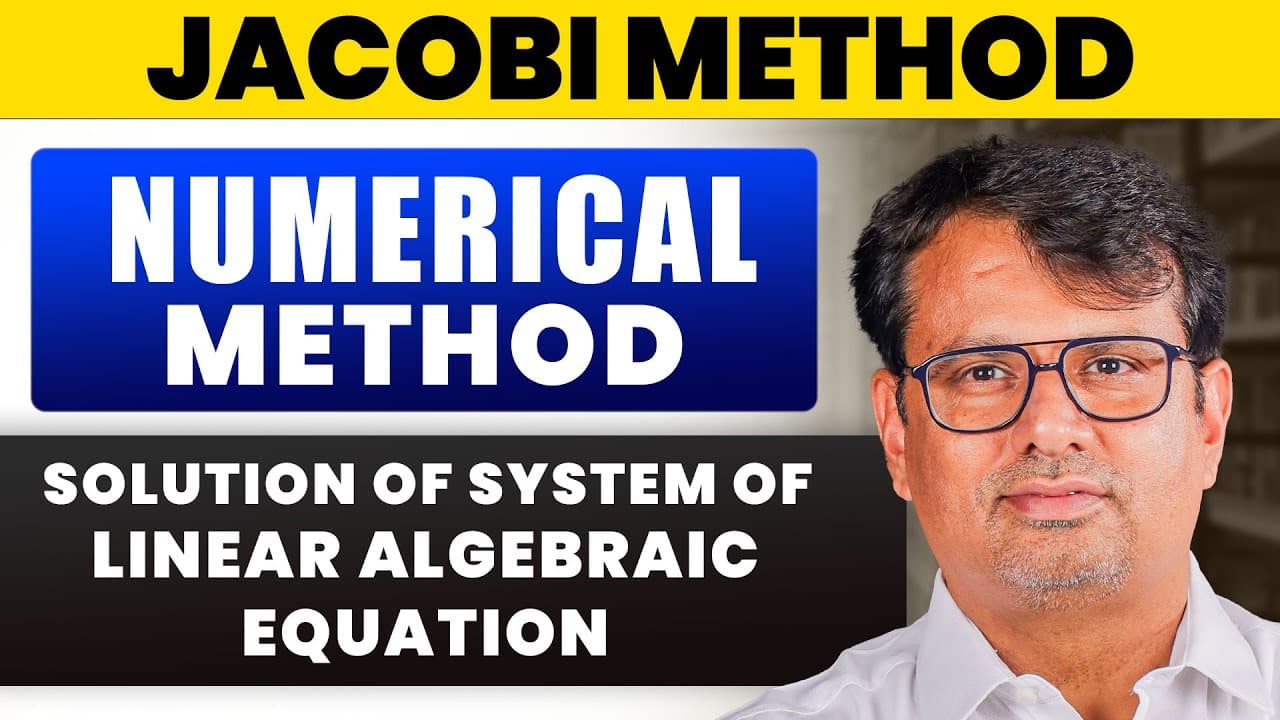
Apply the Jacobi iterative method to solve a system of linear algebraic equations indirectly, using a worked question to understand how the method is applied. The lesson emphasizes question-based, exam-oriented study rather than an extended theoretical presentation, and identifies Gauss-Seidel as another iterative method that is discussed separately.
Transcript
Students you can go to my playlist and watch the videos as the complete playlist is arranged topic wise so you won't face any problem as many students complain that we are not getting this topic that topic so here topic wise the complete playlist is arranged so you ca go and watch my videos Hello students myself Dr. Gajendra Purohit and today I w... Read More
Key Insights
- The Jacobi method is an iterative approach used to solve a system of linear algebraic equations. The lesson presents it through a question so students can observe how the method is applied instead of receiving only a separate theoretical discussion.
- Iterative methods include the Jacobi method and the Gauss-Seidel method in the structure presented by the instructor. Jacobi is covered first, while Gauss-Seidel and its relationship to a drawback of Jacobi are reserved for the following lesson.
- Direct methods previously covered by the instructor include Gauss elimination, Gauss-Jordan, and LU decomposition. These are mentioned to distinguish earlier approaches from the iterative treatment of linear systems introduced in the current lesson.
- The lesson is designed from an examination-oriented perspective, with attention directed toward applying a mathematical method to a problem. The instructor considers practical question solving especially useful for students who understand written theory but struggle to use it correctly.
- Question-based instruction is the central teaching approach used for the Jacobi method. The instructor argues that following a complete application within a problem can also communicate the associated theory without requiring a long, separate theoretical lecture.
- The Jacobi example begins after the introductory material, with the description listing the Jacobi iterative method at 2:28 and the first question at 2:47. The conclusion is listed at 14:34 in the supplied timestamps.
- Gauss-Seidel is presented as another method for solving the same general type of linear-system problem. The instructor states that its treatment will explain what happens concerning a drawback of the Jacobi method, but those details are not included here.
- The intended audience includes engineering and basic science students, specifically B.Sc. and B.Tech learners, as well as students preparing for NET, GATE, and IIT-JAM. The topic is framed as part of numerical methods and engineering mathematics.
Install to Summarize YouTube Videos and Get Transcripts
Explore YouTube Video Summarizer or Get YouTube Transcript Extractor
Questions & Answers
Q: What is the Jacobi iterative method used for?
The Jacobi iterative method is used as an indirect method for solving a system of linear algebraic equations. The lesson demonstrates its use through a worked question rather than through an extended theory-only presentation. Its main instructional purpose is to show students how an iterative method is applied when answering linear-system problems, particularly from an examination-oriented perspective.
Q: How is the Jacobi method taught in this lesson?
The Jacobi method is taught by applying it directly to a question. The instructor deliberately combines the method with the worked problem because many students face difficulty translating textbook theory into an actual solution. The lesson therefore emphasizes following the application within the question, with the expectation that understanding the worked method will also help students understand the associated theory.
Q: What other iterative method is mentioned with Jacobi iteration?
The Gauss-Seidel method is the other iterative method mentioned alongside Jacobi iteration. The instructor introduces Jacobi first and says that Gauss-Seidel will be discussed in the next lesson. That later discussion is also expected to address a drawback associated with the Jacobi method, although the supplied transcript does not provide the specific drawback or its detailed resolution.
Q: How do iterative methods differ from the previously discussed methods?
The lesson categorizes Jacobi and Gauss-Seidel as iterative methods for solving systems of linear equations. It contrasts this topic with direct methods that the instructor covered previously, namely Gauss elimination, Gauss-Jordan, and LU decomposition. The supplied material identifies these two categories but does not provide a detailed theoretical comparison of their calculations, convergence, or computational requirements.
Q: Why does the instructor use a worked question instead of extensive theory?
The instructor uses a worked question because students often have difficulty applying theory to mathematical problems. He argues that theory is available in books, while the more pressing instructional need is demonstrating how to use a method within a question. He also suggests that understanding the complete worked application can help students recognize the theory while keeping the lesson engaging and examination-oriented.
Q: When does the Jacobi method example begin in the lesson?
The supplied timestamps place the Jacobi iterative method section at 2:28 and the first question at 2:47. The conclusion is listed at 14:34. These timestamps show that the worked question follows a short introduction and occupies the central instructional portion, although the supplied transcript does not preserve the actual equations or the numerical steps shown during that example.
Q: Which students is the Jacobi method lesson intended to help?
The lesson is intended for engineering and basic science students, including B.Sc. and B.Tech learners. The description also identifies students preparing for NET, GATE, and IIT-JAM as part of the audience. The presentation is explicitly oriented toward mathematical problem solving and examinations, with the Jacobi method situated within numerical methods and engineering mathematics.
Q: What should students study after the Jacobi method?
Students are directed toward the Gauss-Seidel method after studying Jacobi iteration. The instructor describes Gauss-Seidel as another iterative method and says it will be explained in the next lesson. That continuation is intended to discuss what happens with a drawback of the Jacobi method, but no specific Gauss-Seidel procedure or comparison is included in the supplied material.
Summary & Key Takeaways
-
The lesson introduces iterative approaches for solving systems of linear algebraic equations, focusing specifically on the Jacobi method. It places Jacobi alongside the Gauss-Seidel method and distinguishes these iterative techniques from previously covered direct approaches, including Gauss elimination, Gauss-Jordan, and LU decomposition methods.
-
Rather than presenting an extended abstract derivation, the instructor explains the Jacobi iteration method through a worked question. This question-based format is intended to show students how the method is applied in practice, particularly for examinations, while encouraging them to connect the demonstrated procedure with theory available in textbooks.
-
The conclusion identifies Gauss-Seidel as the next method to study and indicates that it addresses a drawback associated with the Jacobi method. The instructor recommends learning mathematical theory through its application to questions, arguing that solving examples can make the underlying method easier to understand and less abstract.
Read in Other Languages (beta)
Share This Summary 📚
Summarize YouTube Videos and Get Video Transcripts with 1-Click
Try YouTube Summary with ChatGPT & Claude or YouTube Transcript Generator
Explore More Summaries from Dr.Gajendra Purohit 📚


Summarize YouTube Videos and Get Video Transcripts with 1-Click
Try YouTube Summary with ChatGPT & Claude or YouTube Transcript Generator