How to Calculate the Correlation Coefficient
TL;DR
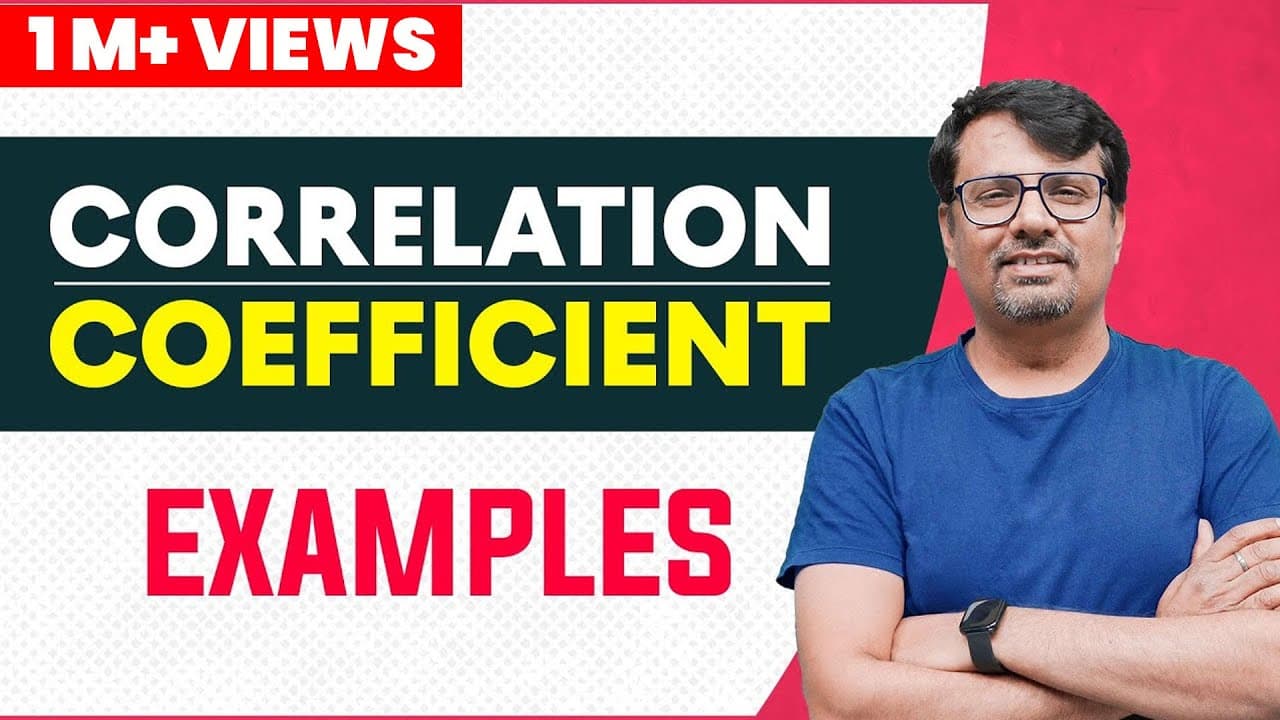
Calculate the correlation coefficient by applying its stated formula to the given data, then verify the process through worked questions. The lesson introduces the concept graphically before demonstrating multiple calculation methods across three examples, with particular relevance to engineering and basic science students preparing for university and competitive examinations.
Transcript
Students you can watch all my videos in the playlist here I've arranged the playlist topic wise so you'll find no problem because I get a complain of many students saying we cant't find the topic so here topic wise I've arranged so you can go and watch all my videos hello students, myself Dr. Gajendra Purohit today I will discuss what is Correl... Read More
Key Insights
- The correlation coefficient is presented as an important statistics concept that appears in competitive and university examinations, especially for engineering and basic science students.
- A graphical introduction is used to build an initial understanding of the correlation coefficient before the lesson moves into formulas and numerical calculations.
- The value of the correlation coefficient is calculated by applying the formula presented during the lecture to the data supplied in each question.
- Worked examples are the main teaching method, with three correlation coefficient questions introduced at 6:04, 13:23, and 17:37.
- More than one calculation method can be used to determine the correlation coefficient, and the instructor explicitly identifies an additional method during the worked examples.
- Repeated explanation is used to reinforce the calculation procedure, with the instructor reviewing how the correlation coefficient value is obtained after solving questions.
- The line of regression is introduced as another important concept connected with the lesson, although the stated focus of this lecture is calculating the correlation coefficient.
- Rank correlation coefficient is identified as the next topic, where the instructor plans to explain the concept and demonstrate how to find its value.
Install to Summarize YouTube Videos and Get Transcripts
Explore YouTube Video Summarizer or Get YouTube Transcript Extractor
Questions & Answers
Q: What is covered in a correlation coefficient lesson?
The lesson covers what the correlation coefficient is, how it can be understood through a graph, and how its value is calculated using a formula. It also works through three questions to demonstrate the calculation process. The instructor briefly introduces the line of regression and identifies rank correlation coefficient as the topic that follows.
Q: How do you calculate the correlation coefficient in the examples?
The correlation coefficient is calculated by using the formula shown during the lecture and applying it to the information supplied in each question. The instructor demonstrates the procedure through multiple worked examples, repeats the explanation, and notes that another method can also be used to obtain the value. The source does not reproduce the formula itself.
Q: Why is the correlation coefficient important for students?
The correlation coefficient is described as an important concept because questions based on it are asked in competitive examinations and university examinations. The lecture is intended to support engineering and basic science students, including B.Sc. and B.Tech students, as well as candidates preparing for NET, GATE, IIT-JAM, and CSIR-NET examinations.
Q: How many correlation coefficient examples are discussed?
Three worked questions are identified in the lesson timestamps. The first question begins at 6:04, the second at 13:23, and the third at 17:37. These examples are used to demonstrate how the value of the correlation coefficient is calculated, reinforce the procedure, and show that an additional calculation method is available.
Q: How is the graph used to explain correlation coefficient?
The instructor first tries to develop an understanding of the correlation coefficient through a graph. This graphical discussion comes before the explanation of how to calculate its value. The transcript does not preserve the graph or its detailed interpretation, so the supported conclusion is that it serves as a conceptual introduction before the formula and worked questions.
Q: Is there more than one method for finding the correlation coefficient?
Yes. During the lesson, the instructor explicitly states that there is another method through which the value of the correlation coefficient can be obtained. The calculation process is then reinforced with another question. The supplied transcript does not include the detailed formulas or distinguish the methods by name, so their exact steps cannot be stated from the source.
Q: What is the relationship between correlation coefficient and regression lines in the lesson?
The correlation coefficient and the line of regression are introduced together as important concepts on which questions are asked in competitive and university examinations. However, the stated content and worked questions focus on understanding and calculating the correlation coefficient. The transcript does not provide a detailed explanation or calculation of the regression line.
Q: What topic comes after the correlation coefficient lesson?
Rank correlation coefficient is announced as the next topic. The instructor says that the following explanation will cover rank correlation coefficient and how to find its value. The current lesson ends after explaining the correlation coefficient through a graphical introduction, a formula-based calculation process, multiple methods, and three worked questions.
Summary & Key Takeaways
-
The lesson introduces the correlation coefficient as an important statistics concept for engineering and basic science students. It first develops an understanding through a graph, then turns to the calculation process. The stated aim is to help students understand both what the coefficient is and how its value is found.
-
The calculation section presents the correlation coefficient formula and demonstrates how to use it in worked problems. Three questions appear in the lesson, beginning at 6:04, 13:23, and 17:37. The instructor revisits the procedure and also indicates that another method can be used to obtain the coefficient.
-
The lecture connects correlation coefficients with regression lines and identifies both as important examination topics. It concludes after the third worked question and previews rank correlation coefficient as the next subject, including how its value is found. Topic-wise playlists are also recommended for locating related mathematics lessons more easily.
Read in Other Languages (beta)
Share This Summary 📚
Summarize YouTube Videos and Get Video Transcripts with 1-Click
Try YouTube Summary with ChatGPT & Claude or YouTube Transcript Generator
Explore More Summaries from Dr.Gajendra Purohit 📚




Summarize YouTube Videos and Get Video Transcripts with 1-Click
Try YouTube Summary with ChatGPT & Claude or YouTube Transcript Generator