How to Solve Equations with the Regula Falsi Method
TL;DR
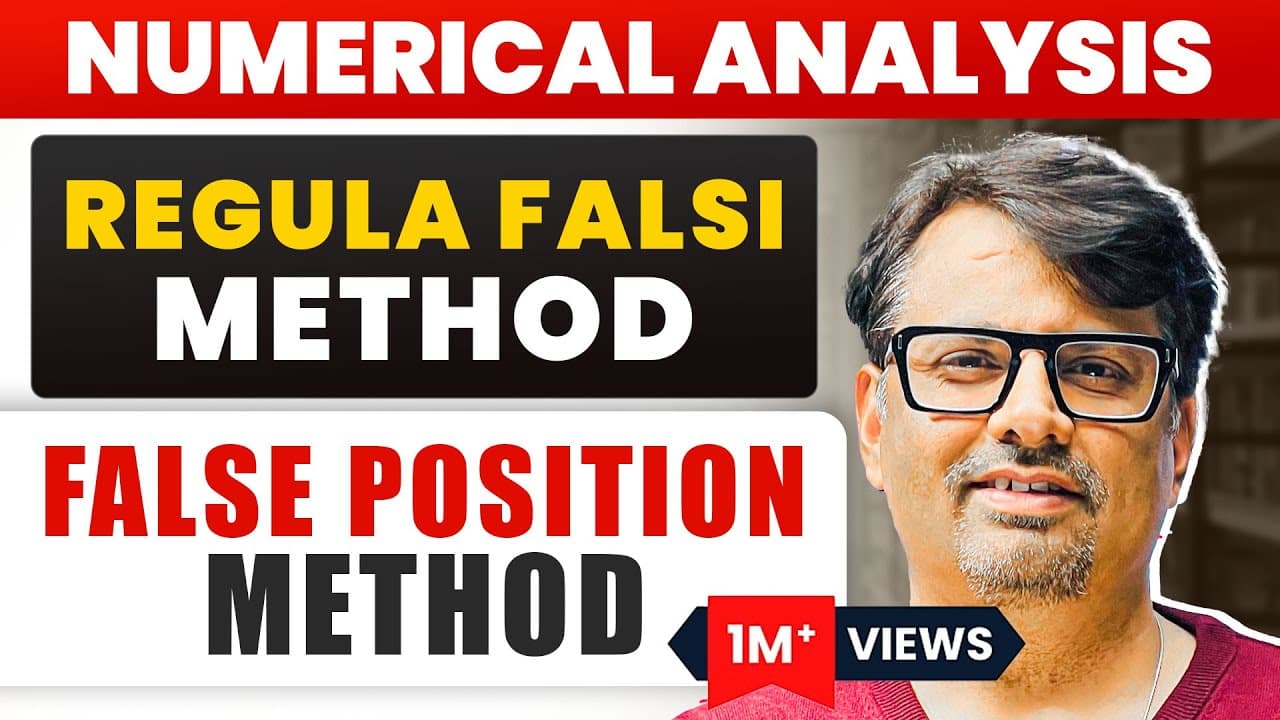
The Regula Falsi method helps solve algebraic and transcendental equations numerically and is also called the False Position method. The lecture introduces its formula and working procedure, then connects it with other equation-solving approaches, including bisection, iteration, secant, and Newton-Raphson methods, for engineering, basic science, and competitive-exam preparation.
Transcript
Students, you can go to the playlist and can see all my videos. Here I have arranged all the playlist according to the topic, so you will not have any difficulty. because so many students complain that we are not able to find that particular topic, so here you will find all videos topic wise arranged in my playlist you can go there and have a loo... Read More
Key Insights
- The Regula Falsi method is a numerical method used to solve algebraic and transcendental equations. The lecture treats the formula and working procedure as the central elements students need to understand before applying the method to an example problem.
- The False Position method is another name for the Regula Falsi method. Both names refer to the same equation-solving topic discussed in the lecture, so students searching under either term can use the presented material.
- The lecture structure is divided into an introduction, the Regula Falsi formula, and the working procedure. The timestamp information places the formula section at 1:27 and the working-procedure section at 4:40.
- The bisection method is presented as prior material in the instructor's numerical-methods sequence. Students are expected to connect that earlier equation-solving lesson with the Regula Falsi topic introduced here.
- The iterative, secant, and Newton-Raphson methods are identified as subsequent topics in the course sequence. This places Regula Falsi among several approaches taught for solving equations within numerical analysis.
- The lesson is designed for engineering and basic science students studying mathematics. The description specifically identifies B.Sc. and B.Tech learners as audiences who may benefit from the concepts, problems, and equation-solving procedures.
- The material is also connected to preparation for IIT-JAM, CSIR-NET, GATE, and other competitive examinations. The instructor mentions separate online classes that include competition-level material and solutions to previous-year questions.
- The instructor's broader numerical-analysis collection includes numerical integration, numerical differentiation, and interpolation. Topic-wise playlists are provided to help students locate these lessons and other previously uploaded mathematics videos more easily.
Install to Summarize YouTube Videos and Get Transcripts
Explore YouTube Video Summarizer or Get YouTube Transcript Extractor
Questions & Answers
Q: What is the Regula Falsi method used for?
The Regula Falsi method is used to solve algebraic and transcendental equations as part of numerical methods. The lecture introduces it as an equation-solving technique and focuses on its formula and working procedure. An example is also listed in the description to show how the method can be applied when working with such equations.
Q: Is the False Position method the same as Regula Falsi?
Yes, the lecture explicitly presents the False Position method as another name for the Regula Falsi method. The title, transcript, and description use both terms for the same numerical equation-solving topic. Students may therefore encounter either name when searching for lessons, concepts, examples, or procedures related to this method.
Q: What topics are covered in the Regula Falsi lesson?
The lesson covers an introduction to the Regula Falsi method, its formula, and its working procedure. The description also identifies an example based on the method and explains that it is used for algebraic and transcendental equations. The timestamp lists the formula at 1:27 and the working procedure at 4:40.
Q: How does Regula Falsi fit into the numerical methods course?
Regula Falsi appears after the instructor's lesson on the bisection method. The planned sequence continues with the iterative method, the secant method, and the Newton-Raphson method. The broader numerical-analysis collection also includes numerical integration, numerical differentiation, and interpolation, giving students several connected topics to study through the organized playlists.
Q: Which equation-solving methods are mentioned alongside Regula Falsi?
The lecture mentions four other equation-solving approaches: the bisection method, iterative method, secant method, and Newton-Raphson method. Bisection was taught before Regula Falsi, while the iterative, secant, and Newton-Raphson methods are presented as upcoming lessons. Together, these topics form part of the instructor's sequence on numerical methods for equations.
Q: Who is the Regula Falsi lecture intended for?
The lecture is intended for engineering and basic science students who need to understand numerical methods. The description specifically mentions B.Sc. and B.Tech students. It also identifies learners preparing for NET, GATE, IIT-JAM, and related competitive examinations as an audience for the mathematical concepts, problems, and equation-solving material.
Q: When does the Regula Falsi formula section begin?
The timestamp states that the formula section for the Regula Falsi, or False Position, method begins at 1:27. The introduction starts at 0:00, and the working-procedure section is listed at 4:40. These markers help students move directly to the part of the lecture that addresses the formula or its procedure.
Q: What related numerical analysis topics are available from the instructor?
The instructor states that lessons on numerical integration, numerical differentiation, and interpolation have already been uploaded. The transcript also mentions bisection as previously taught and identifies iterative, secant, and Newton-Raphson methods as later topics. These lessons are arranged in topic-wise playlists to help students find the relevant mathematics material.
Summary & Key Takeaways
-
The lecture introduces the Regula Falsi method as a numerical technique for solving algebraic and transcendental equations. It identifies False Position method as its alternative name and organizes the lesson around the method's formula, working procedure, and an example intended to demonstrate how the technique is applied to an equation.
-
The topic is positioned within a broader sequence of equation-solving methods. The instructor previously covered the bisection method and plans to discuss the iterative, secant, and Newton-Raphson methods afterward. This sequence gives students a structured path for studying several numerical approaches used to solve equations in numerical analysis.
-
The material is intended for engineering and basic science students, including B.Sc. and B.Tech learners. It is also presented as useful preparation for IIT-JAM, CSIR-NET, GATE, and other competitive examinations. Related lessons cover numerical integration, numerical differentiation, interpolation, theory, and solutions to previous-year examination questions.
Read in Other Languages (beta)
Share This Summary 📚
Summarize YouTube Videos and Get Video Transcripts with 1-Click
Try YouTube Summary with ChatGPT & Claude or YouTube Transcript Generator
Explore More Summaries from Dr.Gajendra Purohit 📚


Summarize YouTube Videos and Get Video Transcripts with 1-Click
Try YouTube Summary with ChatGPT & Claude or YouTube Transcript Generator