How Do Discrete Random Variables, Probability Mass Functions, and CDFs Work? | By GP Sir
TL;DR
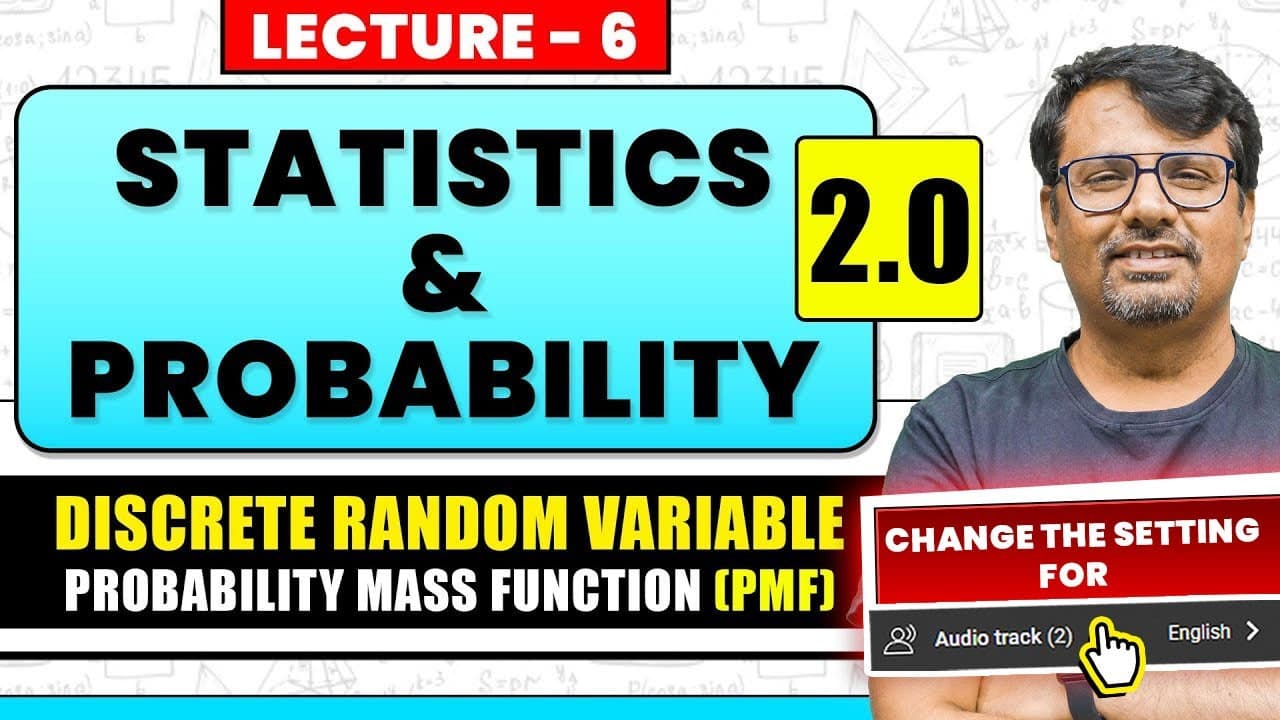
Discrete random variables take separate possible values, probability mass functions assign probabilities to those values, and cumulative distribution functions accumulate probability through a specified value. For two coin tosses, the number of heads can be zero, one, or two, with probabilities one-fourth, two-fourths, and one-fourth. Read on for the defining conditions, worked examples, and the reason named distributions help with larger sample spaces.
Transcript
Hello students, I am Dr. Gajendra Purohit. You are watching our YouTube channel. If you are pursuing B.Tech or B.Sc or preparing for any competitive exam. Our YouTube channel is very helpful for you where higher mathematics is asked. I am currently teaching statistics and probability where I have presented random variable and before that the concep... Read More
Key Insights
- A discrete random variable takes distinct possible values. When two coins are tossed and X counts heads, X can equal zero, one, or two, while fractional counts such as 1.2 or 1.3 heads cannot occur.
- A continuous random variable can cover each point across a changing measurement. The cooling-milk example illustrates this idea because the temperature falls through intermediate values rather than moving only among a few separated outcomes.
- A probability mass function pairs each possible discrete value with its corresponding probability. For two coin tosses, the values zero, one, and two heads have probabilities one-fourth, two-fourths, and one-fourth, respectively.
- A valid probability mass function has nonnegative probabilities. It must also assign probabilities whose sum over all possible random-variable values equals one, as the two-coin distribution does when its three probabilities are added.
- The sample space for two coin tosses contains head-head, head-tail, tail-head, and tail-tail. Defining X as the number of heads converts these four sample points into the three numerical values zero, one, and two.
- The orange-selection distribution uses combinations because two oranges are drawn from sixteen good and four bad oranges. Zero bad oranges uses sixteen choose two over twenty choose two, while two bad oranges uses four choose two over twenty choose two.
- A cumulative distribution function is denoted by capital F and accumulates probability through a stated value. In the coin example, the cumulative probability at zero is one-fourth because only the outcome X equals zero has been included.
- A named distribution can simplify problems with very large sample spaces. The lecture contrasts direct enumeration for three coin tosses with one hundred tosses, where the sample space contains two to the power of one hundred sample points and becomes complicated to write.
Install to Summarize YouTube Videos and Get Transcripts
Explore YouTube Video Summarizer or Get YouTube Transcript Extractor
Questions & Answers
Q: What is a discrete random variable?
A discrete random variable takes separate possible values rather than every intermediate value. If X counts heads in two coin tosses, it can equal zero, one, or two, but it cannot equal values such as 1.2 or 1.3.
Q: What is a probability mass function?
A probability mass function pairs every possible value of a discrete random variable with its probability. For two coin tosses, it assigns probabilities of one-fourth, two-fourths, and one-fourth to zero, one, and two heads, respectively.
Q: What conditions must a probability mass function satisfy?
Every probability assigned by a probability mass function must be greater than or equal to zero. The probabilities across all possible values must also sum to one, as one-fourth plus two-fourths plus one-fourth does in the two-toss example.
Q: How is the number of heads distributed in two coin tosses?
The sample space is head-head, head-tail, tail-head, and tail-tail. If X counts heads, its possible values are zero, one, and two, with respective probabilities one-fourth, two-fourths, and one-fourth.
Q: How do discrete and continuous random variables differ?
A discrete random variable takes separated values, such as zero, one, or two heads. A continuous random variable covers intermediate points; for example, cooling milk passes through temperatures between one hundred degrees and lower readings.
Q: How is the probability distribution for selecting bad oranges formed?
Two oranges are selected from sixteen good and four bad oranges, so the number of bad oranges can be zero, one, or two. Their probabilities are sixteen choose two over twenty choose two, sixteen choose one times four choose one over twenty choose two, and four choose two over twenty choose two, respectively.
Q: What is a cumulative distribution function?
A cumulative distribution function, denoted by capital F, accumulates probabilities for random-variable values less than or equal to a specified value. In the two-coin example, the cumulative probability at zero is one-fourth because only the outcome X equals zero is included.
Q: Why are named probability distributions useful for many trials?
Named distributions help when listing the full sample space becomes complicated. Tossing a coin one hundred times creates two to the power of one hundred sample points, so the lecture points to the binomial distribution for questions about the number of heads.
Summary & Key Takeaways
-
A random variable can be discrete or continuous. Counting heads in two coin tosses produces the discrete values zero, one, and two, with probabilities one-fourth, two-fourths, and one-fourth. Intermediate outcomes such as 1.2 heads are impossible, which illustrates why this counting variable is discrete rather than continuous.
-
A probability mass function lists every possible value of a discrete random variable together with its probability. Every listed probability must be nonnegative, and the sum across all possible values must equal one. These requirements can be checked directly in the two-toss example because one-fourth plus two-fourths plus one-fourth equals one.
-
For two oranges selected from sixteen good and four bad oranges, the number of bad oranges can be zero, one, or two. The respective probabilities are formed with combinations: sixteen choose two, sixteen choose one times four choose one, and four choose two, each divided by twenty choose two. These values form the probability distribution.
Read in Other Languages (beta)
Share This Summary 📚
Summarize YouTube Videos and Get Video Transcripts with 1-Click
Try YouTube Summary with ChatGPT & Claude or YouTube Transcript Generator
Explore More Summaries from Dr.Gajendra Purohit 📚




Summarize YouTube Videos and Get Video Transcripts with 1-Click
Try YouTube Summary with ChatGPT & Claude or YouTube Transcript Generator