How to Calculate Spearman Ranks With Ties
TL;DR
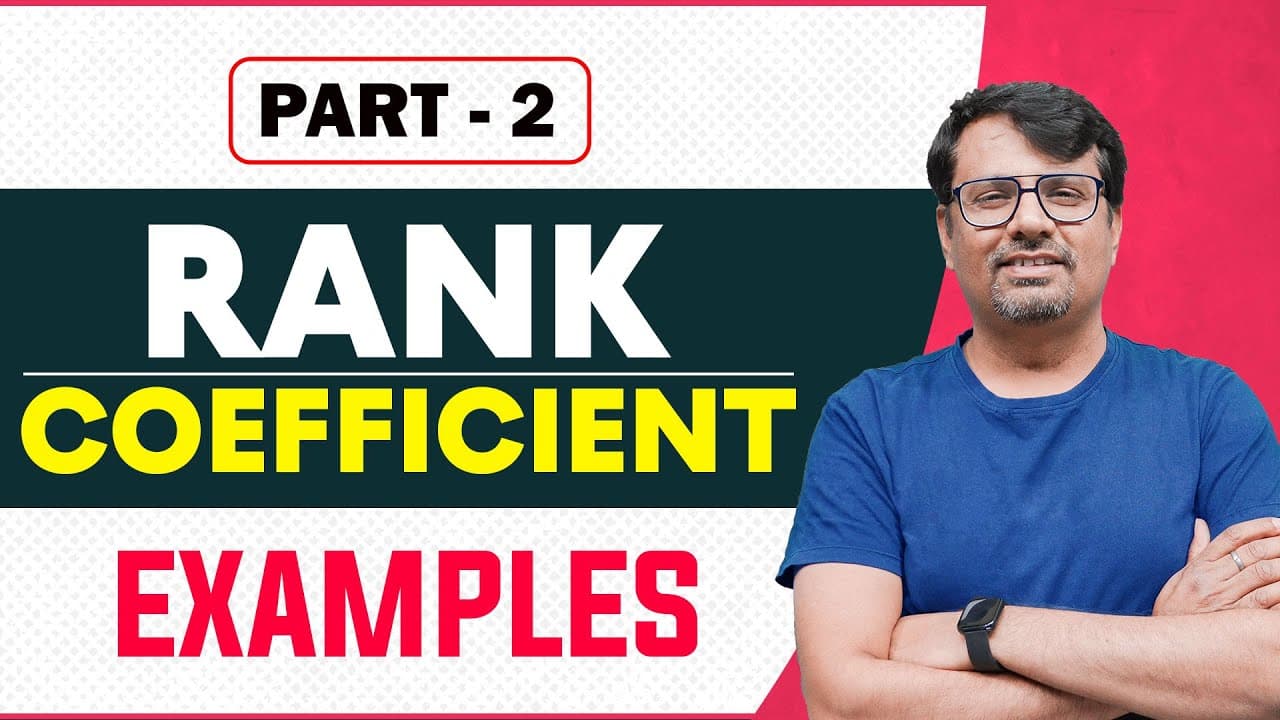
Repeated values require a modified rank-correlation calculation that accounts for tied ranks before the coefficient is determined. The lecture introduces the repeated-rank formula and applies it to an exam-style question, building on earlier lessons about correlation coefficients and rank correlation. It is aimed at engineering, basic science, B.Sc., B.Tech, GATE, IIT-JAM, and CSIR-NET learners.
Transcript
Students you can go to the playlist and watch my videos as the complete playlist is arranged topic wise so you all won't face any problem as many students complain that sir we are not getting this topic that topic so here topic wise the complete playlist is arranged so you can watch all my videos here Hello students myself Dr. Gajendra Puroh...
Key Insights
- Repeated values require a different rank-correlation treatment because the ordinary calculation must be adjusted when ranks are tied. The lesson focuses specifically on how ranks and the correlation coefficient are calculated in that repeated-value case.
- The repeated-rank formula is the central distinction introduced in this lesson. The transcript states that a difference appears in the formula when values repeat, although the supplied text does not preserve the formula itself or its individual terms.
- An example question is used to connect the repeated-rank formula with problem solving. According to the timestamps, the formula begins at 1:36, the first question begins at 1:57, and the lesson's conclusion begins at 7:07.
- Spearman rank correlation is presented as part of the broader topic of rank correlation coefficients. The description lists both the meaning of the coefficient and the method for finding it among the concepts addressed by the lecture.
- The lesson is a continuation rather than a complete introduction to correlation. Students are directed to earlier material covering the correlation coefficient and the rank correlation coefficient before approaching calculations involving repeated values.
- The intended audience includes engineering and basic science students. The description specifically identifies B.Sc. and B.Tech learners, along with students preparing for GATE, IIT-JAM, CSIR-NET, and other government examinations.
- The statistics sequence extends beyond rank correlation to discrete and continuous random variables, expectation, expected value, mean, variance, moment-generating functions, and several named distributions. These earlier topics are presented as background content available through the arranged playlist.
- The teaching plan connects mathematical theory with examination practice. After explaining theory, the instructor says that objective questions, multiple-choice questions, and problem-solving tricks will also be addressed to support students preparing for competitive examinations.
Install to Summarize YouTube Videos and Get Transcripts
Explore YouTube Video Summarizer or Get YouTube Transcript Extractor
Questions & Answers
Q: How do repeated values affect rank correlation?
Repeated values create tied ranks, so the rank-correlation calculation requires a modified treatment. The lecture identifies this as the main difference from the earlier rank-correlation method and introduces a formula specifically for repeated values. It then applies that approach to a question intended to show how such examination problems can be solved.
Q: How do you calculate a rank correlation coefficient when ranks repeat?
The lesson's stated method is to use the repeated-rank correlation formula and then apply it to the given observations. The formula presentation starts at 1:36, followed by the first example at 1:57. The supplied transcript does not include the formula's visible terms or the numerical work, so no exact calculation can be reconstructed from the provided text.
Q: What is the main topic of the repeated rank correlation lesson?
The main topic is calculating a rank correlation coefficient when values repeat and produce tied ranks. It is described as part two of the rank-correlation instruction. The lesson introduces the formula change required for repeated values and uses an example problem to demonstrate how the associated questions can be approached in an examination setting.
Q: What does the lesson cover about Spearman rank correlation?
The description places Spearman's rank correlation coefficient within a lesson covering the meaning of rank correlation, the process for finding the coefficient, repeated-rank formulas, and examples with repeated values. The supplied transcript primarily emphasizes the tied-value case and refers students to an earlier lesson for the general rank correlation coefficient.
Q: When does the repeated-rank formula appear in the lesson?
The timestamps state that the formula for the rank correlation coefficient with repeated values begins at 1:36. The first question starts at 1:57, the conclusion begins at 7:07, and discussion of older videos appears at 9:13. These markers separate the introduction, formula, worked question, conclusion, and course-related comments.
Q: What prior lessons are recommended before repeated rank correlation?
Students are directed to earlier lessons on the correlation coefficient and the rank correlation coefficient. The instructor also describes a broader statistics and probability playlist containing discrete and continuous random variables, expectation, expected value, mean, variance, moment-generating functions, and binomial, Poisson, normal, exponential, and uniform distributions, including their mean, variance, and moment-generating functions.
Q: Who is the repeated rank correlation lesson intended for?
The lesson is intended for engineering and basic science students, including B.Sc. and B.Tech learners. The description also identifies students preparing for NET, GATE, IIT-JAM, and CSIR-NET, while the transcript mentions IAS and other government examination preparation. Mathematics is presented as important for several of these academic and competitive paths.
Q: How is the lesson organized for exam preparation?
The lesson begins with an introduction, presents the repeated-value formula, and then moves to a question before concluding. The instructor says these types of examination questions can be solved using the explained method. The broader teaching plan also includes objective questions, multiple-choice questions, and techniques for solving them after students understand the theory.
Summary & Key Takeaways
-
The lesson continues the rank-correlation series by addressing the case in which values repeat. It distinguishes this situation from ordinary rank-correlation questions and introduces the formula used for repeated ranks. The stated goal is to help students calculate the coefficient correctly when tied observations appear in an examination problem.
-
An example question follows the formula presentation and demonstrates how repeated-value rank correlation is handled in practice. The description identifies the lesson as covering the meaning of the rank correlation coefficient, its calculation, Spearman's rank correlation coefficient, and problems involving repeated ranks, although the supplied transcript omits the detailed numerical working.
-
The lecture belongs to a broader statistics and probability sequence covering random variables, expectation, variance, moment-generating functions, distributions, correlation, and rank correlation. It is presented for engineering and basic science students, including B.Sc. and B.Tech learners preparing for examinations such as GATE, IIT-JAM, CSIR-NET, and government examinations.
Read in Other Languages (beta)
Share This Summary 📚
Summarize YouTube Videos and Get Video Transcripts with 1-Click
Try YouTube Summary with ChatGPT & Claude or YouTube Transcript Generator
Explore More Summaries from Dr.Gajendra Purohit 📚

Summarize YouTube Videos and Get Video Transcripts with 1-Click
Try YouTube Summary with ChatGPT & Claude or YouTube Transcript Generator