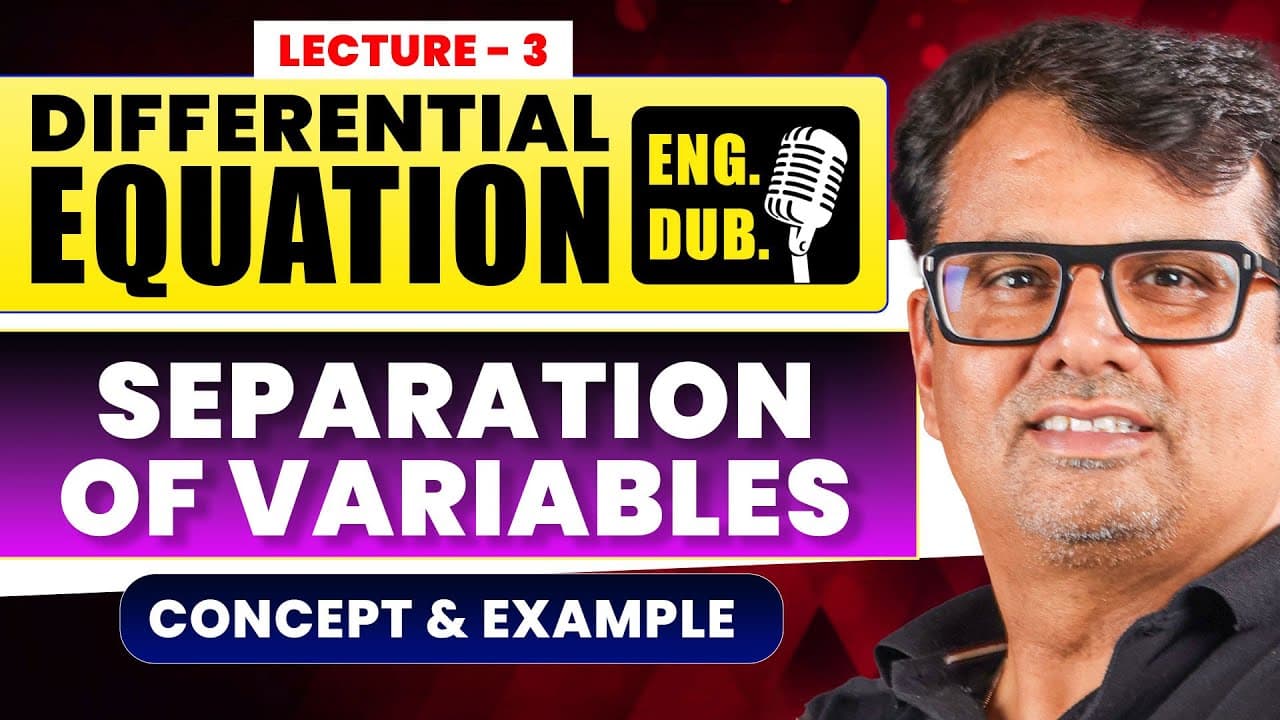
How to Solve ODEs by Separating Variables
TL;DR
Use separation of variables when an ordinary differential equation can be rearranged so every x-dependent term is paired with dx and every y-dependent term is paired with dy. Integrate both sides, include an arbitrary constant, simplify the result, and apply any given initial condition to determine that constant.
Transcript
Hello students, I am Dr. Gajendra Purohit. I upload videos for Engineering Mathematics, BSc on my YouTube channel. If you are preparing for any competitive exam that requires higher mathematics, my channel is very helpful. Through this i tab you can watch my previous videos on differential equations and the series I am starting now, I am teaching t... Read More
Key Insights
- The variable separable method is applicable when a differential equation can be rearranged so x-dependent terms occur with dx and y-dependent terms occur with dy. After this rearrangement, each side can be integrated independently to obtain the general solution.
- The equation dy/dx plus x/y equals zero is separable because it can be rearranged to pair y with dy and x with dx. Direct integration produces quadratic terms, giving y squared over two plus x squared over two equal to an arbitrary constant.
- The equation dy/dx equals the square of x plus y is not directly separable because its x and y terms cannot be placed into independent factors. The inability to isolate an x-only side and a y-only side prevents use of this method.
- The exponential example works by factoring e to the power minus y from the right side. Rearrangement gives e to the power y dy equal to the sum of e to the power x and x squared, multiplied by dx, making direct integration possible.
- The logarithmic example uses the substitution t equals one minus e to the power x. Because dt equals minus e to the power x dx, the x-side integral becomes a logarithm, and simplification gives tan y divided by one minus e to the power x equal to c.
- The rational example requires partial fractions after the variables are separated. The expression 1 divided by y times one minus ay is decomposed into 1/y plus a divided by one minus ay, allowing both y-dependent terms to be integrated logarithmically.
- The arbitrary integration constant can be expressed as log c when logarithms arise on both sides. Combining logarithms and then cancelling them converts the implicit logarithmic relation into a simpler algebraic form containing a multiplicative constant c.
- The initial condition y at zero equals zero determines the arbitrary constant in the equation involving e to the power x, cosine y, and sine y. Substitution gives c equal to one, resulting in e to the power x minus log sec y equal to one.
Install to Summarize YouTube Videos and Get Transcripts
Explore YouTube Video Summarizer or Get YouTube Transcript Extractor
Questions & Answers
Q: How do you identify a variable separable differential equation?
A differential equation is variable separable when it can be rearranged so every expression involving x is grouped with dx and every expression involving y is grouped with dy. The separated form permits direct integration of both sides. If x and y remain inseparably combined, as in the square of x plus y, this method cannot be used directly.
Q: How do you solve dy/dx plus x/y equals zero?
Rearrange the equation so the variables are grouped with their corresponding differentials. Moving x/y to the other side and multiplying appropriately separates y with dy and x with dx. Integrating both sides gives quadratic expressions, which can be written as y squared over two plus x squared over two equals c, where c is the arbitrary integration constant.
Q: Why is dy/dx equal to the square of x plus y not separable?
The equation is not directly separable because the square of x plus y combines both variables inside one expression. Rearrangement does not produce one side depending only on x and another side depending only on y. Since x cannot be paired independently with dx and y cannot be paired independently with dy, the variable separable method does not apply directly.
Q: How is the exponential separable differential equation integrated?
First factor e to the power minus y from the expression containing e to the power x and x squared. Then move that factor across the equation to obtain e to the power y dy equal to the sum of e to the power x and x squared, multiplied by dx. Integration gives e to the power y equals e to the power x plus x cubed over three plus c.
Q: How does substitution simplify the logarithmic separable example?
After separating the equation, the x-dependent integral contains e to the power x divided by one minus e to the power x. Set t equal to one minus e to the power x, so dt equals minus e to the power x dx. The integral becomes a logarithmic expression, which combines with log tan y to produce tan y divided by one minus e to the power x equal to c.
Q: When are partial fractions needed in separation of variables?
Partial fractions are needed when the separated side contains a rational expression that is not convenient to integrate directly. In the example, 1 divided by y times one minus ay is decomposed into 1/y plus a divided by one minus ay. Each part then integrates logarithmically, allowing the equation to be simplified into y divided by one minus ay equals c multiplied by a plus x.
Q: Why can the integration constant be written as log c?
The integration constant may be written as log c when the integrated expressions contain logarithms. This notation makes it convenient to combine several logarithmic terms using quotient or product forms. After the logarithms are collected on both sides, they can be cancelled to produce an algebraic relation with c appearing as a multiplicative constant rather than an added logarithmic constant.
Q: How is the condition y at zero equals zero applied?
Substitute x equal to zero and y equal to zero into the integrated relation e to the power x minus log sec y equals c. Since e to the power zero is one, sec zero is one, and log one is zero, the constant equals one. The particular solution is therefore e to the power x minus log sec y equals one.
Summary & Key Takeaways
-
The variable separable method applies when a differential equation can be rearranged into two independent sides, with x-dependent expressions beside dx and y-dependent expressions beside dy. Once separated, both sides are integrated directly. The resulting arbitrary constant can be written in a convenient form, such as c or log c, to simplify the solution.
-
The worked exponential example rewrites dy/dx as e to the power minus y multiplied by the sum of e to the power x and x squared. Moving the y factor produces e to the power y dy on one side. Integration then gives e to the power y equals e to the power x plus x cubed over three plus c.
-
Further examples combine separation with substitution, logarithmic integration, and partial fractions. One equation produces tan y equals c multiplied by one minus e to the power x. Another requires decomposing 1 divided by y times one minus ay before integration, eventually yielding y divided by one minus ay equals c multiplied by a plus x.
Read in Other Languages (beta)
Share This Summary 📚
Summarize YouTube Videos and Get Video Transcripts with 1-Click
Try YouTube Summary with ChatGPT & Claude or YouTube Transcript Generator
Explore More Summaries from Dr.Gajendra Purohit 📚




Summarize YouTube Videos and Get Video Transcripts with 1-Click
Try YouTube Summary with ChatGPT & Claude or YouTube Transcript Generator