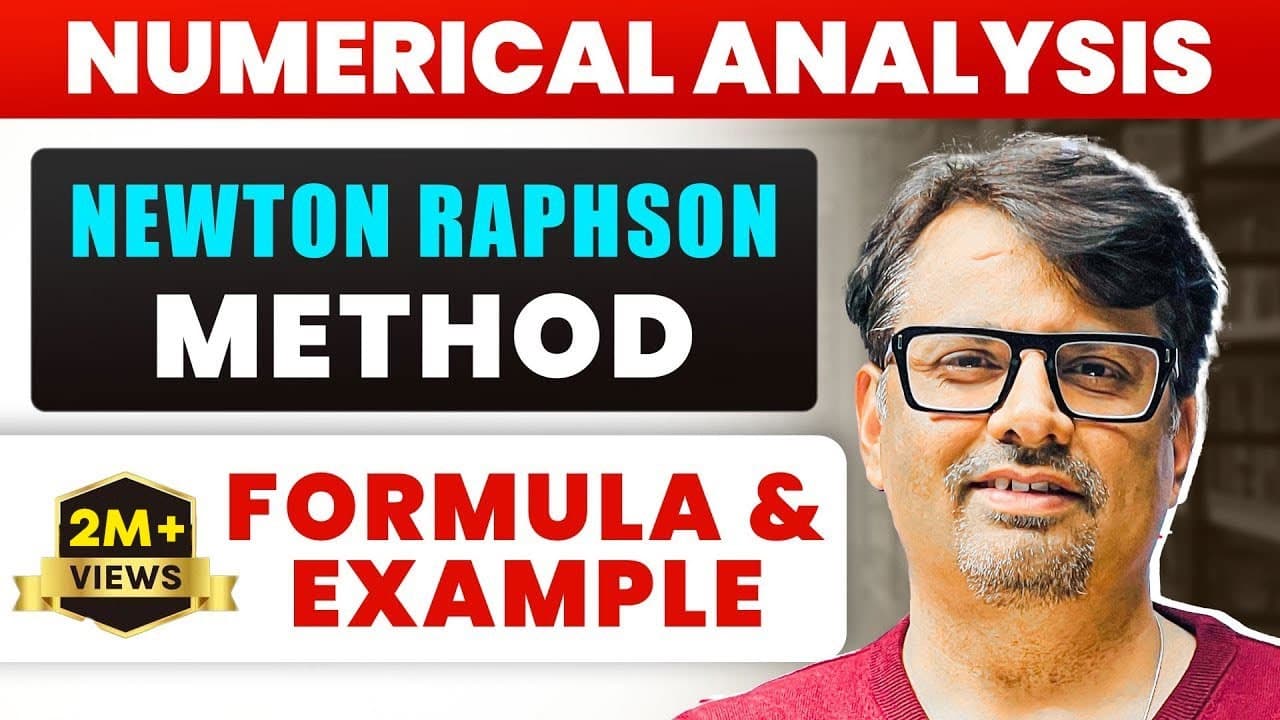
How to Find Roots with Newton Raphson Method
TL;DR
Use the Newton Raphson method to find roots of algebraic and transcendental equations by following its formula and working procedure, then applying that process to example problems. A calculator makes the numerical work much easier, and practicing several questions helps prepare for university and competitive examinations.
Transcript
Students you can go in the playlist and watch all the videos in that all the videos are arranged topic wise so you'll not find any problem because I get complains from many students saying we can't find that topic it is all arranged in playlist and you can go and watch all of them hello students myself Dr. Gajendra Purohit and today I am going to... Read More
Key Insights
- The Newton Raphson method is presented as a procedure for finding roots of algebraic and transcendental equations. The lecture focuses on how to apply its formula and working process through examples intended for engineering mathematics and basic science students.
- The lesson structure is divided into an introduction, an explanation of the formula and procedure, three example questions, and a conclusion. This progression moves from the method’s basic setup to repeated problem-solving practice before closing with information about earlier lessons.
- A calculator is described as essential for applying the method comfortably in the demonstrated problems. The instructor warns that completing the calculations without one would be difficult, making calculator use an important practical part of following the examples.
- The worked examples are designed primarily from a university examination perspective. The instructor’s goal is to help B.Sc. and engineering students understand the procedure well enough to solve Newton Raphson questions when the topic appears in their syllabus and assessments.
- The Newton Raphson method is relevant to several competitive examinations mentioned in the lecture, including GATE, IIT-JAM, CSIR-NET, and other competitive tests. The instructor states that questions based on this method are commonly formed for such examinations.
- The lecture contains three numbered question segments beginning at 5:26, 11:20, and 15:53. These examples provide repeated demonstrations of applying the Newton Raphson procedure rather than limiting the lesson to a formula-only explanation.
- The topic-wise playlists are intended to help students locate related lessons without difficulty. The instructor notes that earlier videos have been uploaded and arranged for engineering mathematics, B.Sc. studies, university examinations, and competitive-exam preparation.
- The planned live classes will focus on the types of Newton Raphson questions asked in competitive examinations and how to solve them. The recorded lecture instead emphasizes examples chosen to support students preparing for university examinations.
Install to Summarize YouTube Videos and Get Transcripts
Explore YouTube Video Summarizer or Get YouTube Transcript Extractor
Questions & Answers
Q: How can the Newton Raphson method find equation roots?
The Newton Raphson method is used to find roots of algebraic and transcendental equations by applying its formula according to a defined working procedure. The lecture introduces that formula and procedure first, then demonstrates their application through three example questions. Following the same process across multiple problems is presented as the practical way to understand and use the method.
Q: What types of equations use the Newton Raphson method?
The lesson identifies algebraic equations and transcendental equations as the two types for which roots can be found using the Newton Raphson method. Its stated focus is not merely the method’s concept, but also its working procedure and application to example problems. The examples are intended to support engineering and basic science students studying numerical methods.
Q: What is the procedure for learning Newton Raphson problems?
The lecture’s learning sequence begins with an introduction, followed by the Newton Raphson formula and working procedure at 1:39. It then applies the method in three question segments starting at 5:26, 11:20, and 15:53. This structure encourages students to understand the stated procedure and then reinforce it by following several worked examples.
Q: Is a calculator needed for Newton Raphson questions?
A calculator is strongly recommended for the Newton Raphson examples covered in the lecture. The instructor says using a calculator makes the work very easy, while completing it without one would be tough. Calculator use is therefore treated as a practical requirement for handling the numerical work involved in applying the demonstrated procedure to the questions.
Q: Why is the Newton Raphson method important for exams?
The Newton Raphson method is described as important because questions based on it appear in university and competitive examinations. The lecture specifically mentions engineering and B.Sc. syllabi, along with GATE, IIT-JAM, CSIR-NET, and other competitive exams. The worked questions are selected mainly to help students solve the topic in university examinations.
Q: How many Newton Raphson examples are covered?
The lecture covers three numbered example questions. According to the timestamps, the first starts at 5:26, the second at 11:20, and the third at 15:53. These examples follow the earlier discussion of the formula and procedure, giving students several opportunities to observe how the Newton Raphson method is applied before the conclusion begins.
Q: Who should study the Newton Raphson method lesson?
The lesson is intended for engineering and basic science students, particularly B.Sc. and B.Tech learners who have numerical methods in their syllabus. It is also presented as useful for candidates preparing for NET, GATE, IIT-JAM, CSIR-NET, and related competitive examinations. University examination preparation is the main perspective used for the recorded examples.
Q: Where can students find more Newton Raphson practice?
Students can use the instructor’s topic-wise playlists to find earlier mathematics lessons, including material organized for engineering mathematics, B.Sc. studies, university examinations, and competitive-exam preparation. The instructor also plans live classes covering the types of Newton Raphson questions asked in competitive exams and the approaches used to solve those questions.
Summary & Key Takeaways
-
The lecture introduces the Newton Raphson method as an important numerical method for finding roots of algebraic and transcendental equations. It is presented for engineering and basic science students, including B.Sc. and B.Tech learners, as well as candidates preparing for examinations such as GATE, IIT-JAM, CSIR-NET, and university assessments.
-
The lesson first covers the Newton Raphson formula and its working procedure, beginning after the introductory portion. It then demonstrates how the method is applied through three example questions. The instructor emphasizes that following the demonstrated process makes the method easier to use and recommends having a calculator available for the numerical calculations.
-
The lecture approaches the examples mainly from a university examination perspective, while noting that competitive examinations also ask questions based on the method. Additional competitive-exam question types and solution approaches are planned for live classes. Students are also directed to topic-wise playlists containing earlier lessons for broader engineering mathematics and B.Sc. preparation.
Read in Other Languages (beta)
Share This Summary 📚
Summarize YouTube Videos and Get Video Transcripts with 1-Click
Try YouTube Summary with ChatGPT & Claude or YouTube Transcript Generator
Explore More Summaries from Dr.Gajendra Purohit 📚



Summarize YouTube Videos and Get Video Transcripts with 1-Click
Try YouTube Summary with ChatGPT & Claude or YouTube Transcript Generator