How Are Carbohydrates Digested and Absorbed?
TL;DR
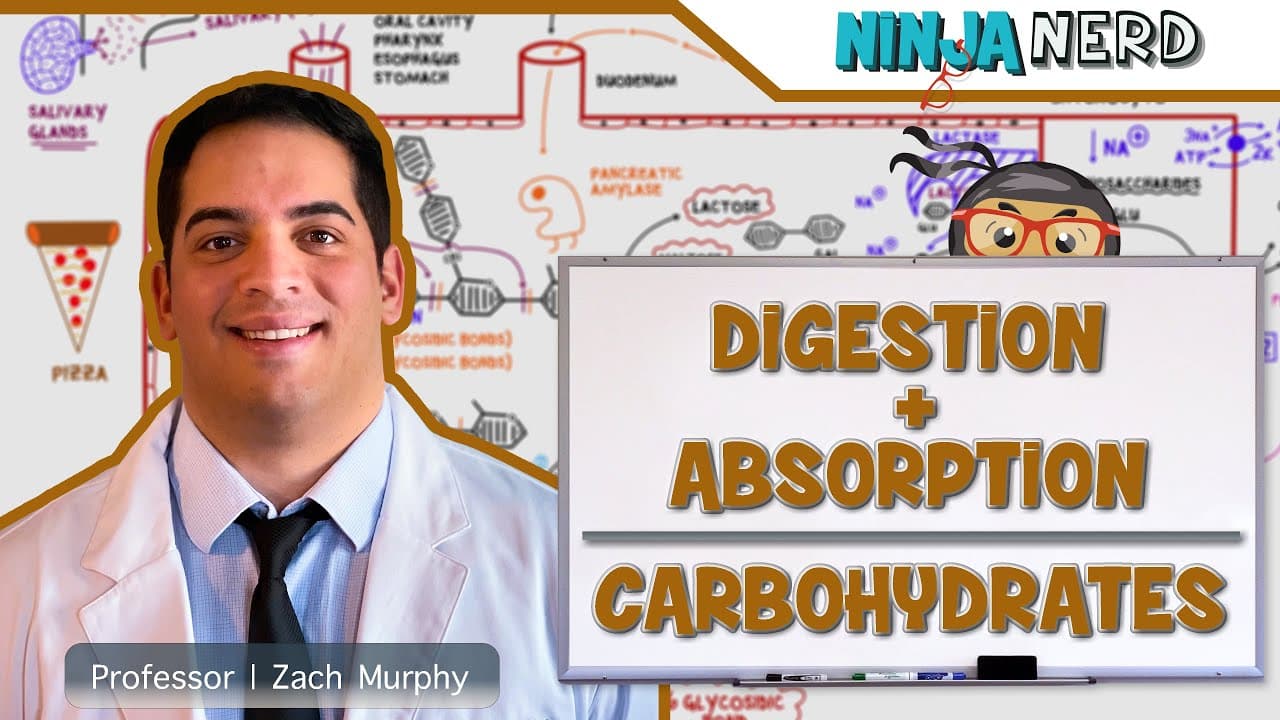
Carbohydrates are digested into absorbable monosaccharides by salivary amylase, pancreatic amylase, and small-intestinal brush border enzymes. Glucose and galactose enter enterocytes through SGLT1, while fructose uses GLUT5. All three sugars leave through GLUT2 and enter the bloodstream, with the sodium gradient maintained by the Na+/K+ ATPase supporting sodium-linked transport.
Transcript
I ninja nerds in this video we are gonna talk about the digestion and the absorption of carbohydrates so let's go and get started so let's imagine for a second we take a scenario where we're going to ingest a particular food substance that's rich in carbohydrates and for example here I love pizza pizza is awesome it's amazing it's delicious and wha... Read More
Key Insights
- Dietary starch is composed primarily of amylose and amylopectin. Amylose is a linear molecule containing alpha 1–4 glycosidic bonds, while amylopectin contains both linear alpha 1–4 bonds and alpha 1–6 bonds at its branching points.
- Cellulose is dietary fiber because humans do not have the enzyme cellulase needed to break it down for absorption. It consequently contributes to larger stools and easier bowel movements, while also being associated with prebiotic activity and control of bacterial metabolism and insulin release.
- Salivary alpha-amylase is an enzyme released in saliva, mainly from the extrinsic salivary glands. It is also called ptyalin and begins the chemical digestion of amylose and amylopectin in the oral cavity by targeting selected glycosidic bonds.
- Alpha 1–4 glycosidic bonds connect the first carbon of one monosaccharide to the fourth carbon of another. These bonds create the linear portions of amylose and amylopectin and are the specific starch bonds attacked by salivary and pancreatic amylase.
- Alpha 1–6 glycosidic bonds create branching points within amylopectin. Salivary amylase does not break these branching bonds, so branched carbohydrate fragments remain after its action and are represented among the digestion products called alpha-limit dextrins.
- Amylase digestion produces maltose, maltotriose, and alpha-limit dextrins. Maltose is a disaccharide containing two monosaccharides, while maltotriose and branched alpha-limit dextrins are oligosaccharides that must undergo additional digestion before their sugars can be absorbed.
- Carbohydrate digestion continues in the small intestine when pancreatic amylase is released near the duodenum. Brush border disaccharidases and other enzymes on enterocytes then complete digestion by converting the remaining disaccharides and oligosaccharides into absorbable monosaccharides.
- Monosaccharide absorption uses different apical transporters but a shared basolateral route. Glucose and galactose enter enterocytes through sodium-glucose linked transporter SGLT1, fructose enters through GLUT5, and all three leave through GLUT2 before moving into the bloodstream and toward the liver.
Install to Summarize YouTube Videos and Get Transcripts
Explore YouTube Video Summarizer or Get YouTube Transcript Extractor
Questions & Answers
Q: How are dietary carbohydrates digested and absorbed?
Dietary carbohydrates are progressively converted into monosaccharides. Salivary alpha-amylase begins starch digestion in the mouth, and pancreatic amylase continues the process after entering the small intestine near the duodenum. Brush border enzymes on enterocytes finish breaking down disaccharides and oligosaccharides. Glucose and galactose then enter through SGLT1, fructose enters through GLUT5, and all three exit through GLUT2 into the bloodstream.
Q: What is the difference between amylose and amylopectin?
Amylose is a linear starch molecule built from monosaccharides connected by alpha 1–4 glycosidic bonds. Amylopectin also contains alpha 1–4 bonds along its linear segments, but it has additional alpha 1–6 glycosidic bonds that create branching points. This structural difference matters during digestion because amylase attacks alpha 1–4 bonds, while branched fragments containing alpha 1–6 bonds remain as alpha-limit dextrins.
Q: What does salivary alpha-amylase do during digestion?
Salivary alpha-amylase, also known as ptyalin, begins the chemical digestion of starch after it is released into the oral cavity with saliva. The enzyme targets alpha 1–4 glycosidic bonds in amylose and amylopectin. Its action breaks these large carbohydrate molecules into smaller products, including maltose, maltotriose, and alpha-limit dextrins. Digestion is not completed in the mouth because food remains there only briefly.
Q: Why can humans not digest and absorb cellulose?
Humans cannot digest cellulose because they lack cellulase, the enzyme required to break it down. Cellulose from plants, fruits, and vegetables therefore functions as dietary fiber instead of being converted into absorbable sugars. The source associates this fiber with increased stool size, easier bowel movements, control of bacterial metabolism through prebiotic mechanisms, and a possible role in controlling insulin release.
Q: What products are formed when amylase digests starch?
Amylase digestion of amylose and amylopectin produces maltose, maltotriose, and alpha-limit dextrins. Maltose consists of two monosaccharides and is therefore classified as a disaccharide. Maltotriose and alpha-limit dextrins contain more monosaccharide units and are described as oligosaccharides. Alpha-limit dextrins retain branching points associated with alpha 1–6 glycosidic bonds, so further brush border digestion is required before absorption.
Q: How are glucose and galactose absorbed by enterocytes?
Glucose and galactose cross the apical membrane of small-intestinal enterocytes through the sodium-glucose linked transporter SGLT1. This transport depends on the sodium gradient maintained by the Na+/K+ ATPase pump. After entering the cell, both monosaccharides cross the basolateral membrane through GLUT2. They then enter the bloodstream and move through the hepatic portal system toward the liver.
Q: How is fructose absorbed in the small intestine?
Fructose enters small-intestinal enterocytes by facilitated diffusion through the GLUT5 transporter on the apical membrane. This route differs from glucose and galactose absorption, which uses the sodium-linked SGLT1 transporter. Once fructose is inside the enterocyte, it follows the same basolateral pathway as the other monosaccharides, leaving through GLUT2 before entering the bloodstream and traveling toward the liver.
Q: What roles do pancreatic amylase and brush border enzymes play?
Pancreatic amylase continues the digestion of carbohydrate molecules after being released by the pancreas into the gastrointestinal tract near the duodenum. It helps process starch fragments through action on alpha 1–4 glycosidic bonds. Brush border enzymes located on enterocytes then complete the process by breaking disaccharides and oligosaccharides into glucose, fructose, and galactose, the monosaccharides that can be transported across the intestinal lining.
Summary & Key Takeaways
-
Dietary carbohydrates include starch polysaccharides such as amylose and amylopectin, disaccharides such as lactose and sucrose, and the monosaccharides glucose, fructose, and galactose. Cellulose cannot be digested because humans lack cellulase, so it remains dietary fiber that increases stool size, eases bowel movements, and may offer additional metabolic benefits.
-
Carbohydrate digestion begins when salivary alpha-amylase attacks alpha 1–4 glycosidic bonds in starch. Amylose contains linear alpha 1–4 bonds, while amylopectin also contains branching alpha 1–6 bonds. Amylase activity produces maltose, maltotriose, and branched alpha-limit dextrins, which require further processing before their component sugars can be absorbed.
-
Pancreatic amylase continues carbohydrate digestion after being released into the duodenum. Brush border enzymes on small-intestinal enterocytes then convert disaccharides and oligosaccharides into monosaccharides. SGLT1 absorbs glucose and galactose, GLUT5 absorbs fructose, and GLUT2 transfers all three across the basolateral membrane toward the bloodstream and hepatic portal system.
Read in Other Languages (beta)
Share This Summary 📚
Summarize YouTube Videos and Get Video Transcripts with 1-Click
Try YouTube Summary with ChatGPT & Claude or YouTube Transcript Generator
Explore More Summaries from Ninja Nerd 📚





Summarize YouTube Videos and Get Video Transcripts with 1-Click
Try YouTube Summary with ChatGPT & Claude or YouTube Transcript Generator