How to handle a cheaper competitor quote in sales
TL;DR
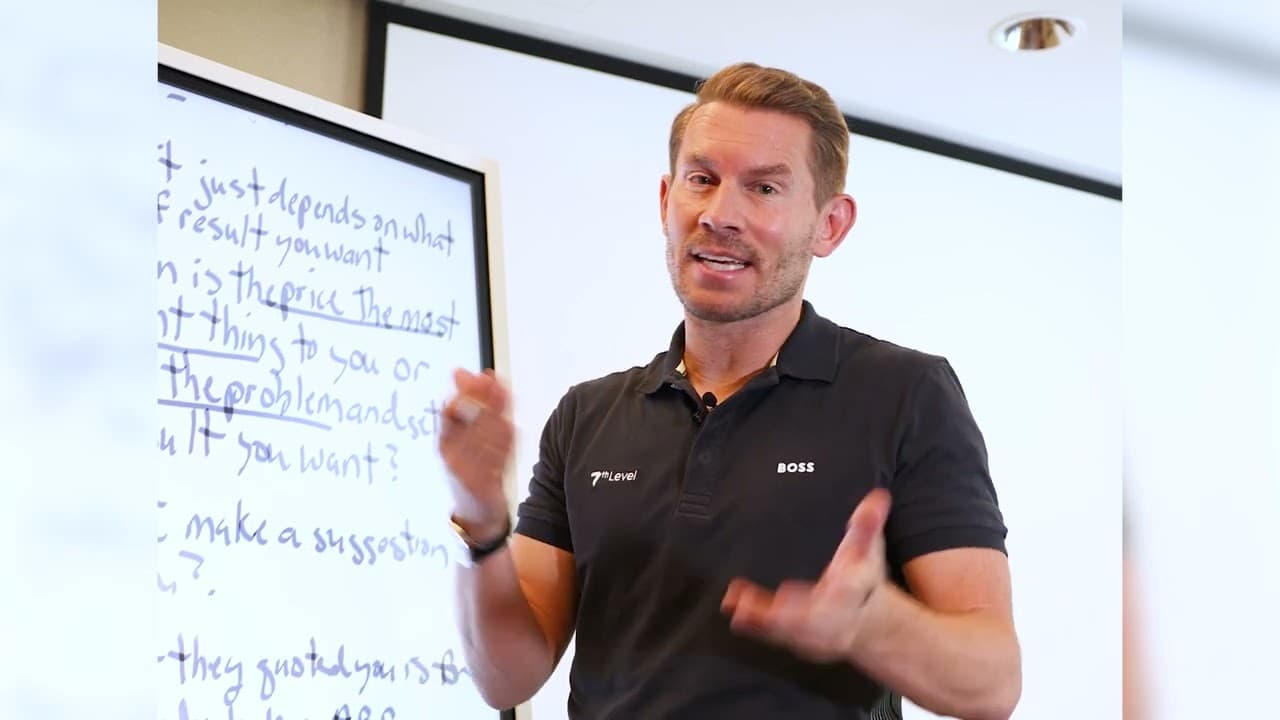
When a prospect says a competitor is cheaper, guide them toward results based thinking instead of price. Start by confirming the exact quote and what it covers, then reframe the discussion to the outcomes the client must achieve. Offer options showing different result levels and tie cost to long term value, not just initial price.
Transcript
so how do you close a sale when one of your competitors undercuts you let's say that you gave the prospect a proposal with different quotes in it and they're also getting different quotes and bids from some of your competition and they say something like this to you they say first of all go down to the bottom of this video hit the subscribe button ... Read More
Key Insights
- Price undercutting is common and can be countered by uncovering the exact quote and its scope.
- Results based thinking reframes the discussion from price to the actual outcomes the client wants to achieve.
- Ask the prospect to specify what the competing quote covers and what it is for to avoid guessing or deception.
- Showcasing the true gap between quotes helps the client see if the cheaper option actually delivers the desired results.
- Introduce a three option framework: cheaper, mid-range, and the full solution that solves the stated problems.
- Explain how the long term benefits and reduced energy costs justify higher upfront investments.
- Use industry specific examples to demonstrate how different choices affect outcomes and costs.
- Conclude by guiding the prospect to compare long term value rather than upfront price, which increases willingness to pay more for better results.
- More videos from this channel:
- More from this channel: Jeremy Miner
Install to Summarize YouTube Videos and Get Transcripts
Explore YouTube Video Summarizer or Get YouTube Transcript Extractor
Questions & Answers
Q: What should you do first when a prospect mentions a cheaper quote from a competitor?
Begin by asking to see the exact quote and what it covers. This helps you understand the scope and avoid taking the claim at face value. By clarifying the specifics, you can identify what the other proposal actually promises and what it does not, which is essential for a constructive conversation about value.
Q: How can you shift the conversation from price to results?
Pose a question that frames the decision around outcomes rather than cost, such as whether price or the actual result is the priority. This triggers the prospect to consider the end result and how it aligns with their needs, reducing the likelihood of price based grinding and commoditization.
Q: What is the recommended way to respond if the client says the result matters but price is also a factor?
Acknowledge the importance of both while keeping focus on results. Explain that you could match the initial quote but emphasize that the end result would determine long term value. Use this to pivot back to outcomes that the client values and reinforce that price is a secondary concern to results.
Q: How do you reveal the limitations of a cheaper quote?
Describe what the cheaper option does not address, such as unresolved problems or fewer features that impact outcomes. By showing the gap between what was quoted and what is truly needed to achieve the result, you create doubt about the cheaper option’s effectiveness.
Q: What is the three option framework and how does it help?
Present three paths: the cheaper option, a mid-range that lasts longer and saves more over time, and the fully capable solution that resolves all problems. This helps the client compare not just price but how each choice aligns with desired outcomes and long term value.
Q: How can you use a real industry example effectively?
Use a concrete scenario, such as windows, to illustrate how different choices affect performance and energy savings. Explain the potential problems with cheaper options, like drafts and higher replacement costs, and contrast them with longer lasting solutions that deliver meaningful reductions in utility costs.
Q: What role does problem awareness play in the conversation?
Identify and articulate the client’s stated problems, such as cold drafts or high utility bills, and link each problem to a specific solution in your proposal. This keeps the discussion focused on the client’s needs and makes the value of your higher tier options clear.
Q: What is the ultimate goal of the NEPQ based approach in this scenario?
The goal is to steer the client toward results based thinking, reduce price based payoffs, and demonstrate that paying more for a complete solution often yields greater long term value. This approach helps sustain higher margins while delivering better outcomes for the client.
Summary & Key Takeaways
-
The video explains a negotiation framework to handle price undercutting by focusing on end results rather than price alone. It advises to first uncover the exact quote and scope to avoid assumptions. It then shifts the conversation to the value and outcomes the client wants to achieve.
-
A practical industry example for windows shows presenting multiple options: cheap, mid-range, and high-end that solve specific problems and reduce utility costs. The speaker emphasizes illustrating how longer lasting solutions deliver greater value over time.
-
The overall method is to use a results based questioning sequence, expose gaps in the competitor quote, and guide the prospect to see the true cost of choosing the cheaper option. The aim is to keep the prospect thinking in terms of results, not just price.
Read in Other Languages (beta)
Share This Summary 📚
Summarize YouTube Videos and Get Video Transcripts with 1-Click
Try YouTube Summary with ChatGPT & Claude or YouTube Transcript Generator
Explore More Summaries from Jeremy Miner 📚

Summarize YouTube Videos and Get Video Transcripts with 1-Click
Try YouTube Summary with ChatGPT & Claude or YouTube Transcript Generator