How to Use Tonality in Sales to Get Real Answers
TL;DR
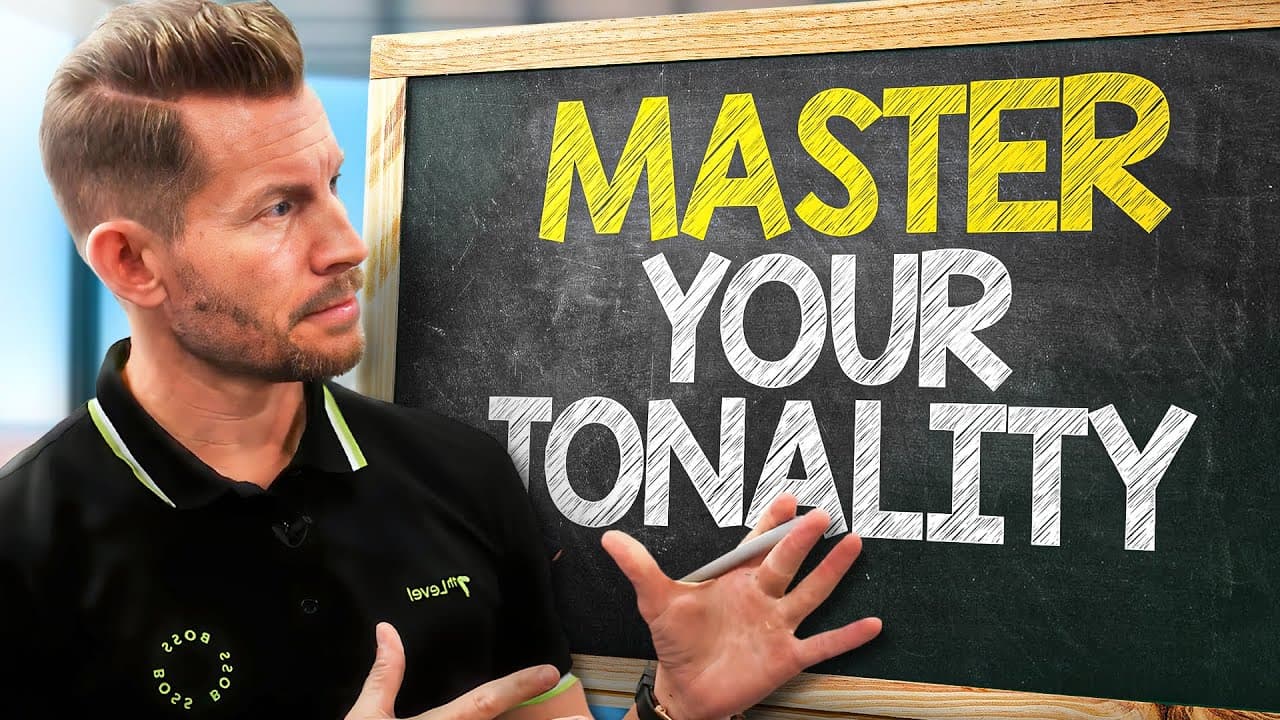
Prospects give vague, surface level answers because tone signals the intention behind every question you ask. Five tones matter most: confused, curious, challenging, concerned, and playful. Pair them with facial expressions, which act as the remote control for tone, and slow questions down with verbal pauses so prospects have time to internalize and clarify rather than react.
Transcript
do you ever notice when you ask questions to your prospects you think they're good but they give you vague generalized surface level answers you ask a question like yeah yeah you ask another question well I I don't know they're just kind of vague there's a reason why that's happening and it all has to do with you know what it's going to sound kind ... Read More
Key Insights
- Tone is how a prospect interprets the intention behind everything you say and every question you ask, which is why identical wording delivered fast and flat produces vague answers while the same words paced and inflected produce emotional disclosure.
- Five main types of tone matter for becoming a top 1% salesperson or a market leading company: confused, curious, challenging, concerned, and playful. Each is used in a specific context rather than applied uniformly across a conversation.
- A confused tone works because the prospect's subconscious concludes "he didn't understand what I meant by that, I need to clarify that better," which pushes them to explain their situation in more detail and open up emotionally.
- Facial expressions are the remote control for tonality. A confused tone cannot be delivered with a motionless face, and the same challenging line lands completely differently depending on whether the expression shifts with it.
- A challenging tone should not be used in the first two minutes of a conversation, when there is zero trust or credibility established with the prospect. Timing determines whether a tone builds pressure or destroys the conversation.
- Verbal pacing means inserting pauses between certain words so the prospect hangs on every word. Questions asked too fast leave no time to internalize, so the prospect returns a knee-jerk reaction instead of a real answer.
- Describing a competitor as "fairly decent" in a skeptical, concerned tone seeds doubt without attacking them. Saying the company is horrible reads as biased salesperson talk, and praising them outright helps nobody.
- Getting prospects to state their own reasons is more persuasive than telling them, because when it is their idea rather than yours, the sale does not unwind after the pressure wears off and they decide to cancel.
Install to Summarize YouTube Videos and Get Transcripts
Explore YouTube Video Summarizer or Get YouTube Transcript Extractor
Questions & Answers
Q: Why do prospects give vague, surface level answers to sales questions?
Two causes are given: the questions themselves, which most salespeople were trained to ask, and the tonality used to deliver them. Tone is how a prospect interprets the intention behind everything you say, so a flat, fast delivery signals nothing worth engaging with. Questions asked too quickly also give the prospect no time to internalize what was asked, so they fire back a knee-jerk reaction rather than a considered answer. Slowing down and shifting tone fixes both problems.
Q: What are the five types of tone in sales?
The five main tones are confused, curious, challenging, concerned, and playful. There are many types of tone, but these five are singled out as what you must master to become a top 1% salesperson in your industry, or for a company that wants to scale into the market leader position and stay on top of everyone else. Each tone is deployed in a specific context to trigger different emotional drivers in the prospect's mind and get them to let their guard down.
Q: How does a confused tone help you sell more?
A confused tone triggers the prospect's subconscious to think "he didn't understand what I meant by that, I need to clarify that better." That reaction makes them explain their situation in more depth and open up emotionally. The whole point of the conversation is getting the prospect to open up, because if they never clarify their pain and relive it, they feel no need to change. When they feel no need to change, that is where objections come from and where sales are lost.
Q: What is verbal pacing in sales conversations?
Verbal pacing is slowing a question down and inserting verbal pauses between certain words so the prospect hangs on every single word being said. Without it, questions come out too fast and the prospect has no time to internalize what is being asked, so they give a knee-jerk reaction. The same question about why a current vendor cannot scale their business produces a throwaway "we just always want to look around" when rushed, but produces a real explanation when paced with tonal shifts.
Q: Why do facial expressions matter for tonality?
Facial expressions are described as the remote control for how tonality comes across. You cannot deliver a confused tone with a completely still face. The example given is a challenging line, "what happens if you don't do anything about this," delivered motionless versus delivered with the expression engaged: the facial expression causes the tone to change and shift. Watching a favorite actor or actress in a movie shows the same thing, their facial expressions are what change their tonality.
Q: When should you not use a challenging tone with a prospect?
A challenging tone should not be used in the first two minutes of a conversation with a prospect, when you have zero trust or credibility with them. Tone selection is context dependent rather than fixed, so the challenging tone has its place later once credibility exists. The same principle applies to the confused tone, which is not meant to sound like genuine confusion about your own offer during a presentation, only the specific probing confusion used when the prospect describes their situation.
Q: How should you talk about a prospect's current vendor or competitor?
Call them "fairly decent" using a concerned, skeptical tone. Saying the company they are with is really good does not help you. Saying that company sucks or is horrible does not work either, because prospects respond with "of course you're going to say that, you're a salesperson, you're biased." The middle path plants doubt purely through tone: it implies you might know something about that company that is not very good without you actually saying it, so the doubt is seeded rather than argued.
Q: Why is it better for prospects to convince themselves than for you to convince them?
When a question is framed so the prospect explains why their current situation will not work, they are telling themselves, not just you. That is more persuasive than you telling them why they should buy or sell, because it becomes their idea rather than yours. Pressure-based selling produces a different outcome: the prospect buys, then once you leave and the pressure wears off, they decide to cancel. Self-generated reasons hold up after the conversation ends.
Summary & Key Takeaways
-
Vague prospect answers trace back to tonality, because tone is how a prospect interprets the intention behind everything you say. Five main tones drive top performance: confused, curious, challenging, concerned, and playful. A challenging tone is not used in the first two minutes when there is zero trust or credibility built.
-
Facial expressions are described as the remote control for tonality. You cannot deliver a confused tone with a still face, and watching actors shows expressions shifting tone. Saying "what happens if you don't do anything about this" with a flat face fails, while the matching expression makes the challenging tone land naturally.
-
Verbal pacing and verbal pauses between certain words give prospects time to internalize the question instead of firing back a knee-jerk reaction. Asking too fast produces surface level replies. Slowing the question and ending on a concerned tone makes the prospect explain, and more importantly tell themselves, why their current situation will not work.
Read in Other Languages (beta)
Share This Summary 📚
Summarize YouTube Videos and Get Video Transcripts with 1-Click
Try YouTube Summary with ChatGPT & Claude or YouTube Transcript Generator
Explore More Summaries from Jeremy Miner 📚





Summarize YouTube Videos and Get Video Transcripts with 1-Click
Try YouTube Summary with ChatGPT & Claude or YouTube Transcript Generator