How to Automate YouTube to Blog Posts Using AI
TL;DR
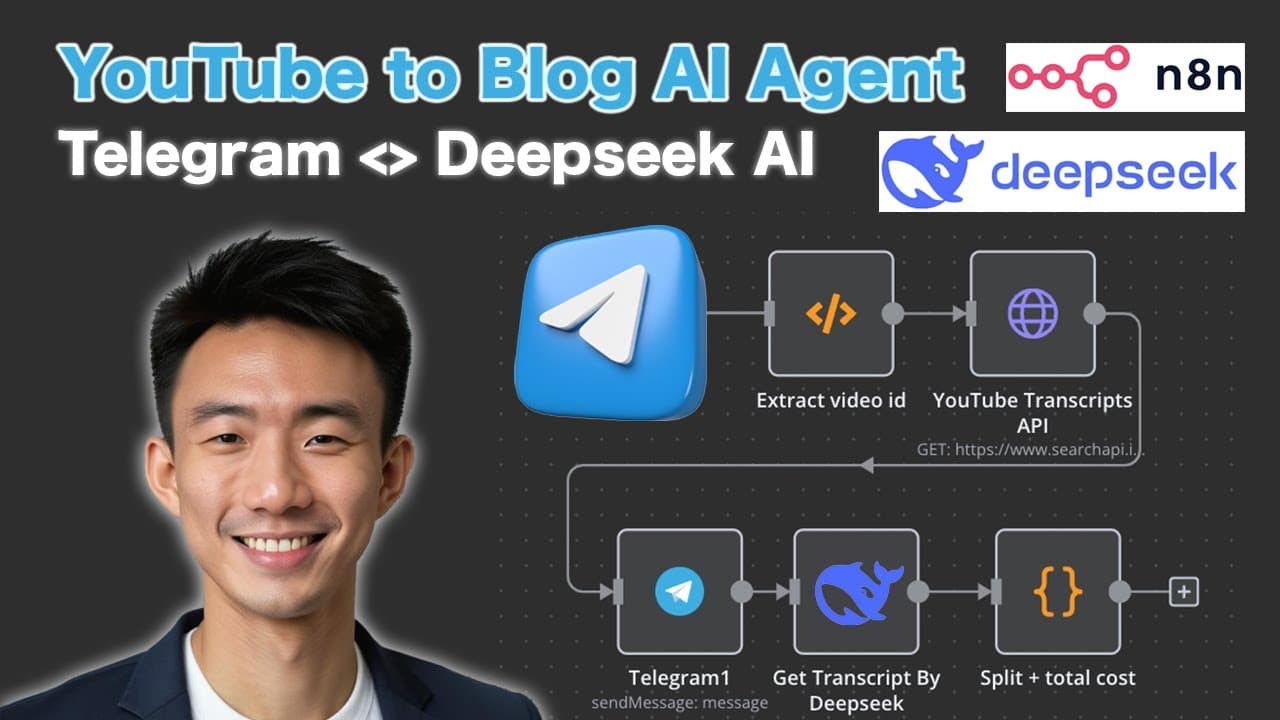
Automate the conversion of YouTube videos into blog posts by using an AI agent with Telegram and DeepSeek AI. This tutorial walks you through setting up APIs and creating a seamless workflow for extracting transcripts and generating structured blog content, saving you valuable time without needing coding skills.
Transcript
hi in today's video we're going to talk about how you can create an AI agent to turn YouTube into blogs we're going to use Telegram and dip seek AR in this tutorial so before we dive into the NN workflow let's do a quick Demo First so for example we're going to use this video which is around 14 minutes long a... Read More
Key Insights
- The video demonstrates how to use an AI agent to convert YouTube videos into blog posts using Telegram and DeepSeek AI, streamlining content creation.
- A Telegram bot is used to initiate the process by receiving a YouTube URL, which triggers the workflow to start the conversion process.
- The system retrieves YouTube video transcripts automatically using searchapi.io, facilitating quick and accurate content extraction.
- DeepSeek AI processes the transcript to create a well-structured blog post, enhancing readability and summarizing the video content efficiently.
- The workflow calculates the time saved by converting video content into a blog, highlighting the efficiency of the automation process.
- The setup involves configuring APIs for Telegram, DeepSeek AI, and searchapi.io, ensuring seamless data flow between platforms.
- The process includes cost estimation for the conversion, providing transparency on the resources used during the automation.
- The tutorial provides a step-by-step guide on setting up the entire system, making it accessible for users without coding experience.
Install to Summarize YouTube Videos and Get Transcripts
Explore YouTube Video Summarizer or Get YouTube Transcript Extractor
Questions & Answers
Q: How does the AI agent convert YouTube videos into blogs?
The AI agent uses a combination of Telegram, DeepSeek AI, and searchapi.io to convert YouTube videos into blogs. The process begins with a Telegram bot receiving a YouTube URL, triggering a workflow that retrieves the video's transcript using searchapi.io. DeepSeek AI then processes the transcript to create a structured blog post, which is sent back to the user via Telegram.
Q: What are the main components needed for setting up the workflow?
The main components for setting up the workflow include a Telegram bot, DeepSeek AI API, and searchapi.io API. Users need to configure these APIs to enable seamless data flow and automation. This involves creating API keys, setting up credentials, and integrating them into the workflow to facilitate the conversion process.
Q: How does the system ensure the accuracy of the transcript?
The system ensures the accuracy of the transcript by using searchapi.io, which is designed to retrieve YouTube video transcripts accurately. This API handles the extraction of video transcripts, which are then processed by DeepSeek AI to enhance and summarize the content for blog creation, ensuring both accuracy and readability.
Q: What benefits does this automation provide to content creators?
This automation provides several benefits to content creators, including significant time savings, efficient content repurposing, and improved workflow management. By automating the conversion of YouTube videos into blog posts, creators can focus on content quality and strategy rather than manual transcription and formatting, enhancing productivity and output.
Q: How does the workflow calculate the cost of conversion?
The workflow calculates the cost of conversion by considering the token cost charged by DeepSeek AI for processing the transcript. This cost estimation is included in the response sent back to the user via Telegram, providing transparency and allowing users to understand the resources utilized during the conversion process.
Q: Is coding experience required to set up this system?
No, coding experience is not required to set up this system. The tutorial provides a detailed step-by-step guide, making it accessible to users without coding knowledge. The process involves configuring APIs and using pre-prepared codes, enabling users to implement the workflow with minimal technical expertise.
Q: What role does Telegram play in this workflow?
Telegram plays a crucial role in this workflow as it serves as the interface for triggering the conversion process. Users send a YouTube URL to the Telegram bot, which initiates the workflow. Telegram also acts as the communication channel for delivering the final blog post and cost estimation back to the user.
Q: Can this workflow handle multiple video languages?
The workflow is primarily set up for English transcripts, as indicated by the language parameter in the API configuration. However, with appropriate adjustments to the API settings and language parameters, it may be possible to adapt the workflow to handle multiple video languages, depending on the capabilities of the APIs used.
Summary & Key Takeaways
-
This tutorial explains how to automate the conversion of YouTube videos into blog posts using a no-code AI agent. The process involves integrating Telegram, DeepSeek AI, and searchapi.io, allowing for efficient transcript retrieval, processing, and response delivery.
-
Users learn to trigger workflows through Telegram, extract YouTube video transcripts with searchapi.io, and enhance transcripts using DeepSeek AI for blog creation. The system also automates response delivery and cost calculations directly in Telegram.
-
By following this tutorial, users can set up an efficient workflow to convert YouTube content into blog-ready material with minimal effort. The video provides a comprehensive guide to the entire process, making it accessible even for those without coding knowledge.
Read in Other Languages (beta)
Share This Summary 📚
Summarize YouTube Videos and Get Video Transcripts with 1-Click
Try YouTube Summary with ChatGPT & Claude or YouTube Transcript Generator
Explore More Summaries from Andy Lo 📚
![100+ Jobs Per Day - Full Job Search AI Automation System [Free Template] thumbnail](/_next/image?url=https%3A%2F%2Fi.ytimg.com%2Fvi%2FvfMHPb0Uayc%2Fhqdefault.jpg&w=750&q=75)
Summarize YouTube Videos and Get Video Transcripts with 1-Click
Try YouTube Summary with ChatGPT & Claude or YouTube Transcript Generator