What Are 5 AI Workflows That Revolutionize Automation?
TL;DR
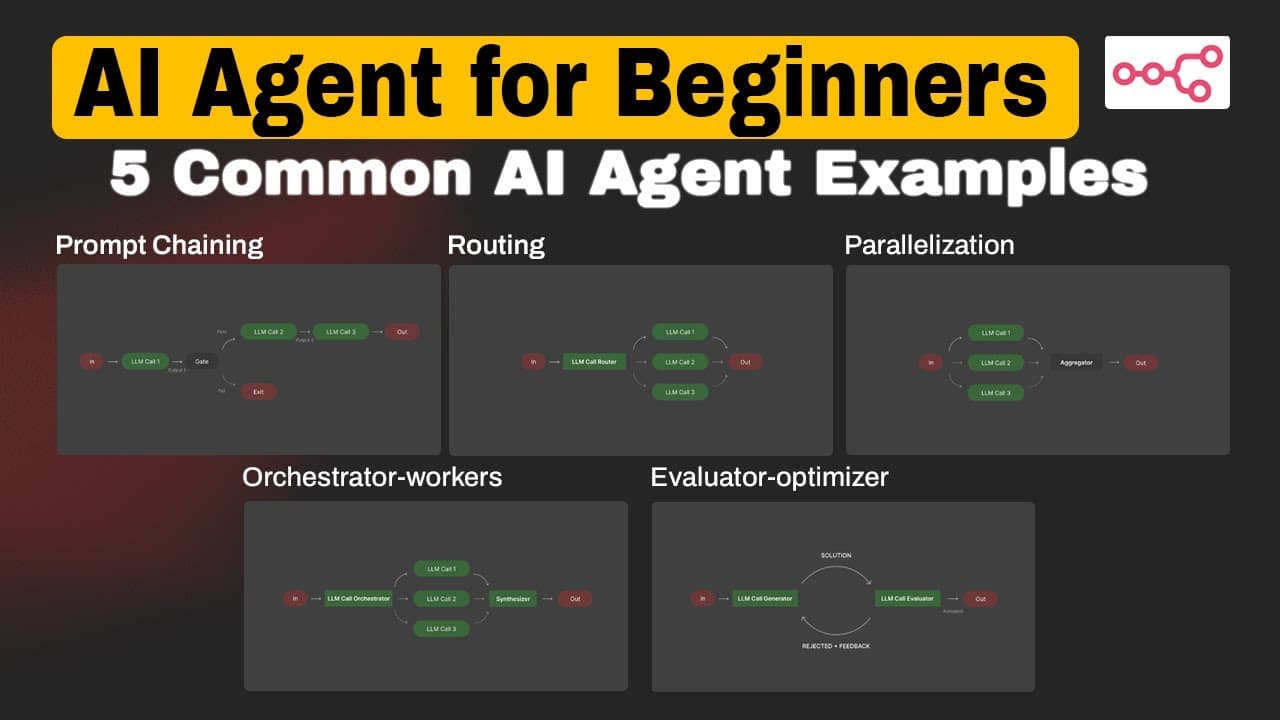
Discover five innovative AI workflows that enhance automation without coding. These workflows—prompt chaining, routing, parallelization, orchestrator-workers, and evaluator-optimizer—transform how tasks are managed, improving efficiency and accuracy across various applications.
Transcript
hey everyone in today's video we're going to talk about AI agent recipes and how we can use them to upgrade our AI agents and llm applications um this AI agent recipes uh is prepared by together Ai and together AI is a company that offers cloudbased tools for deploying open source um generative AI models and the materials I'... Read More
Key Insights
- AI agent recipes can significantly enhance automation by using structured workflows that integrate various AI models for different tasks.
- Prompt chaining allows for sequential task completion by using the output of one AI model as the input for another, facilitating structured reasoning.
- Routing optimizes task handling by directing inputs to the most suitable AI model, balancing complexity and efficiency.
- Parallelization increases efficiency by running multiple AI tasks simultaneously, such as translating documents into multiple languages.
- The orchestrator-workers model breaks down complex tasks into subtasks handled by different AI models, which are then combined for a complete solution.
- Evaluator-optimizer workflows ensure task requirements are fully met through iterative refinement and validation processes.
- Together AI provides cloud-based tools for deploying open-source generative AI models, enhancing the flexibility of AI agent workflows.
- These AI workflows are designed to be implemented without coding, making them accessible to a broader range of users.
Install to Summarize YouTube Videos and Get Transcripts
Explore YouTube Video Summarizer or Get YouTube Transcript Extractor
Questions & Answers
Q: What is prompt chaining and how does it work?
Prompt chaining is a workflow where the output of one AI model becomes the input for another, creating a sequential design. This allows for structured reasoning and step-by-step task completion. It can be used for tasks like generating marketing copies, translating languages, or cleaning and standardizing data before passing it to another model for further insights.
Q: How does routing optimize AI model usage?
Routing optimizes AI model usage by classifying and directing inputs to the most suitable AI model based on task complexity. Simple tasks are directed to smaller models for efficiency, while complex or unusual tasks are handled by more capable models. This approach helps optimize performance, cost, and speed.
Q: What is the purpose of parallelization in AI workflows?
Parallelization in AI workflows is designed to increase efficiency by allowing multiple AI tasks to run simultaneously. For example, it can be used to translate a document into multiple languages at once, with each language being handled by a separate AI model. The results are then aggregated for a comprehensive output.
Q: Can you explain the orchestrator-workers model?
The orchestrator-workers model breaks down complex tasks into subtasks, which are processed in parallel by multiple worker AI models. The orchestrator AI model then synthesizes the outputs from these workers into a final result. This model is useful for tasks like coding problems, data searches, or creating tutorials by handling each part separately and combining them into a cohesive output.
Q: What role does the evaluator-optimizer workflow play?
The evaluator-optimizer workflow ensures that task requirements are fully met through iterative refinement. After an AI model performs a task, a second AI model evaluates the output against specified criteria. If the output does not meet the criteria, the process repeats with adjustments until the evaluator confirms all requirements are satisfied.
Q: How does Together AI support these workflows?
Together AI offers cloud-based tools for deploying open-source generative AI models, providing the infrastructure needed to implement these AI agent workflows. It supports various models and configurations, enabling users to choose the best fit for their specific tasks, enhancing flexibility and efficiency in automation processes.
Q: What are some use cases for these AI workflows?
These AI workflows can be used in various scenarios such as content creation, data processing, automation, and business intelligence. They help in tasks like generating marketing content, translating documents, optimizing customer service inquiries, analyzing large datasets, and ensuring outputs meet specific criteria through iterative refinement.
Q: How accessible are these AI workflows for non-coders?
These AI workflows are designed to be implemented without coding, making them highly accessible to non-coders. The workflows use structured designs and tools that allow users to automate tasks and optimize AI model usage without needing programming skills, broadening the potential user base and application areas.
Summary & Key Takeaways
-
The video introduces five AI agent workflows designed to automate tasks without coding. These workflows include prompt chaining, routing, parallelization, orchestrator-workers, and evaluator-optimizer models, each serving unique purposes in task automation.
-
Prompt chaining involves using the output of one AI model as the input for another to achieve structured reasoning. Routing directs tasks to the most suitable AI model based on complexity, optimizing performance and cost.
-
Parallelization allows multiple tasks to run simultaneously, increasing efficiency. The orchestrator-workers model breaks down tasks into subtasks handled by different AI models, while evaluator-optimizer workflows ensure outputs meet specified criteria through iterative refinement.
Read in Other Languages (beta)
Share This Summary 📚
Summarize YouTube Videos and Get Video Transcripts with 1-Click
Try YouTube Summary with ChatGPT & Claude or YouTube Transcript Generator
Explore More Summaries from Andy Lo 📚

![100+ Jobs Per Day - Full Job Search AI Automation System [Free Template] thumbnail](/_next/image?url=https%3A%2F%2Fi.ytimg.com%2Fvi%2FvfMHPb0Uayc%2Fhqdefault.jpg&w=750&q=75)

Summarize YouTube Videos and Get Video Transcripts with 1-Click
Try YouTube Summary with ChatGPT & Claude or YouTube Transcript Generator