How Will AI Transform Mathematical Research?
TL;DR
AI is likely to become robustly superhuman at doing mathematics as it is practiced today, producing comprehensible results faster than researchers can absorb them. Mathematics may advance rapidly, but mathematicians will need new systems for selecting, categorizing, summarizing, and understanding results, while students should recognize that the traditional academic career path is being disrupted.
Transcript
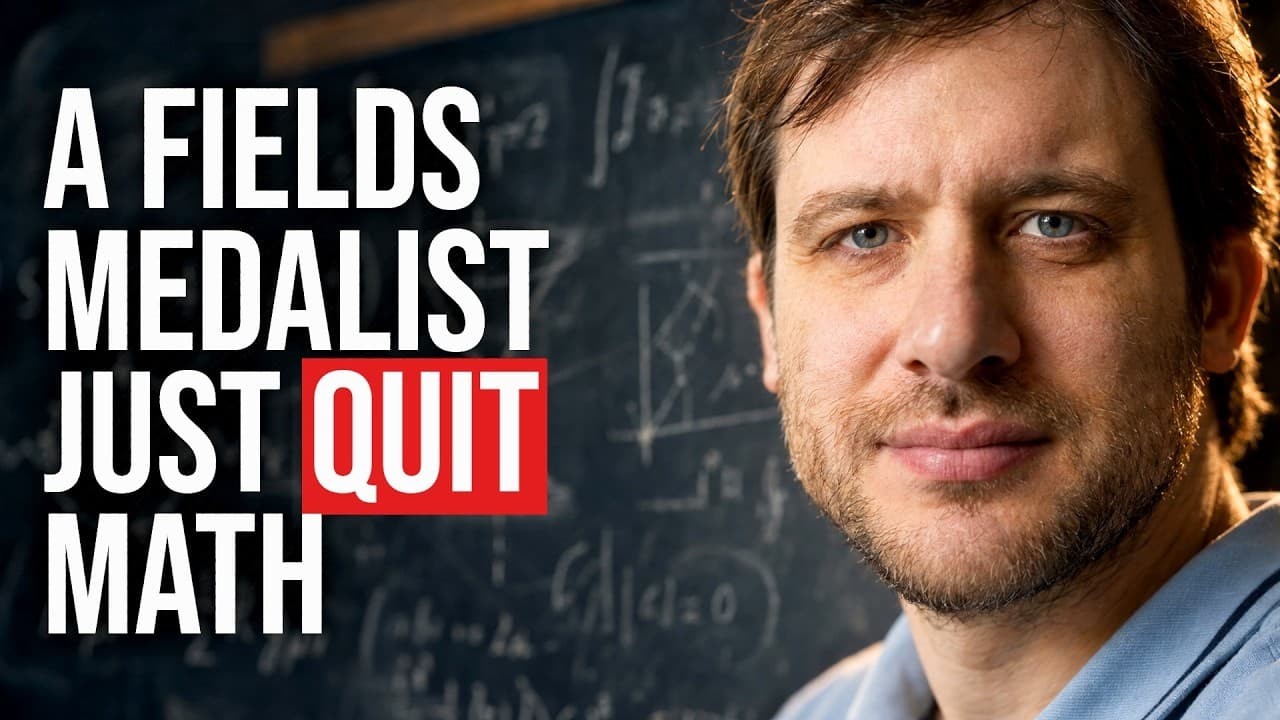
Jacob: We're living in crazy times. It's not gonna be business as usual. Curt: This is an exclusive, Jacob Tsimerman's first podcast. 10 days prior to filming this, he was awarded the Fields Medal, math's highest honor. That same day, on stage, he announced he's leaving temporarily to OpenAI and AI safety. Jacob: I'm definitely grieving. I... Read More
Key Insights
- Mathematics is especially susceptible to rapid AI progress because it is a closed system that can be investigated through reasoning alone, without experiments or physical materials. This makes its difficulty for humans a poor guide to how quickly capable AI systems may transform it.
- AI is expected to become robustly superhuman at mathematical work as it is practiced today, although the timing and social response remain uncertain. Tsimerman emphasizes that this forecast does not determine whether the outcome is good or bad, because society can still shape its response.
- Mathematicians face a deeper personal disruption than mathematics itself because professional identity often depends on year-long or decade-long projects, gradual exploration, and rare moments of insight. Faster AI research could weaken or eliminate that familiar style of intellectual work.
- Young mathematicians face an upended professional path because entering a PhD with expectations of continuing academic business as usual may no longer be realistic. The field must reconsider its structure while AI capabilities advance too quickly for confident predictions even a few years ahead.
- Automated mathematical research could operate continuously by proposing conjectures, solving problems, creating definitions, categorizing discoveries, and expanding mathematical knowledge. Such a system would require humans to decide where to direct its capabilities and how to evaluate the resulting body of work.
- Current AI-generated proofs remain connected to human mathematical work and use recognizable ideas rather than arriving from an entirely alien foundation. Their presentation can be more disorganized than human writing, creating a substantial need for rewriting even when the underlying reasoning is clever and comprehensible.
- The main near-term problem is the volume of comprehensible mathematics, not billion-line proofs that nobody can decipher. AI may produce results so quickly that researchers could understand any chosen proof with effort but remain unable to study more than a small fraction of the total output.
- Mathematical expertise depends on a broad division of labor because researchers understand their own narrow areas far better than distant fields. Shared language can make a major result quickly communicable within a specialty, while understanding work from another field may require weeks of dedicated study.
- More videos from this channel:
- More from this channel: Curt Jaimungal
Install to Summarize YouTube Videos and Get Transcripts
Explore YouTube Video Summarizer or Get YouTube Transcript Extractor
Questions & Answers
Q: Why could AI transform mathematics so quickly?
AI could transform mathematics quickly because mathematical work occurs within a closed system and can be pursued through reasoning without experiments, laboratory materials, or physical observation. Although mathematics is difficult for humans, that difficulty does not necessarily slow AI progress. The systems discussed can build on established human work, recognize familiar patterns, and already contribute solutions to conjectures.
Q: What worries Jacob Tsimerman about AI and mathematics?
Tsimerman is currently more concerned about mathematicians than mathematics. He expects mathematics to change but believes the field can navigate that change. The immediate disruption affects people, especially young researchers planning a conventional PhD and academic career, as well as established mathematicians whose identities are tied to long projects, slow progress, and personal moments of discovery.
Q: Will AI replace the traditional work of mathematicians?
Tsimerman predicts that AI will become robustly superhuman at performing mathematics as humans practice it today, but he does not claim to know exactly when or how society will respond. Traditional work based on long research projects may diminish, while human responsibilities may shift toward choosing questions, organizing results, extracting central ideas, and restructuring the mathematical profession.
Q: Can an AI-generated proof count if humans cannot understand it?
The interview treats that as an unresolved question, especially for a hypothetical proof consisting of an enormous amount of technically correct but indecipherable code. However, Tsimerman stresses that current systems are not producing fundamentally incomprehensible mathematics. Their proofs build on human work and familiar ideas, although the writing can be disorganized and may require substantial human revision.
Q: What is the biggest near-term problem with AI-generated mathematics?
The bigger near-term problem is likely to be excessive output rather than alien or incomprehensible reasoning. AI may generate proofs that people could understand individually if they devoted enough time, yet produce them far faster than the mathematical community can study them. Researchers would then need methods for categorization, summarization, prioritization, and identification of the most important ideas.
Q: How might an automated mathematics system operate?
An automated mathematics system could run continuously, make conjectures, solve problems, create definitions, categorize results, and keep expanding mathematical knowledge. Its existence would create a new allocation problem: humans would need to decide where to point its capabilities and how to organize what it produces. Tsimerman presents this as plausible but emphasizes that detailed predictions remain difficult.
Q: Why can mathematicians understand some proofs faster than others?
Mathematicians rely on specialization because the subject is too broad for anyone to master completely. Within a researcher's own area, shared concepts and methods can allow another expert to communicate the main idea of an outstanding result in minutes. A proof from a distant field may instead require weeks of study because the reader must first bridge differences in language and background.
Q: What does current AI mathematics suggest about human cognition?
Tsimerman suggests that current results provide a slight update toward viewing human patterns of thought as less arbitrary than they might appear. AI systems often use recognizable approaches and build on human ideas rather than inventing wholly alien methods. He also notes an important counterargument: these systems are trained using human language and human-produced material, which may explain that similarity.
Summary & Key Takeaways
-
Jacob Tsimerman argues that mathematics is being transformed unusually quickly because it is a closed system that can be explored through reasoning without experiments or physical materials. AI can build on existing human mathematics, solve conjectures, and potentially perform mathematical work faster than researchers can read, evaluate, or meaningfully absorb it.
-
The immediate concern is less the survival of mathematics than the future of mathematicians, particularly young people entering doctoral programs under traditional assumptions. Tsimerman is grieving the possible loss of a working culture built around long projects, gradual progress, specialized expertise, and personally meaningful moments of discovery.
-
Future mathematical systems may continuously formulate conjectures, solve problems, create definitions, and organize results. The central challenge could therefore shift from proving individual theorems to deciding which questions deserve attention, categorizing an overwhelming volume of output, extracting important ideas, and helping specialists understand developments beyond their own narrow fields.
Read in Other Languages (beta)
Share This Summary 📚
Summarize YouTube Videos and Get Video Transcripts with 1-Click
Try YouTube Summary with ChatGPT & Claude or YouTube Transcript Generator
Explore More Summaries from Curt Jaimungal 📚
Summarize YouTube Videos and Get Video Transcripts with 1-Click
Try YouTube Summary with ChatGPT & Claude or YouTube Transcript Generator