How Do Michael Levin and Anna Ciaunica Explain Consciousness Beyond the Brain and the Self?

TL;DR
Michael Levin and Anna Ciaunica argue that consciousness, intelligence, and selfhood cannot be understood by examining the brain or isolated individual alone. Levin describes learning and information integration in cells and bacterial biofilms, while Ciaunica says the self develops through relationships with others. Read on to see how ancient cellular mechanisms and a second-person perspective challenge brain-centered, adult-centric theories.
Transcript
If you don't change, you will die. If you do change, you are no longer yourself. What all of this is about, it's not really philosophy, it's empirical claims about which set of tools is going to apply. You are in no way tied to the story that was told by your past self. We need to figure out how basically we are linked to other individuals ... Read More
Key Insights
- Consciousness and selfhood are influenced by cellular intelligence, extending beyond the brain.
- Memory is not solely a brain function but involves body-wide processes and cellular interactions.
- The self emerges from interactions with others, challenging the notion of an isolated individual.
- Traditional views of consciousness often overlook the role of embodiment and physical processes.
- Interdisciplinary approaches are essential to understanding complex phenomena like consciousness.
- Pregnancy exemplifies a fundamental interconnectedness, with two immune systems interacting.
- The concept of self is dynamic, involving continuous reinterpretation of memories and experiences.
- Aging and goal-directed systems suggest that reaching a goal without new challenges leads to degradation.
Install to Summarize YouTube Videos and Get Transcripts
Explore YouTube Video Summarizer or Get YouTube Transcript Extractor
Questions & Answers
Q: How does cellular intelligence challenge brain-centered theories of consciousness?
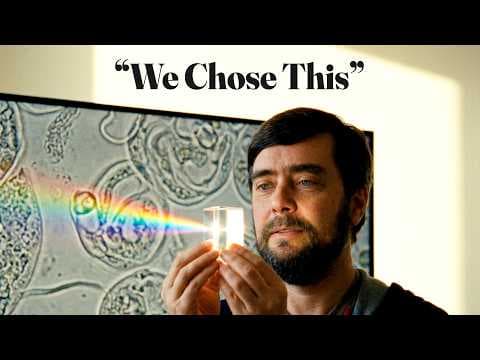
Michael Levin argues that different kinds of intelligence are not necessarily limited to brains. Capacities such as learning from experience and navigating physiological, metabolic, gene-expression, and anatomical problem spaces exist far beyond organisms with brains.
Q: What evidence does Michael Levin give for intelligence outside the brain?
Levin points to ion channels, electrical synapses called gap junctions, and neurotransmitters working in networks that integrate information across space and time. He says these mechanisms are evolutionarily ancient and predate multicellularity.
Q: Can bacterial biofilms have components associated with neural networks?
Yes, Levin says bacterial biofilms have the components used by neural networks, including ion channels, gap junctions, and neurotransmitters. These components support the integration of information across space and time.
Q: What kinds of problem spaces can non-neural systems navigate?
Non-neural systems can navigate physiological, metabolic, gene-expression, and anatomical problem spaces. Levin distinguishes these from movement through 3D space and says the relevant capacities predate nerves and muscles.
Q: Why does Anna Ciaunica say the self cannot be understood in isolation?
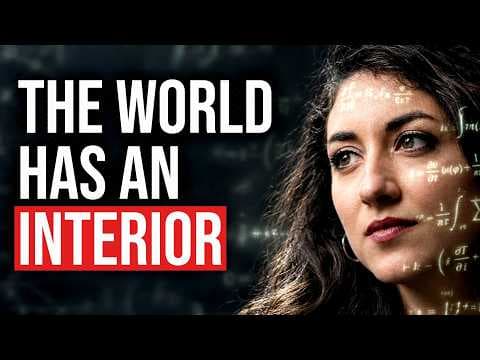
Ciaunica argues that a person cannot become a self by themselves because another individual is present from the beginning. Understanding the self therefore requires examining how individuals are linked to other individuals.
Q: What does it mean to start with the second person when studying the self?
It means beginning with the relationship between a person and another, rather than assuming a fully formed individual self. Ciaunica summarizes this position by saying that the second person comes first.
Q: Why does Anna Ciaunica criticize adult-centric concepts of the self?
She says these concepts assume that the individual self is already fully formed. That static lens obscures the developmental question of how a self emerges from a group of cells and through connections with others.
Q: How does the epicycle analogy apply to theories of the self?
Ciaunica compares current assumptions to the old belief that celestial movement had to be circular, which required increasingly complicated epicycles to fit conflicting observations. Her point is that dropping a mistaken foundational idea can make the empirical picture fall into place.
Summary & Key Takeaways
-
Definition: Cellular intelligence includes learning from experience and navigating physiological, metabolic, gene-expression, and anatomical problem spaces.
-
Tool: Ion channels, gap junctions, and neurotransmitters enable networks to integrate information across space and time.
-
When: The mechanisms associated with neural networks predate multicellularity and are evolutionarily ancient.
-
Compare: Intelligence extends beyond brains to single cells and bacterial colonies.
-
Definition: Selfhood develops from cells and cannot be understood by examining an isolated, fully formed adult.
-
Who: Michael Levin is a developmental biologist and distinguished professor at Tufts University.
-
Who: Anna Ciaunica is a cognitive scientist and philosopher based at institutions in Lisbon and London.
-
Definition: The second-person approach begins with relationships to others before analyzing the individual self.
-
Compare: Static, adult-centric concepts treat the self as already formed, while the developmental view asks how it emerges.
-
Number: Curt Jaimungal recorded five podcasts during a three-day tour of Harvard, Tufts, and MIT.
Read in Other Languages (beta)
Share This Summary 📚
Summarize YouTube Videos and Get Video Transcripts with 1-Click
Try YouTube Summary with ChatGPT & Claude or YouTube Transcript Generator
Explore More Summaries from Curt Jaimungal 📚
Summarize YouTube Videos and Get Video Transcripts with 1-Click
Try YouTube Summary with ChatGPT & Claude or YouTube Transcript Generator