How does Bell's theorem prove quantum non locality
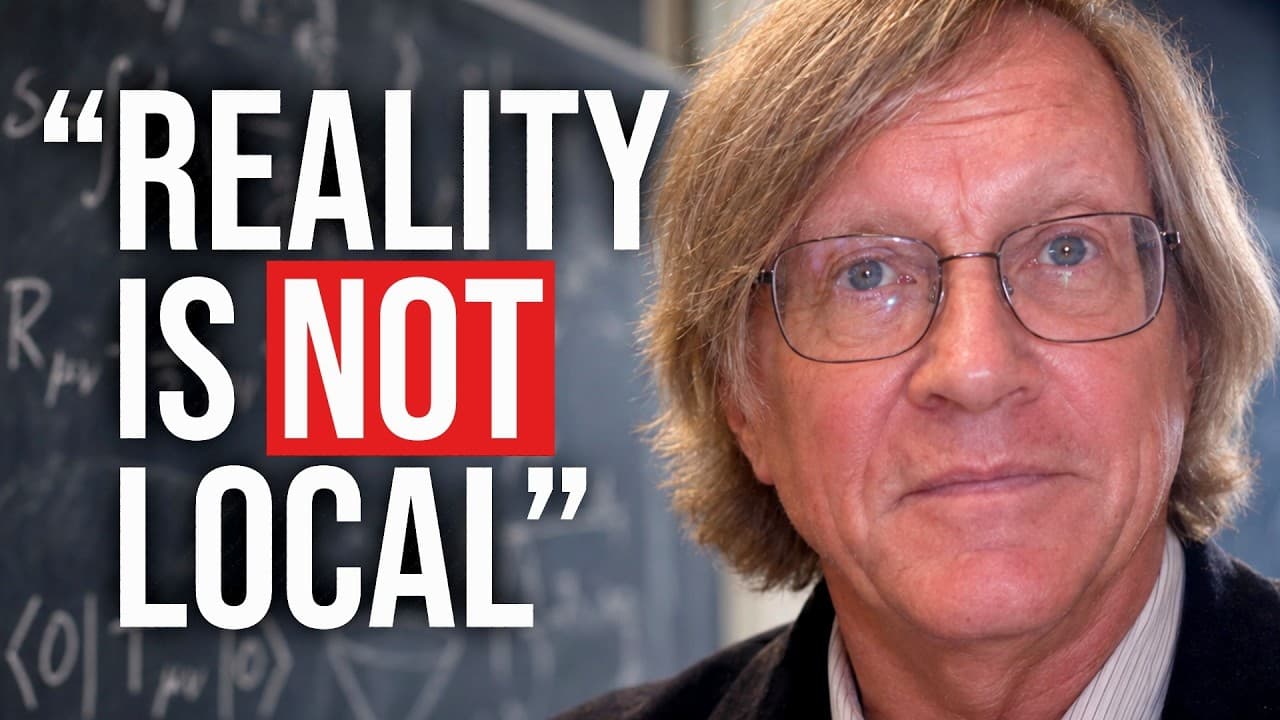
TL;DR
Bell's theorem shows that no local hidden variable theory can reproduce the predictions of quantum mechanics. By analyzing EPR correlations and locality, it demonstrates that a theory must abandon locality or determinism to match quantum statistics. The discussion also traces how Bell's result extends from Einstein, Podolsky, and Rosen to Bohm and beyond.
Transcript
Tim: Most of what you hear about quantum mechanics is wrong. The subjectivity, the thing about observation, even the indeterminism, none of that is forced on you. All this talk about how in quantum mechanics, the observer can’t be left out. You’ve heard it a million times. No. This is so outrageous. Curt: This is Tim Maudlin, professor o... Read More
Key Insights
- Bell's theorem states that any theory preserving locality cannot reproduce all quantum statistics observed in experiments. This positions locality as a central constraint in reconciling quantum predictions with intuitive realism.
- The EPR argument introduces a criterion of physical reality based on predictability without disturbing the system, which becomes a benchmark for testing the completeness of quantum descriptions.
- Einstein objected to spooky action at a distance because it threatens relativistic locality; the concern is not about indeterminism but the instantaneous influence across space.
- The transcript explains that perfect correlations in EPR setups provide a testing ground for locality and determinism, guiding the logical deduction that a local theory cannot match quantum outcomes.
- Bohm's reframing of the EPR scenario via particle spin helps formulate Bell's inequality, turning abstract locality questions into measurable predictions.
- Bell's theorem does not rely on a priori determinism; instead it derives limits on local theories from empirical predictions, showing how non local correlations arise in quantum mechanics.
- The discussion emphasizes that Bell's argument targets locality as the core issue and uses freedom of measurement choices to avoid hidden bias in testing locality.
- The text mentions the GHZ experiment as a fully deterministic variant of the same locality challenge, reinforcing the non locality conclusion across different experimental setups.
- More videos from this channel:
- More from this channel: Curt Jaimungal
Install to Summarize YouTube Videos and Get Transcripts
Explore YouTube Video Summarizer or Get YouTube Transcript Extractor
Questions & Answers
Q: A real search query question about the video (e.g. 'How to...', 'What is...', 'Why does...', 'When should...'). Question 1
Bell's theorem is presented as a fundamental result showing that local realism cannot reproduce quantum statistics, which means any theory that insists on locality must give up predictability or determinism in the quantum realm. The answer is that experiments testing Bell inequalities reveal correlations that no local theory can explain, thereby supporting non locality in quantum mechanics.
Q: What is the EPR criterion of reality and how does it relate to locality
The EPR criterion of reality says that if you can predict the outcome of a measurement with certainty without disturbing the system, then that quantity has a real counterpart in the physical theory. This criterion is used to argue about completeness and locality, because if locality were true, certain predictions would force a deterministic, local description that quantum mechanics seemingly violates.
Q: Why did Einstein object to spooky action at a distance
Einstein objected to spooky action at a distance because it implied instantaneous effects across space, which would conflict with special relativity, where no absolute simultaneity exists and no instantaneous influence can be defined. He was worried about the fundamental structure of cause and effect rather than about indeterminism itself.
Q: How does the lecture relate to Bohm's reformulation of EPR
The lecture traces how David Bohm reframed the EPR argument using particle spin, which makes the theorem more amenable to experimental testing. This reframing facilitates Bell's 1964 proof by presenting clear, testable correlations while preserving the essential critique of locality and the challenge to classical deterministic intuitions.
Q: What role do perfect correlations play in Bell-type arguments
Perfect correlations provide a scenario where the outcome in one laboratory can perfectly predict the outcome in another only under certain locality assumptions. These correlations are used to argue that a locally realistic theory cannot reproduce quantum predictions, thereby forcing a non local description to align with experimental data.
Q: Do the conclusions depend on determinism
No, the conclusions about locality do not depend on assuming determinism. Bell's reasoning uses locality and the observed quantum statistics to show that any local theory cannot account for those statistics. Determinism follows as a derived consequence under a locality assumption, not as a starting point.
Q: What is the GHZ experiment mentioned in the transcript
The GHZ experiment is cited as a cleaner, fully deterministic version of the same locality challenge. It extends the locality argument to a three-particle entangled system, providing a more definitive demonstration of non locality without relying on certain probabilistic assumptions, thus reinforcing the main conclusion across different experimental setups.
Q: What is the main takeaway about locality from this discussion
The main takeaway is that locality, when combined with realistic predictions of measurement outcomes, cannot reproduce the statistics of quantum mechanics. This implies that quantum non locality is a fundamental feature of nature, as opposed to a loophole or artifact of a particular interpretation.
Summary & Key Takeaways
-
Bell's theorem rules out local hidden variables while remaining compatible with quantum statistics in many experiments, highlighting a fundamental non locality in nature.
-
The lecture traces the EPR critique of completeness and explains how locality leads to determinism under certain assumptions, ultimately conflicting with quantum predictions.
-
The discussion culminates with historical context including Bohm's reformulation and the GHZ experiment as a determinant version of the same proof.
Read in Other Languages (beta)
Share This Summary 📚
Summarize YouTube Videos and Get Video Transcripts with 1-Click
Try YouTube Summary with ChatGPT & Claude or YouTube Transcript Generator
Explore More Summaries from Curt Jaimungal 📚




Summarize YouTube Videos and Get Video Transcripts with 1-Click
Try YouTube Summary with ChatGPT & Claude or YouTube Transcript Generator