How Does Space-Time Emerge From Quantum Entanglement?
TL;DR
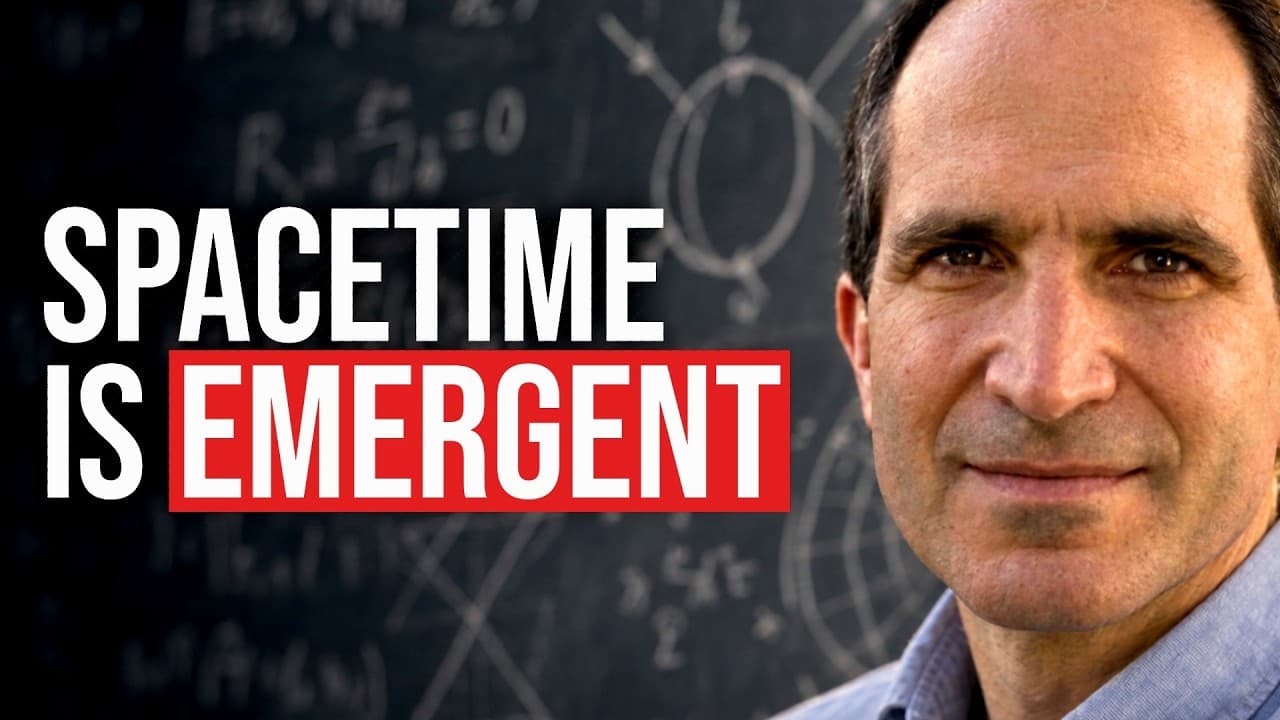
Space-time may emerge from deeper quantum degrees of freedom tied to the boundary of space-time. The discussion centers on how geometry can be a manifestation of entanglement and why a conventional outside observer cannot describe space-time fully. The conversation also explores limits of general relativity, attempts at a fuller quantum theory, and the role of entropy in black hole physics.
Transcript
Wormholes are a bit like leaky pipes. Not everything is fitting together. The singularity is not a place inside the black hole, it's a place in the future. I think it's common, maybe not to feel good, to feel that maybe you're not good enough, but well, eventually you'll make your contributions. Professor Juan Maldacena has spent 30 years ... Read More
Key Insights
- Space-time is treated as an emergence from more fundamental boundary degrees of freedom rather than a fixed backdrop.
- The boundary or distant region of space-time can encode interior information, suggesting a holographic perspective.
- Entanglement is proposed as a potential origin for geometric structure, linking quantum information to space-time fabric.
- General relativity and quantum mechanics conflict due to variable space-time geometry and the lack of a defined external observer.
- Black hole entropy involves both horizon area and quantum corrections from Hawking radiation, leading to a finite description.
- The island formula and related ideas offer a way to reconcile entropy calculations without infinities.
- ER equals EPR connects quantum entanglement with space-time connections like wormholes, implying geometry can reflect quantum correlations.
- Traversable wormhole physics and simulations with qubits illustrate how quantum information experiments can model space-time features.
- More videos from this channel:
- More from this channel: Curt Jaimungal
Install to Summarize YouTube Videos and Get Transcripts
Explore YouTube Video Summarizer or Get YouTube Transcript Extractor
Questions & Answers
Q: How does the idea that space-time emerges from boundary degrees of freedom change our view of physics?
The concept reframes space-time as something that can arise from more fundamental quantum degrees of freedom located on the boundary of space-time. It shifts the focus from asking what space-time is made of to how entanglement and information on the boundary can give rise to the interior geometry we experience. This perspective aims to unify gravity with quantum mechanics by treating geometry as an emergent property rather than a basic substrate.
Q: What is meant by ER equals EPR in this discussion?
ER equals EPR is proposed as a link between quantum entanglement and spacetime connections such as wormholes. The idea suggests that entangled quantum states correspond to geometric connections inside space-time, meaning that entanglement could manifest as wormhole-like structures. This provides a pathway to understanding how quantum information and geometry intertwine at a fundamental level.
Q: Why is the singularity described as a name for what we do not understand rather than a place inside a black hole?
The speaker argues that the singularity is not a physical point inside the black hole but a placeholder for current gaps in our understanding. It marks where our theories fail to describe the physics, motivating the development of a better theory of quantum gravity. This view emphasizes epistemic limits rather than a literal location.
Q: What role does entropy play in the discussion of black holes, and how is it refined?
Black hole entropy traditionally relates to the horizon area, but quantum corrections from Hawking radiation complicate the picture. The discussion highlights that a finite and consistent description can be achieved by combining area contributions with quantum corrections without infinities. This refined entropy captures how matter interacts with a black hole within a quantum framework.
Q: How does the boundary viewpoint relate to the interior of space-time according to Maldacena?
The boundary viewpoint posits that the interior geometry and dynamics of space-time are encoded in the boundary degrees of freedom. By treating the boundary as the primary arena, one can describe what happens inside space-time through holographic relations. This aligns with the idea that exterior observers cannot access space-time entirely without considering boundary information.
Q: What are the main obstacles when trying to merge general relativity with quantum theory as discussed?
The difficulties include the variable geometry of space-time in general relativity, the problem of ordering events in a dynamic space-time, and the issue that observers inside the universe cannot be external to the system. These conceptual differences, along with technical infinities that arise in calculations, complicate a unified theory.
Q: How do quasi-experimental ideas like simulating wormholes with qubits contribute to the field?
Simulating wormholes with qubits translates abstract space-time concepts into controllable quantum systems. These experiments provide a testbed for understanding how quantum information propagates in curved space-time-like settings, offering insights into how entanglement relates to geometric connections. While not a full theory, they help illuminate how holographic principles might operate in practice.
Q: What mindset does the physicist advocate for students and researchers entering this field?
The physicist emphasizes perseverance, continual learning, and honest exploration of tough questions. He encourages studying hard, maintaining curiosity, and not giving up in the face of difficult problems. This mindset supports progress in understanding how space-time, quantum mechanics, and gravity may be reconciled through emergent concepts and innovative ideas.
Summary & Key Takeaways
-
The talk argues that space-time might be an emergent phenomenon arising from boundary quantum degrees of freedom, rather than a fundamental backdrop.
-
It discusses how entanglement could encode geometric information and how this perspective challenges traditional views of space and time.
-
The episode highlights current progress and remaining questions in merging gravity with quantum mechanics, including the role of entropy and holography in black hole physics.
Read in Other Languages (beta)
Share This Summary 📚
Summarize YouTube Videos and Get Video Transcripts with 1-Click
Try YouTube Summary with ChatGPT & Claude or YouTube Transcript Generator
Explore More Summaries from Curt Jaimungal 📚
Summarize YouTube Videos and Get Video Transcripts with 1-Click
Try YouTube Summary with ChatGPT & Claude or YouTube Transcript Generator