What Does Gödel's Incompleteness Theorem Prove?
TL;DR
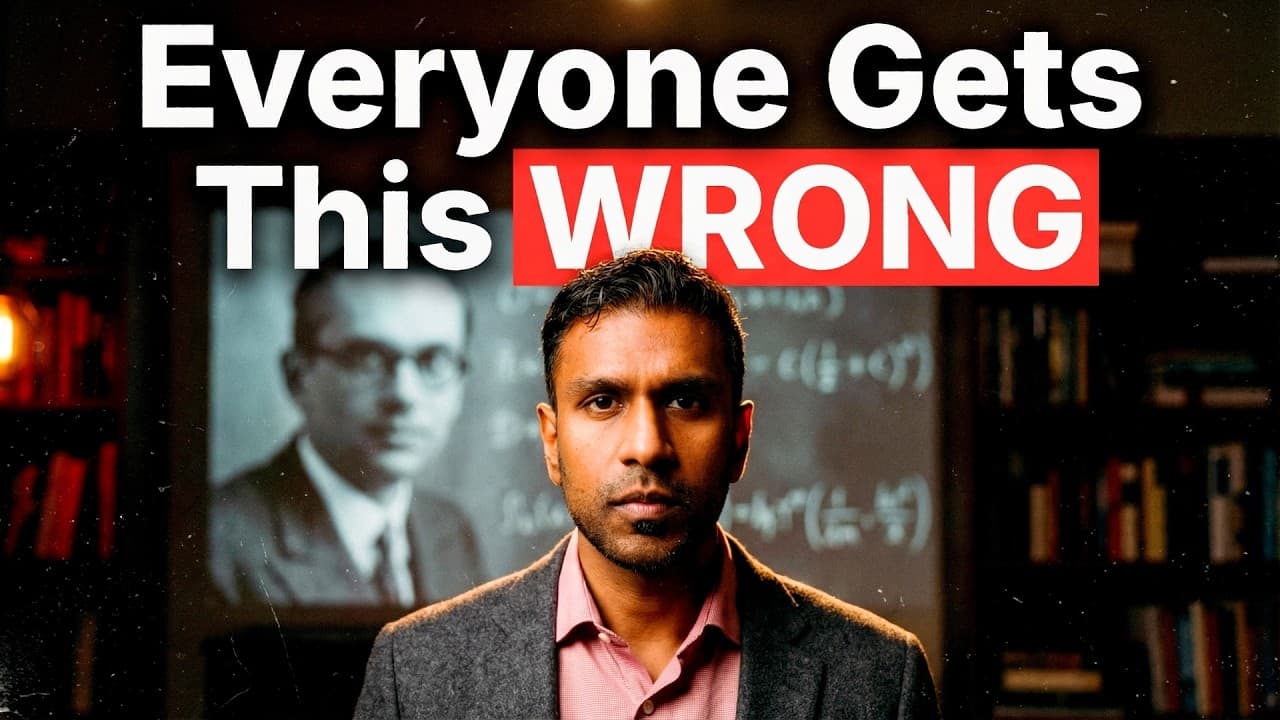
Gödel's incompleteness theorem limits particular formal systems, not human knowledge as a whole. Any consistent, mechanically checkable axiomatization of arithmetic contains statements that it can neither prove nor disprove, but people can adopt stronger axioms, move between systems, use informal reasoning, and draw on empirical observation.
Transcript
Many popularizers who use Gödel's incompleteness theorem to make bold claims about fundamental limits of human knowledge have made a category error. Neil deGrasse Tyson: "Gödel, he concluded that at some point in mathematics, you just have to make something up!" Deepak Chopra: "Gödel's theorem shows the limitations of almost every theory ... Read More
Key Insights
- Gödel's incompleteness theorem is about axiomatization rather than epistemology. It identifies limitations within qualifying formal systems, while epistemology examines the nature, sources, and limits of knowledge more generally, so conclusions in one domain do not automatically transfer to the other.
- The first incompleteness theorem applies to any consistent recursive axiomatization of arithmetic. If a formal system avoids contradictions and its proofs can be mechanically checked, some arithmetic statements expressible inside it can be neither proved nor disproved within that same system.
- The limitation established by incompleteness belongs to a particular proof verifier. A person can step outside that system, strengthen its axioms, or adopt another formal framework, although Gödel's machinery can then identify undecidable statements for the expanded system as well.
- Human knowledge is not presented as a single fixed formal system. People also rely on informal reasoning, intuition, empirical observation, higher-order logics, and new axioms, which prevents Gödel's technical result from directly establishing a universal ceiling on human understanding.
- Axioms are not necessarily arbitrary claims invented without justification. The transcript argues that established mathematical knowledge helps determine whether an axiomatic system is fitting, meaning axioms can be assessed through their consequences rather than treated as unsupported foundations for all knowledge.
- Finite memory, processing speed, and lifespan already prevent people from comprehending or completing some mathematical tasks. These practical human limitations exist independently of Gödel's theorem and should not be confused with the theorem's proof-theoretic limits on recursively axiomatized systems.
- Gödel's theorem does not establish claims about consciousness, dualism, non-dualism, God, or multiverses. None of those subjects appears in the proof, so using incompleteness as unrestricted support for metaphysical conclusions extends the result beyond its stated mathematical domain.
- Physics is model-based, empirical, and provisional rather than obviously a Gödel-style formal system. Incompleteness places no stated barrier on how effectively equations can model observations, so it does not by itself rule out a physical theory of everything.
- More videos from this channel:
- More from this channel: Curt Jaimungal
Install to Summarize YouTube Videos and Get Transcripts
Explore YouTube Video Summarizer or Get YouTube Transcript Extractor
Questions & Answers
Q: What does Gödel's first incompleteness theorem actually prove?
Gödel's first incompleteness theorem proves that any consistent, recursively axiomatized formal system capable of expressing arithmetic is incomplete. Some arithmetic statements can be formulated within that system but cannot be proved or disproved using the system itself. The result therefore establishes a technical limit on each qualifying formal proof system, not a general limit on every form of human knowledge.
Q: Why does Gödel's theorem not prove that human knowledge is fundamentally limited?
Gödel's theorem applies to consistent, mechanically checkable axiomatizations of arithmetic, while human knowledge is not shown to be one fixed formal system. People can use intuition, informal reasoning, empirical observation, higher-order logics, new axioms, and different formal systems. Consequently, a limit on what one proof verifier can establish does not automatically become a limit on everything humans can know.
Q: What does recursively axiomatized mean in Gödel's theorem?
A recursively axiomatized system is presented in the transcript as a formal system whose relevant operations and proofs can be mechanically checked. This requirement matters because Gödel's result is not aimed at every conceivable theory or method of reasoning. It concerns concrete formal machinery with checkable rules, enough expressive strength for arithmetic, and consistency, meaning that it does not prove contradictions.
Q: Can adding new axioms overcome Gödel incompleteness?
Adding or strengthening axioms can push the boundary beyond statements that were undecidable in the original system. A person can zoom out and adopt a more powerful framework instead of remaining confined to one proof verifier. However, the transcript says Gödel's machinery can generate undecidable arithmetic statements for any new system that still satisfies the relevant conditions, so no single qualifying system becomes complete through this process.
Q: Does Gödel's theorem mean mathematical axioms are simply made up?
Gödel's theorem does not establish the need to invent arbitrary axioms. Axioms are already a prerequisite of the formal deductive systems being analyzed, rather than Gödel's central discovery. The transcript also argues that mathematicians judge axiomatic systems using previously established mathematical knowledge and their consequences. On that account, selecting axioms is not equivalent to making unsupported claims without standards or justification.
Q: Does incompleteness rule out a theory of everything in physics?
Incompleteness does not by itself rule out a physical theory of everything because the theorem concerns proof-theoretic closure in recursively axiomatized arithmetic systems. Physics is described as empirical, model-based, and provisional, and a physical theory could involve stochastic, continuous, or algorithmically infinite features. Gödel's proof therefore places no stated prior barrier on how successfully equations might model empirical observations.
Q: Does Gödel's theorem support claims about consciousness or metaphysics?
Gödel's theorem does not directly support claims about consciousness, mind-matter dualism, non-dualism, God, or multiverses. Its proof addresses formal systems and arithmetic statements, and none of those metaphysical subjects forms part of the theorem. The transcript characterizes attempts to import such conclusions as a category error that moves from an internal mathematical gap to claims in a different domain without justification.
Q: What is the difference between mathematical truth and formal proof?
Formal proof is what can be derived using the axioms and rules inside a specified system. Mathematical truth can outrun that internal proof capacity because a consistent, recursively axiomatized system of arithmetic contains statements that are true but unprovable within it, along with negations that are also unprovable there. The distinction is system-relative and does not automatically define knowledge or capital-T truth in every context.
Summary & Key Takeaways
-
Gödel's first incompleteness theorem concerns consistent, recursively axiomatized formal systems capable of expressing arithmetic. Within every such system, some expressible arithmetic statements cannot be proved or disproved. The result establishes a ceiling for each particular proof verifier, rather than an unrestricted boundary on everything that human beings can know with certainty.
-
Popular interpretations often transform a precise result about formal proof into a sweeping claim about knowledge, consciousness, metaphysics, or physics. The transcript argues that this is a category error because humans generate knowledge through multiple methods, including intuition, informal reasoning, empirical observation, new axioms, and movement between different formal systems.
-
The theorem does not say that axioms are arbitrary inventions, that physics cannot produce a theory of everything, or that consciousness escapes formal explanation. Its actual lesson is narrower: truth outruns proof inside qualifying mathematical systems. Careful attention to consistency, mechanical checkability, arithmetic, formal syntax, and proof is therefore essential.
Read in Other Languages (beta)
Share This Summary 📚
Summarize YouTube Videos and Get Video Transcripts with 1-Click
Try YouTube Summary with ChatGPT & Claude or YouTube Transcript Generator
Explore More Summaries from Curt Jaimungal 📚
Summarize YouTube Videos and Get Video Transcripts with 1-Click
Try YouTube Summary with ChatGPT & Claude or YouTube Transcript Generator