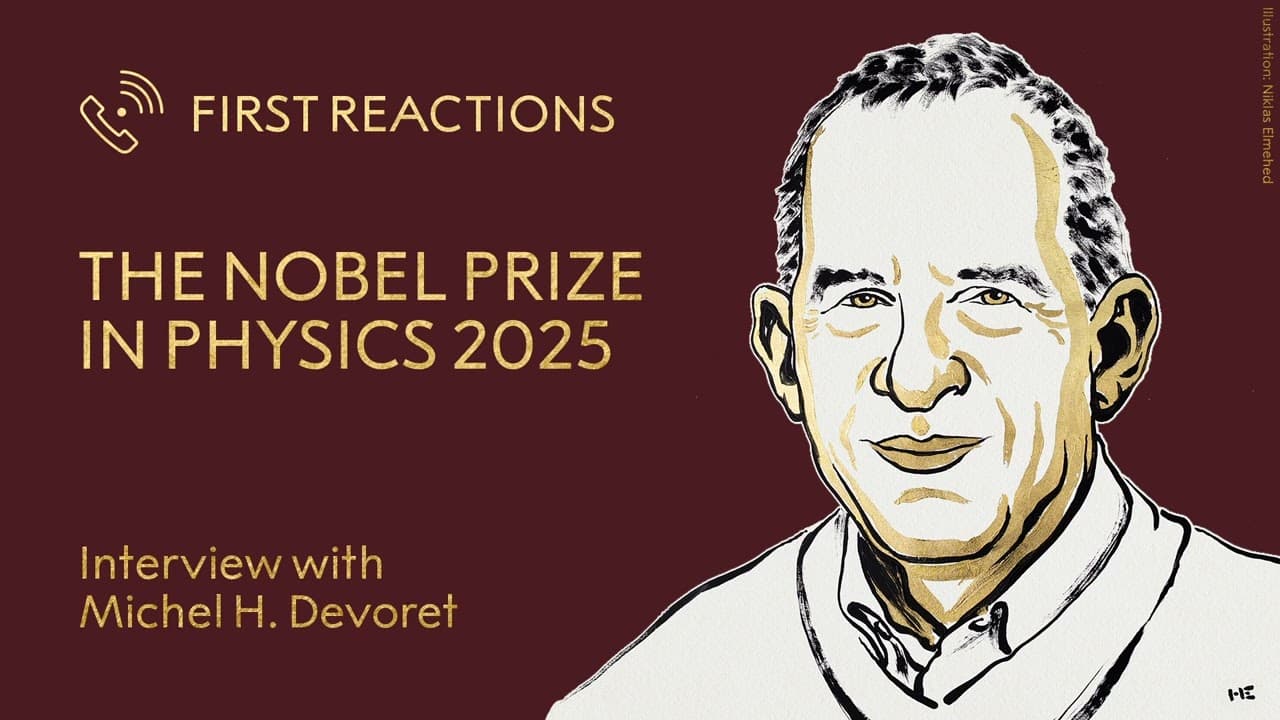
What were Michel Devoret's first reactions after Nobel Prize win?
TL;DR
Michel Devoret woke on the Nobel Prize news and initially thought it was a joke, then confirmed it with his Paris-based daughter. He recalls fond memories of Berkeley years, discusses the west coast environment and his current role at Google Quantum AI, and emphasizes the value of combining fundamental research with practical applications.
Transcript
Yes. Hello. Hello. This is Adam Smith calling from the website of the Nobel Prize. Am I speaking to Michelle Deere? Yes. Uh, unfortunately, there's a conflict. There is a organization with Nobelprize.org. And I That's me. There was maybe a confusion. No, that's me. That's I'm I'm the one calling from Nobelprize.org. There's been a little confusion.... Read More
Key Insights
- Devoret woke up to Nobel Prize news and initially doubted its truth.
- He confirmed the news by calling his daughter who is in Paris.
- Memories from the 82 to 84 Berkeley period highlight collaboration and open discussion.
- The west coast environment is described as productive, adventurous, and well suited for scientific work.
- Google Quantum AI is the current platform where he explores quantum superconducting circuits.
- Quantum error correction is identified as essential for scaling quantum computers.
- He believes in combining fundamental research with practical applications, inspired by mentors.
- Lord Kelvin is cited as an example of linking fundamental science with large-scale industry.
- More videos from this channel:
- More from this channel: Nobel Prize
Install to Summarize YouTube Videos and Get Transcripts
Explore YouTube Video Summarizer or Get YouTube Transcript Extractor
Questions & Answers
Q: How did Devoret first learn about the Nobel Prize announcement and react?
Devoret woke up to many notifications on the day of the prize announcement and initially thought it was a joke. He had to verify the news by contacting his daughter, who lives in Paris, nine hours ahead, to confirm that the Nobel Prize was indeed awarded. This moment illustrates the surprise and surreal nature of rapidly receiving such news.
Q: Who did Devoret mention as role models or predecessors in his discussion of science and application?
Devoret references John Clarke as a role model who conducted both fundamental research and applied work, such as squids for sensing devices, illustrating the value of blending fundamental science with practical applications. He also mentions Lord Kelvin as an historic figure who linked thermodynamics and electromagnetism to industrial application.
Q: What memory does Devoret share about his Berkeley years and collaboration?
He recalls working in a lab in Berkeley during 82 to 84, describing it as a time of freedom to mull over experiments and meaning, with an exchange of ideas among colleagues. He emphasizes fond memories of a collaborative environment that fostered big questions in physics.
Q: How does Devoret describe the West Coast scientific environment?
Devoret describes the West Coast as highly productive and adventurous, noting that it fosters experimentation and collaboration. He uses the description of America of America and the double sense of American character to illustrate a conducive environment for pursuing grand scientific challenges.
Q: What is Devoret’s perspective on the transition from fundamental discovery to applications?
Devoret believes that a fundamental discovery truly becomes meaningful when it can be applied to something concrete. He highlights the importance of translating theoretical insights into real-world technologies, and cites colleagues who successfully bridged fundamental research with practical developments.
Q: What role does Google Quantum AI play in Devoret’s work?
Devoret explains that Google Quantum AI provides a platform for developing quantum superconducting circuits aimed at quantum computation and error correction. He emphasizes that the ability to work on scalable quantum systems at Google aligns with the goal of turning foundational physics into useful computational tools.
Q: What does Devoret say about mentoring and communicating science to students?
Devoret notes that the disruption of current work is balanced by the opportunity to speak to young students and give back by communicating science clearly. He values scientists who can explain their work in simple terms, making complex ideas accessible and inspiring the next generation.
Q: What analogy does Devoret use to illustrate the continuum from science to industry?
Devoret references Lord Kelvin, a founder in thermodynamics, who connected fundamental science with the creation of a transatlantic telegraph line, illustrating how scientific discovery can lead to large-scale industrial applications. This analogy reinforces the link between basic research and societal impact.
Summary & Key Takeaways
-
Devoret describes waking up to news of the Nobel Prize and thinking it might be a joke, then verifying it with his daughter in Paris.
-
He fondly recalls the Berkeley lab years and the free exchange of ideas with Clarke and Martinez.
-
He emphasizes that fundamental discoveries become real when they can be applied, and he values scientists who bridge basic and applied research.
Read in Other Languages (beta)
Share This Summary 📚
Summarize YouTube Videos and Get Video Transcripts with 1-Click
Try YouTube Summary with ChatGPT & Claude or YouTube Transcript Generator
Explore More Summaries from Nobel Prize 📚

Summarize YouTube Videos and Get Video Transcripts with 1-Click
Try YouTube Summary with ChatGPT & Claude or YouTube Transcript Generator