The Nobel Prize Award Ceremony 2014
TL;DR
At the 2014 Nobel Prize Award Ceremony, laureates in physics, chemistry, medicine, literature, and economics received recognition for contributions benefiting humanity. Held at the Stockholm Concert Hall on 10 December 2014, the event particularly celebrated Isamu Akasaki, Hiroshi Amano, and Shuji Nakamura for inventing efficient blue LEDs that enabled energy-saving white light. Read on for the winners, scientific breakthroughs, and ideas emphasized during the ceremony.
Transcript
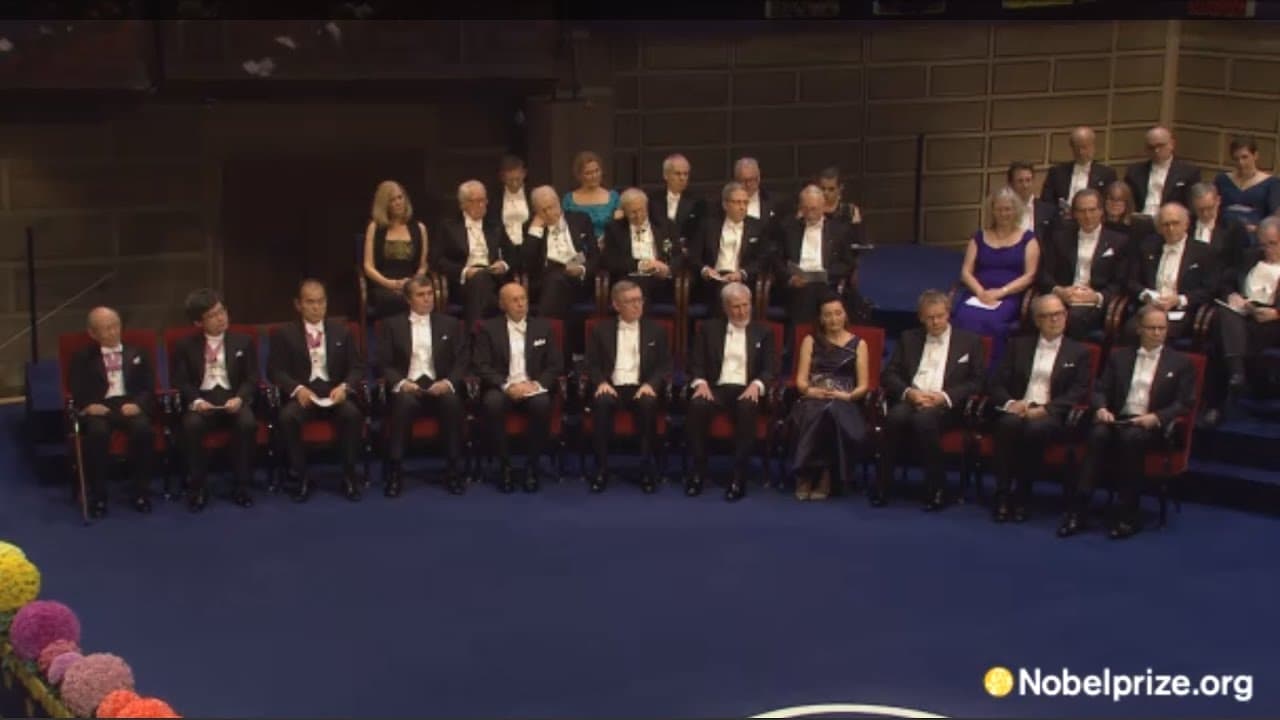
the and first we will have a speech by Professor Carl Henrik Helen the chairman of the board of the Nobel Foundation before that speech of course uh the laurat entrance the laurates that take the seats on the stage first in line we have the physics laurates isamu akasaki Hiroshi Amano and shuji Nakamura followed by chemic laats Eric big Stefan hell... Read More
Key Insights
- The 2014 Nobel Prize in Physics was awarded to Isamu Akasaki, Hiroshi Amano, and Shuji Nakamura for inventing efficient blue light-emitting diodes, which enabled bright and energy-saving white light sources used in phones, cars, and homes.
- White light requires blue LEDs because mixing red, green, and blue light produces white. Red and green LEDs existed for decades, but the missing blue diode made practical white LED lighting impossible until the 1990s.
- The breakthrough depended on growing gallium nitride crystals, which had defeated earlier researchers whose crystals turned into powder. A new crystal-growing technique developed in the early 1970s eventually opened the path to success.
- Akasaki worked with his PhD student Amano at Nagoya University in Japan, while Nakamura was a researcher at a small company in Tokushima. All succeeded in the late 1980s after years of persistent effort where others had given up.
- LED lamps have an approximate lifetime of 100,000 hours, or about 11 years, and are efficient enough to run for many hours on a battery that can be charged using sunlight, bringing light to places with no power grid.
- The Nobel Peace Prize was awarded the same day in Oslo to Kailash Satyarthi and Malala Yousafzai for their fight for children's rights, described as a prize for the fundamental right to education and a safe childhood.
- Carl Henrik Heldin, chairman of the Nobel Foundation board, argued that scientific breakthroughs require freedom, a long-term perspective, and long-term funding, noting that harder work tends to produce more of the luck scientists rely on.
- The Nobel Foundation runs outreach including museums in Stockholm and Oslo displaying the work of 889 Nobel laureates, interdisciplinary meetings in Sweden, and a planned Nobel Center in Stockholm for public and scientific activities.
Install to Summarize YouTube Videos and Get Transcripts
Explore YouTube Video Summarizer or Get YouTube Transcript Extractor
Questions & Answers
Q: What happened at the 2014 Nobel Prize Award Ceremony?
Laureates in physics, chemistry, medicine, literature, and economics were honored for outstanding contributions to science and literature. The ceremony took place at the Stockholm Concert Hall in Sweden on 10 December 2014, with members of the Swedish royal family attending. Nobel Foundation chairman Carl Henrik Heldin welcomed the laureates and discussed education, scientific freedom, and long-term research funding.
Q: Who won the 2014 Nobel Prize in Physics and why?
Isamu Akasaki, Hiroshi Amano, and Shuji Nakamura received the 2014 Nobel Prize in Physics for inventing efficient blue light-emitting diodes. Their work enabled bright, energy-saving white light sources used in phones, cars, and homes.
Q: Why was the blue LED essential for producing white light?
White light can be created by combining red, green, and blue light. Red and green LEDs had existed for decades, but practical white LED lighting remained impossible without an efficient blue diode. The breakthrough therefore completed the set of colors needed for white light.
Q: How did the researchers succeed in creating efficient blue LEDs?
The breakthrough depended on producing suitable gallium nitride crystals, which earlier researchers had struggled to grow successfully. A new crystal-growing technique developed in the early 1970s opened a path forward. Akasaki and his PhD student Amano at Nagoya University, along with Nakamura at a small company in Tokushima, succeeded in the late 1980s after years of persistent experimentation.
Q: What benefits do LED lamps provide?
LED lamps convert electricity directly into light and use less energy than incandescent bulbs, which produce light by heating a filament. An LED lamp has an approximate lifetime of 100,000 hours, or about 11 years. Its efficiency also allows it to shine for many hours using a battery charged with sunlight, including in places without a power grid.
Q: Who received the 2014 Nobel Peace Prize?
Kailash Satyarthi and Malala Yousafzai received the Nobel Peace Prize in Oslo earlier that day for their fight for children's rights. Carl Henrik Heldin described the award as recognizing the fundamental right to education and a safe childhood regardless of religion, gender, or ethnicity.
Q: What did Carl Henrik Heldin say scientific breakthroughs require?
Heldin said breakthroughs arise from inspired and hard work, sometimes requiring researchers to challenge accepted truths or overcome skeptical environments. He argued that scientists need freedom, a long-term perspective, and long-term funding to undertake ambitious projects without guaranteed success. He also observed that the harder successful scientists work, the more luck they seem to have.
Q: What outreach activities did the Nobel Foundation describe?
The Foundation operated museums in Stockholm and Oslo displaying the work of 889 Nobel laureates and shared their stories through digital channels. It had also organized interdisciplinary meetings in Sweden for the previous three years on the genetic revolution, energy, and aging. A planned Nobel Center in Stockholm was intended to host public activities, scientific meetings, and events.
Summary
This video is of the Nobel Prize Awards Ceremony, where laureates from various fields are honored for their contributions. The chairman of the Nobel Foundation emphasizes the importance of education and research in solving global challenges. Then, the laureates from physics, chemistry, medicine, literature, and economics are presented with their awards. Professor Cole Henrik Heldin, the chairman of the board of the Nobel Foundation, highlights the significance of the laureates' work and encourages them to continue making important scientific discoveries. The video concludes with musical performances and the Swedish national anthem.
Questions & Answers
Q: What did Professor Cole Henrik Heldin emphasize in his speech?
Professor Cole Henrik Heldin emphasized the importance of education and research in tackling global challenges. He stated that education should be accessible to all and that scientists need freedom, a long-term perspective, and sufficient funding to make scientific breakthroughs.
Q: Why are the Nobel Prizes awarded?
The Nobel Prizes are awarded to individuals who have made outstanding contributions in their respective fields. Alfred Nobel's vision was to reward those who have conferred the greatest benefit on mankind. The achievements of the laureates have already benefited or will likely benefit mankind in significant ways.
Q: What achievements were recognized in the Physics category?
The achievements of Isamu Akasaki, Hiroshi Amano, and Shuji Nakamura in the field of Physics were recognized. They were awarded for their invention of efficient blue light-emitting diodes (LEDs) that enable bright and energy-saving white light sources. These LEDs have far-reaching applications, such as in lighting up places without electricity.
Q: Explain the significance of the invention of blue LEDs.
The invention of blue LEDs by Isamu Akasaki, Hiroshi Amano, and Shuji Nakamura is significant because it allows for the production of white light sources that are energy-efficient and have a long lifetime. These LEDs can operate for many hours using minimal energy, making them environmentally friendly and suitable for areas with limited access to electricity.
Q: What was the contribution of Eric Betzig, Stefan Hell, and William Moerner in the field of Chemistry?
Eric Betzig, Stefan Hell, and William Moerner were awarded the Nobel Prize in Chemistry for their development of super-resolution fluorescence microscopy. This technology allows researchers to visualize essential details and movements of molecules in living cells with extraordinary precision. Their work has revolutionized the field of microscopy and has opened up new possibilities for studying biological processes at the molecular level.
Q: How does super-resolution fluorescence microscopy work?
Super-resolution fluorescence microscopy works by labeling molecules in cells with fluorescent markers and then using specific techniques to overcome the diffraction limit, which was long considered a fundamental barrier in optical microscopy. By cleverly activating and localizing specific fluorescent molecules, researchers can create precise images and obtain detailed information about the structures and movements of molecules within living cells.
Q: What did John O'Keefe, May-Britt Moser, and Edvard Moser discover in the field of Medicine?
John O'Keefe, May-Britt Moser, and Edvard Moser made groundbreaking discoveries related to the brain's positioning system. They discovered special nerve cells called place cells in the hippocampus that are active only when an animal is in a specific location in its environment. They also discovered grid cells in the entorhinal cortex that create a coordinate system, allowing animals to navigate and keep track of their position. Their work has provided profound insights into how the brain creates awareness of space and has important implications for understanding memory and navigation.
Q: How do place cells and grid cells contribute to the brain's positioning system?
Place cells, discovered by John O'Keefe, are specialized nerve cells in the hippocampus that are active when an animal is in a specific location in its environment. By creating an inner map of the environment, these cells contribute to the brain's ability to recognize familiar and unfamiliar places. Grid cells, discovered by May-Britt Moser and Edvard Moser, are located in the entorhinal cortex and form a coordinate system by generating a grid pattern of activity. Together with place cells, this grid-like activity helps animals navigate their environment and keep track of their position.
Q: What was the main theme of Patrick Modiano's literature work?
Patrick Modiano's literature work explores the art of memory and the destinies of human beings trying to find their way in their surroundings. His writing often delves into the history of the occupation in France, particularly during World War II. Modiano's novels integrate elements of autobiography, fiction, and historical research, creating a unique narrative style that evokes the complexities of memory and human experiences.
Q: How did Patrick Modiano's work challenge the perception of the occupation period in France?
Patrick Modiano's work, particularly his earlier novels, challenged the prevailing perception of the occupation period in France by presenting a different view. While the occupation was synonymous with the legends of the resistance, Modiano's exploration delved into the contradictions and complexities of that time. His novels uncovered the cruel farce associated with the occupation, portraying it as a disturbing reality rather than a heroic struggle. His writings anticipated the revaluation of the Vichy period by historians and provided a unique perspective on that era.
Q: What was the contribution of Jean Tirole in the field of Economics?
Jean Tirole's contributions in the field of Economics focus on understanding behavior in markets with a few players and how regulation can be implemented to promote the best interests of society. He has used game theory to analyze decision-making in markets, the role of regulators, and the need to balance various objectives. Tirole's work has helped shed light on how regulations should be designed to address different industries' peculiarities, such as natural monopolies or industries like banking and telecommunications. His research advocates for responsible behavior by powerful companies and regulators.
Takeaways
The Nobel Prize Awards Ceremony celebrated the outstanding contributions of laureates in the fields of physics, chemistry, medicine, literature, and economics. These achievements have brought significant advances, such as efficient LED lighting, super-resolution microscopy, understanding brain positioning systems, exploring complex historical narratives, and developing economic theories for responsible market behavior and regulation. The laureates' work highlights the importance of education, research, and the pursuit of knowledge for the benefit of society. These awards serve as a reminder of the impact that dedicated individuals can make in shaping our world.
Summary & Key Takeaways
-
The 2014 Nobel Prize Award Ceremony was held at the Stockholm Concert Hall in Sweden on 10 December 2014. Laureates in physics, chemistry, medicine, literature, and economics took their seats on stage, with members of the Swedish royal family in attendance for the formal presentation of prizes.
-
Foundation chairman Carl Henrik Heldin welcomed the laureates and reflected on Alfred Nobel's vision that those who confer the greatest benefit on mankind should be rewarded. He stressed the importance of education, research funding, and scientific freedom, and noted the Peace Prize awarded in Oslo to Satyarthi and Malala.
-
The Physics prize honored Akasaki, Amano, and Nakamura for the blue LED. The presentation traced lighting history from mastering fire and Edison's light bulb to LEDs, explaining how gallium nitride crystals and persistent experimentation finally produced efficient, long-lasting, energy-saving white light.
Read in Other Languages (beta)
Share This Summary 📚
Summarize YouTube Videos and Get Video Transcripts with 1-Click
Try YouTube Summary with ChatGPT & Claude or YouTube Transcript Generator
Explore More Summaries from Nobel Prize 📚

Summarize YouTube Videos and Get Video Transcripts with 1-Click
Try YouTube Summary with ChatGPT & Claude or YouTube Transcript Generator