Nobel Minds 2019
TL;DR
Nobel laureates turn research into impact by defending evidence-based decisions, testing practical interventions, working with governments, and communicating science publicly. The Nobel Minds 2019 discussion highlights randomized trials that influenced free preventive health programs, lithium batteries for energy sustainability, and Esther Duflo’s role as the second woman to receive the economics prize. Read on for specific examples of research shaping policy, representation, and public debate.
Transcript
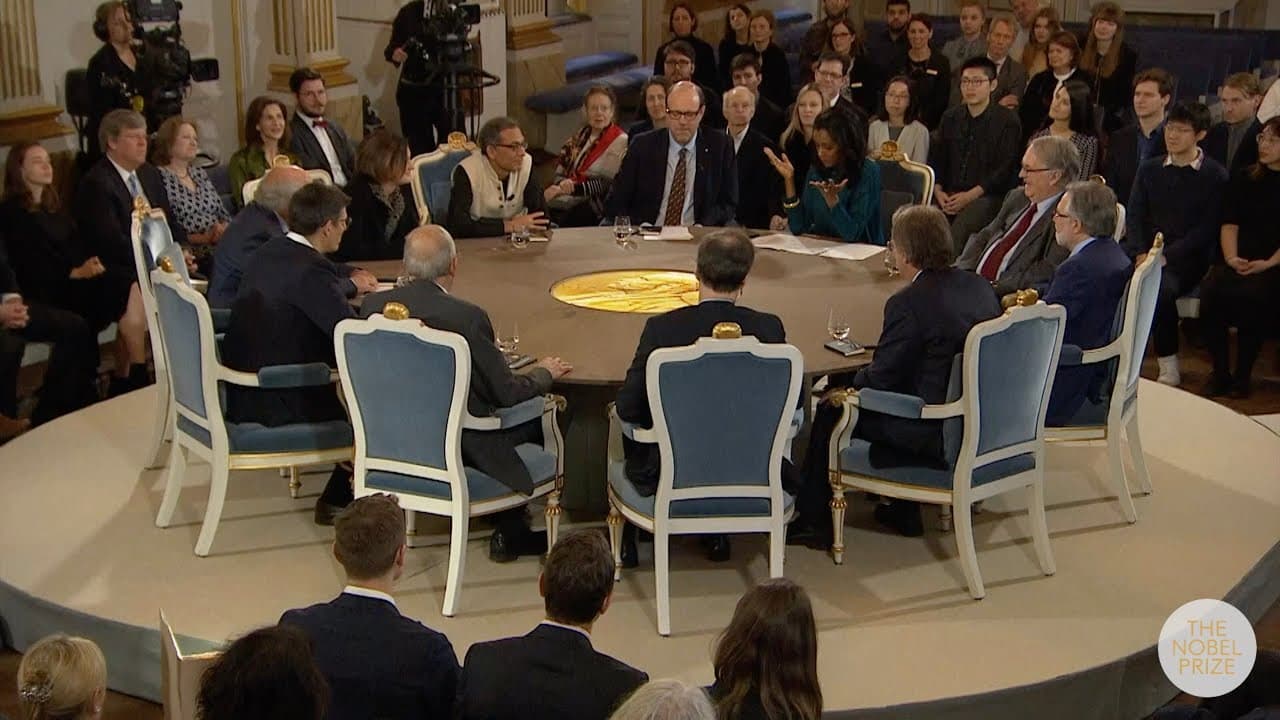
welcome to the old Stock Exchange Building in Stockholm which now houses the Swedish Academy the Nobel Prize museum and library and this is where we have brought together this year's Nobel Prize laureates for the first time in discussion on TV we'll be hearing about their groundbreaking contributions to economics and science work that has been judg... Read More
Key Insights
- Science is presented as both intellectually rewarding and socially useful. The laureates describe research as fun, beautiful, and driven by curiosity, while also emphasizing their responsibility to communicate knowledge, influence public decisions, and apply discoveries to problems affecting people around the world.
- Nobel recognition is a platform for defending facts and expertise. Gregg Semenza and William Kaelin argue that science should guide important societal decisions, especially when truth, knowledge, and expert judgment face public resistance or when people selectively accept convenient claims about climate change.
- Representation is limited in economics and the sciences. Esther Duflo hopes her visibility as the second woman and youngest recipient of the economics prize can encourage more women and members of underrepresented groups to enter economics, science, and related fields.
- Mobile phones create opportunities to distribute useful information widely. Michael Kremer says big data and machine learning can help tailor messages to individual needs, while cooperation with governments and private firms can improve how important information reaches people in different parts of the world.
- Lithium batteries can contribute to energy sustainability and responses to global warming. Stanley Whittingham wants to use the prize to communicate the urgency of these issues and encourage action when some political voices dismiss or minimize their importance.
- Curiosity is a foundation for scientific discovery. James Peebles urges people to remain curious, observe what surrounds them, and pay attention to evidence, even while recognizing that practical responsibilities such as earning a living also shape individual choices.
- Randomized controlled trials make poverty interventions testable. The economics laureates divide broad problems into smaller questions, evaluate proposed solutions, and identify approaches that improve outcomes, including remedial tutoring in Indian schools and subsidies for preventive health care.
- Small fees can sharply reduce participation in preventive health programs. Kremer reports that charging even a small amount lowered demand for clean water or deworming medicine, while free provision influenced governments and organizations to expand mosquito-net and school-based deworming programs.
Install to Summarize YouTube Videos and Get Transcripts
Explore YouTube Video Summarizer or Get YouTube Transcript Extractor
Questions & Answers
Q: How can Nobel laureates use their public platform?
They can explain why science matters, defend facts and expertise, and encourage decisions based on reliable evidence. The Nobel Minds 2019 participants also discuss inspiring underrepresented groups, promoting energy sustainability, improving information delivery, and working with governments and private organizations.
Q: How do randomized controlled trials help fight poverty?
Randomized controlled trials divide broad poverty problems into smaller questions that researchers can test. The economics laureates cite applications including remedial tutoring in Indian schools, preventive health subsidies, clean-water provision, and deworming programs for children in rural Kenya.
Q: Why can free preventive health care increase participation?
Michael Kremer says charging even a very small fee caused a tremendous decline in the use of preventive measures such as clean water or deworming medicine. Providing these measures free removes that barrier and challenged organizations that believed charging something was important.
Q: What practical effects followed the deworming research?
The findings helped shift policy toward providing preventive health measures without charge. National governments and the World Bank changed their approaches, while Kenya and India established national school-based programs whose decisions resulted in 150 million children being dewormed.
Q: Why do the laureates argue that facts matter in politics?
Gregg Semenza says science and scientists should play an important role in societal decision-making. William Kaelin warns that truth, knowledge, and expertise are under assault, pointing to climate change debates in which people select convenient facts or pseudo-facts instead of following data.
Q: How can mobile technology deliver useful information?
Michael Kremer says the spread of mobile phones creates opportunities to reach people around the world with needed information. He proposes using big data and machine learning to tailor messages and collaborating with governments and private firms to improve delivery.
Q: How can Nobel recognition improve representation in science and economics?
Esther Duflo says relatively few women participate in science and even fewer in economics, with minorities also underrepresented. As the second woman and youngest recipient of the economics prize, she hopes to serve as a role model for women and other underrepresented people entering these fields.
Q: What motivated the economics laureates to study poverty?
The laureates describe poverty as both morally important and intellectually engaging. Michael Kremer cites his mother’s lessons about responsibility, Esther Duflo recalls her mother helping children affected by war, and Abhijit Banerjee describes growing up beside a Kolkata slum.
Summary
This video features Nobel Prize laureates in economics, medicine, physiology, chemistry, and physics discussing their groundbreaking contributions and the importance of their work. They discuss topics such as poverty alleviation, climate change, and the possibility of extraterrestrial life.
Questions & Answers
Q: Are the laureates enjoying the attention after winning the Nobel Prize?
The laureates express mixed feelings about the attention, with some finding it overwhelming while others embrace it as an opportunity to showcase their work and inspire others.
Q: How do the economics laureates plan to use their platform to address poverty?
The economists aim to use their platform to promote evidence-based policies and interventions to alleviate poverty. They emphasize the importance of conducting rigorous experiments and challenging common assumptions in order to find effective solutions.
Q: How have the medicine and physiology laureates made advancements in the field?
The laureates have made significant contributions in understanding the molecular mechanisms that regulate genes in response to varying levels of oxygen. Their work has paved the way for new strategies in fighting diseases such as anemia and cancer.
Q: Do the chemistry laureates believe there is potential for renewable energy storage?
The chemistry laureates discuss the potential of lithium-ion batteries to store renewable energy, reducing reliance on fossil fuels. They believe that these batteries can contribute to addressing climate change and transitioning to a sustainable energy future.
Q: What are the physics laureates' views on the existence of extraterrestrial life?
The physics laureates acknowledge that the existence of extraterrestrial life is still unknown. While they discuss the possibility of microbial life on other planets, they emphasize that further exploration and research are needed to understand the origins and conditions for life elsewhere in the universe.
Takeaways
The laureates highlight the importance of science in addressing global challenges such as poverty, climate change, and the search for extraterrestrial life. They stress the need for evidence-based approaches, rigorous experimentation, collaboration, and public engagement. They also emphasize the urgency of addressing current issues such as providing basic necessities and protecting the environment. Additionally, they reflect on the continued pursuit of knowledge and the impact of their work in advancing human understanding and improving lives.
Summary & Key Takeaways
-
The 2019 Nobel laureates discuss how recognition gives them a public platform and creates new responsibilities. Several intend to defend science, truth, expertise, and evidence-based decisions. Others emphasize inspiring women and underrepresented groups, communicating the beauty of science, addressing climate change, and encouraging sustained curiosity about the world.
-
The economics laureates describe an experimental approach to global poverty that breaks large problems into specific, testable questions. Randomized controlled trials can reveal which interventions work in education and preventive health. Their research challenged policies that charged small fees and helped support free deworming medicine, mosquito nets, and related programs.
-
The laureates connect their research interests to moral responsibility, intellectual excitement, family influence, and personal experience. Their discussion shows how scientific achievement can extend beyond laboratories and universities through government cooperation, public communication, practical implementation, stronger representation, and advocacy for decisions based on reliable data, knowledge, and observed results.
Read in Other Languages (beta)
Share This Summary 📚
Summarize YouTube Videos and Get Video Transcripts with 1-Click
Try YouTube Summary with ChatGPT & Claude or YouTube Transcript Generator
Explore More Summaries from Nobel Prize 📚
Summarize YouTube Videos and Get Video Transcripts with 1-Click
Try YouTube Summary with ChatGPT & Claude or YouTube Transcript Generator