How Does YouTube Detect and Remove AI Slop?
TL;DR
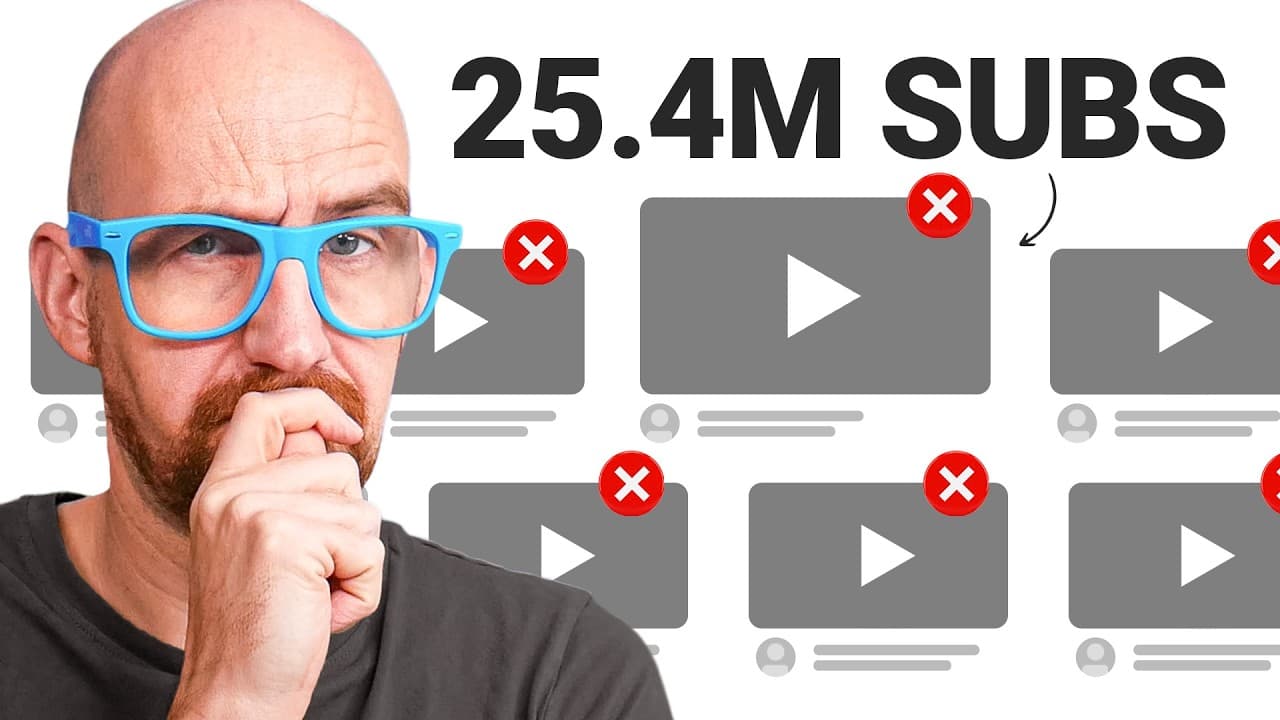
YouTube reportedly removed 130,000 channels after identifying 50,000 connected clusters producing synthetic content at scale. The system targets coordinated networks through shared behavior, upload patterns, and infrastructure, but its errors can harm legitimate creators, as shown when a major human-run animation channel was reportedly misclassified and its distribution declined.
Transcript
All right, let's start with the good news first and give YouTube their flowers on this one for a job well done. YouTube's purge of AI slop channels is getting pretty serious and pretty intensive. Over a 100,000 channels wiped out in the last 6 months alone, which means that my very own It's an AI dog life channel is well and truly doomed. >> Sorry,... Read More
Key Insights
- YouTube's reported enforcement identified 50,000 clusters and removed 130,000 individual channels associated with large-scale synthetic content production. The presenter interprets the affected material as potentially representing millions of videos removed from the platform.
- The cluster detection system works by finding connections among channels rather than judging every creator in isolation. It analyzes shared behavior, upload patterns, and infrastructure to identify coordinated networks that appear to produce or distribute synthetic content at industrial scale.
- The enforcement described in the research is aimed primarily at organized content farms, not necessarily individual creators trying their first AI-assisted, faceless, or automated channel. Its cluster-based design focuses on coordinated abuse involving groups of related channels.
- The reported overturn rate is below 1%, but that percentage still represents potentially hundreds of mistaken terminations when applied to 130,000 removed channels. A small statistical error rate can therefore create serious disruption for legitimate creators.
- Kurzgesagt reported that its click-through rates increased, watch time improved, and viewers responded positively while overall views fell to their lowest level since 2013. YouTube reportedly confirmed that automated tools had wrongly categorized its human-made animation as AI slop.
- YouTube's response to detected AI slop may include reducing a channel's distribution, according to the presenter’s interpretation of Kurzgesagt's account and his own AI dog channel experiment. The transcript raises the possibility of an effective shadowban but does not establish that term as YouTube's official policy.
- The presenter's AI dog Shorts initially received a few thousand views across roughly 20 uploads before later videos received zero views. He considered the decline deserved because the videos were generated from single prompts in about two minutes and likely dissatisfied viewers.
- Direct access to YouTube support creates an important difference in correcting detection errors. Kurzgesagt could contact YouTube and receive confirmation and assistance, while smaller creators without established contacts may struggle to learn whether automated classification contributed to declining distribution.
- More videos from this channel:
- More from this channel: vidIQ
Install to Summarize YouTube Videos and Get Transcripts
Explore YouTube Video Summarizer or Get YouTube Transcript Extractor
Questions & Answers
Q: How does YouTube detect coordinated AI slop channels?
The system described in the transcript looks for groups of connected channels producing synthetic content at scale. It analyzes shared behavior, upload patterns, and infrastructure, then identifies clusters that appear to be coordinating media abuse. This approach allows the platform to terminate entire related groups rather than reviewing only one channel or video at a time.
Q: How many AI slop channels did YouTube reportedly remove?
The research discussed in the transcript reportedly identified 50,000 clusters and removed 130,000 individual channels from a major online video platform believed by the presenter and his cited source to be YouTube. Because each channel may contain multiple uploads, the presenter says the action could represent millions of videos considered AI slop being removed.
Q: Does YouTube's AI slop system target individual creators?
The system described is primarily designed to detect coordinated groups producing synthetic content at industrial scale. According to the presenter, it is not mainly about individual creators experimenting with their first AI-assisted, faceless, or fully automated channel. It instead uses connections among channels, including common behavior, upload patterns, and infrastructure, to identify organized content farms.
Q: How often does YouTube's channel detection make mistakes?
The transcript says the overturn or repeal rate is below 1%, referring to terminated creators who successfully appealed because the original decision was incorrect. Although that rate appears low, applying it across 130,000 removed channels can still mean hundreds of legitimate channels were affected. The presenter also argues that platform scale makes some mistakes inevitable.
Q: Why did Kurzgesagt's YouTube views reportedly decline?
Kurzgesagt said its views reached their worst level since 2013 even though click-through rates were higher, watch time was longer, and viewers were responding positively. After the channel contacted YouTube, YouTube reportedly confirmed that automatic AI detection tools had wrongly interpreted its human-made animation as AI slop, causing the platform to restrict the channel's distribution.
Q: Does YouTube shadowban channels classified as AI slop?
The transcript does not confirm shadowbanning as an official YouTube policy. The presenter infers that AI-slop classification may function like a shadowban because Kurzgesagt said its channel was being choked after misclassification, while his own low-effort AI dog Shorts abruptly stopped receiving views. He presents this as a possibility created by connecting those observations, not as a formally established rule.
Q: What happened to the presenter's AI dog YouTube channel?
The presenter's AI dog channel initially received a few thousand views on its Shorts across roughly 20 uploads. Distribution then stopped abruptly, with later videos receiving zero views. He considered the outcome justified because each video came from a single prompt, took about two minutes to generate, and likely caused viewers to swipe away because they were dissatisfied or frustrated.
Q: Why are false AI slop classifications a concern for smaller creators?
Large, influential channels may have direct contacts who can investigate and correct an automated classification error. Kurzgesagt reportedly used those contacts to obtain confirmation from YouTube and assistance with the problem. Smaller channels may lack that access, leaving them unable to determine whether falling views reflect AI detection, audience behavior, cultural trends, or another platform-level cause.
Summary & Key Takeaways
-
Google researchers describe a scalable cluster termination system designed to detect coordinated networks producing synthetic content. Instead of focusing only on individual uploads, it examines relationships among channels, including shared behavior, upload patterns, and infrastructure. The system reportedly identified 50,000 clusters and removed 130,000 channels from a major video platform.
-
The reported appeal overturn rate is below 1%, suggesting that most channel terminations remained in place. However, applying even a low error rate across 130,000 removals can affect hundreds of legitimate channels. The platform's enormous scale, including at least 20 million daily video uploads, makes imperfect enforcement especially consequential.
-
Kurzgesagt, a human-run animation channel with 25 million subscribers and more than 3.5 billion views, reported its weakest views since 2013 despite stronger click-through rates, longer watch time, and favorable viewer responses. YouTube reportedly confirmed that automated detection had mistaken its videos for AI slop and then addressed the apparent bug.
Read in Other Languages (beta)
Share This Summary 📚
Summarize YouTube Videos and Get Video Transcripts with 1-Click
Try YouTube Summary with ChatGPT & Claude or YouTube Transcript Generator
Explore More Summaries from vidIQ 📚



Summarize YouTube Videos and Get Video Transcripts with 1-Click
Try YouTube Summary with ChatGPT & Claude or YouTube Transcript Generator