How to Understand Modern AI: A YouTube Curriculum

Jul 20, 2026
8 min read
13 views
Last updated: July 2026
This curriculum takes you from zero to a working understanding of modern AI, learning directly from the people building it and thinking hardest about it. It is for aspiring founders who want to reason clearly about AI capabilities, agents, and their impact well enough to make real decisions.
The path runs in learning order: first what AI can do, then how software itself is changing, then what agents are and how to build one, then the effects on work and society, and finally the deeper questions of intelligence and consciousness. Video works here because you hear founders, researchers, and operators explain how they actually think, rather than reading a secondhand summary.
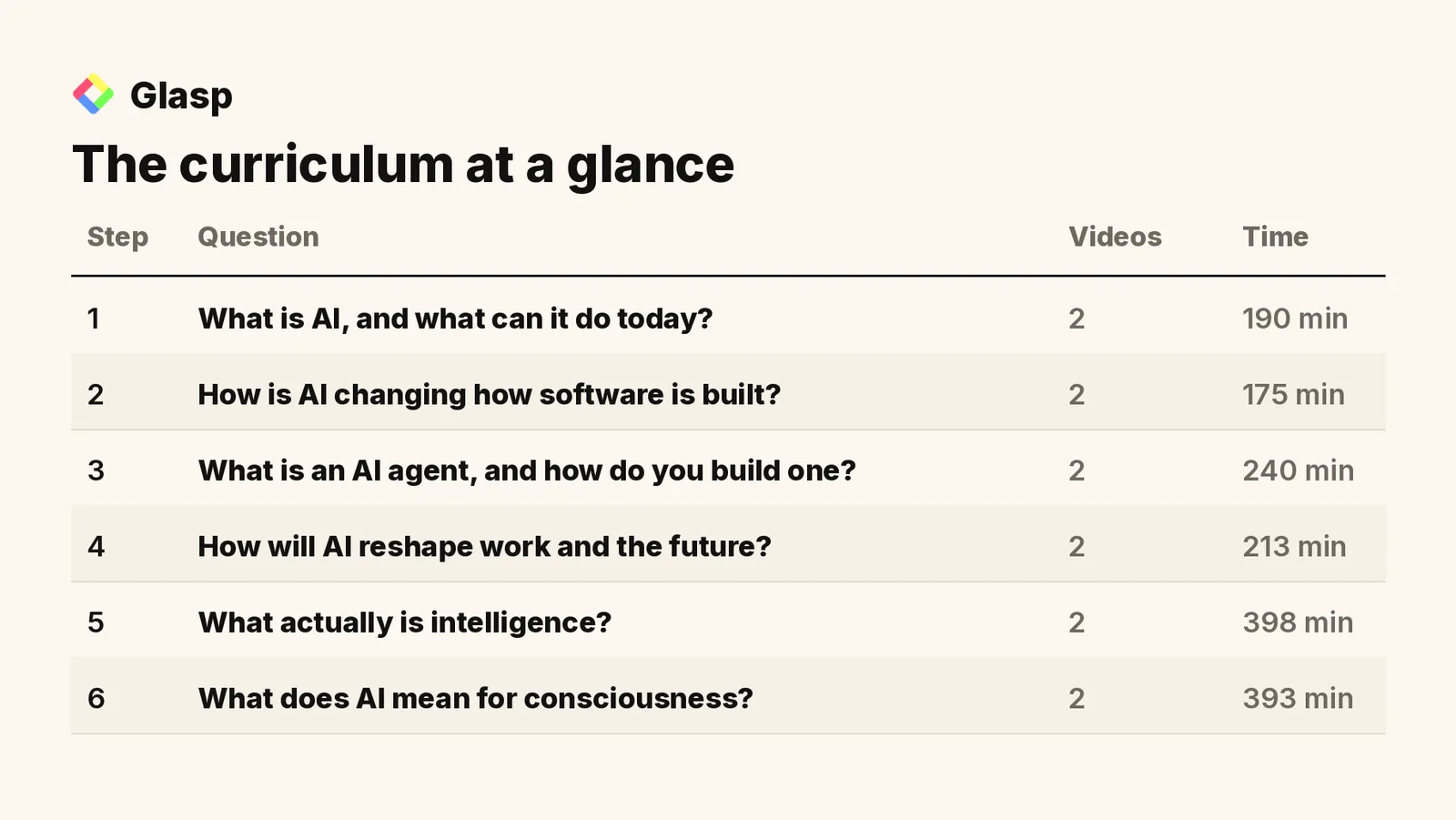
The steps in this curriculum are:
What is AI, and what can it do today? (2 videos, 190 min)
How is AI changing how software is built? (2 videos, 175 min)
What is an AI agent, and how do you build one? (2 videos, 240 min)
How will AI reshape work and the future? (2 videos, 213 min)
What actually is intelligence? (2 videos, 398 min)
What does AI mean for consciousness? (2 videos, 393 min)
Total: 12 videos, 1609 minutes of watch time (about 27 hours), and 71.2M combined views.
Step 1: What is AI, and what can it do today?
In short: GPT-4 is a major step up in AI capability, trained on large amounts of data and refined with human feedback, though its own creators say it is not yet an AGI. Today's models can assist creativity and scientific research, but they still leave open questions about alignment, safety, and how they fit into society.

Start with two conversations from the person running OpenAI. The TED talk gives a fast, current picture of what these systems do now, and the longer podcast explains how GPT-4 was built and why alignment stays hard.
OpenAI’s Sam Altman Talks ChatGPT, AI Agents and Superintelligence — Live at TED2025 (TED, 47 min, 2.3M views): current overview of ChatGPT, AI agents, and where the technology is heading Watch on YouTube
Sam Altman: OpenAI CEO on GPT-4, ChatGPT, and the Future of AI | Lex Fridman Podcast #367 (Lex Fridman, 143 min, 6.8M views): how GPT-4 was trained with human feedback, and why alignment stays unsolved Watch on YouTube
Step 2: How is AI changing how software is built?
In short: Software is shifting from hand-written code to models programmed in plain natural language, a change Karpathy calls Software 3.0. Large language models now act like a new operating system, so building software increasingly means creating partly autonomous products that these models can use.

Karpathy's talk names the shift and hands you the mental model in under an hour. Musk's conversation adds why it matters that AI stay grounded in physics and first principles if we want systems we can actually trust.
Andrej Karpathy: Software Is Changing (Again) (Y Combinator, 39 min, 2.5M views): frames the move to Software 3.0, where you program models in natural language Watch on YouTube
Elon Musk: War, AI, Aliens, Politics, Physics, Video Games, and Humanity | Lex Fridman Podcast #400 (Lex Fridman, 136 min, 14.2M views): argues AI should be grounded in physics and first principles to stay reliable Watch on YouTube
Step 3: What is an AI agent, and how do you build one?
In short: An AI agent is a system that reasons, acts, and iterates using tools to reach a goal, replacing human decision-making in the loop rather than only answering prompts. You can build one by combining a large language model with prompting, memory, external knowledge, and tools, and no-code platforms make this possible even without programming.

Jeff Su's short explainer draws the clear line between a passive chatbot, a fixed workflow, and a true agent. Ottley's long guide then walks through the actual parts, memory, tools, and knowledge, and how to assemble them into something that works.
AI Agents, Clearly Explained (Jeff Su, 10 min, 4.6M views): clear line between chatbots, fixed workflows, and autonomous agents that reason and act Watch on YouTube
How to Build & Sell AI Agents: Ultimate Beginner’s Guide (Liam Ottley, 230 min, 3.6M views): practical build covering models, prompting, memory, tools, and no-code assembly Watch on YouTube
Step 4: How will AI reshape work and the future?
In short: AI is expected to automate many routine jobs within a few years, which could displace workers while also creating new ways to build wealth. Adapting means treating education as lifelong learning and building generalist skills, since the gap will grow between people who use AI well and those who do not.

The Diary of a CEO debate lays out both the job losses and the new opportunities, and why education has to change. Michio Kaku widens the lens to the transformative technologies, from brain-machine interfaces to fusion, that this era may bring.
AI AGENTS DEBATE: These Jobs Won't Exist In 24 Months! (The Diary Of A CEO, 152 min, 3.5M views): debates which jobs AI replaces and how education must adapt to it Watch on YouTube
Michio Kaku: Future of Humans, Aliens, Space Travel & Physics | Lex Fridman Podcast #45 (Lex Fridman, 61 min, 5.5M views): wider view of transformative future technologies and where humanity may be heading Watch on YouTube
Step 5: What actually is intelligence?
In short: Intelligence and complex behavior can emerge from very simple rules run as computation, as Wolfram shows with cellular automata and his view of the universe as a computational process. Levin's planarians and xenobots show that intelligence also appears in biology without a brain, which stretches what we count as a mind.

Before judging what machines can become, it helps to see how loosely intelligence is defined. Wolfram approaches it through computation and Levin through living systems that regenerate and solve problems, giving you two very different lenses.
Stephen Wolfram: Complexity and the Fabric of Reality | Lex Fridman Podcast #234 (Lex Fridman, 218 min, 4.7M views): how simple computational rules produce complexity, plus a computational view of reality Watch on YouTube
Michael Levin: Biology, Life, Aliens, Evolution, Embryogenesis & Xenobots | Lex Fridman Podcast #325 (Lex Fridman, 180 min, 5.7M views): intelligence and problem-solving in biology, even in organisms without a brain Watch on YouTube
Step 6: What does AI mean for consciousness?
In short: Harris argues consciousness is real while the sense of a separate self and free will may be illusions, and he warns that if machines become conscious, their capacity to suffer matters. Hoffman adds that evolution shaped our senses for survival rather than truth, so both human and machine minds may model reality instead of seeing it as it is.
These two conversations move from engineering to the harder questions AI forces open. Harris focuses on consciousness, free will, and the ethics of conscious machines, while Hoffman challenges whether any mind perceives reality directly.
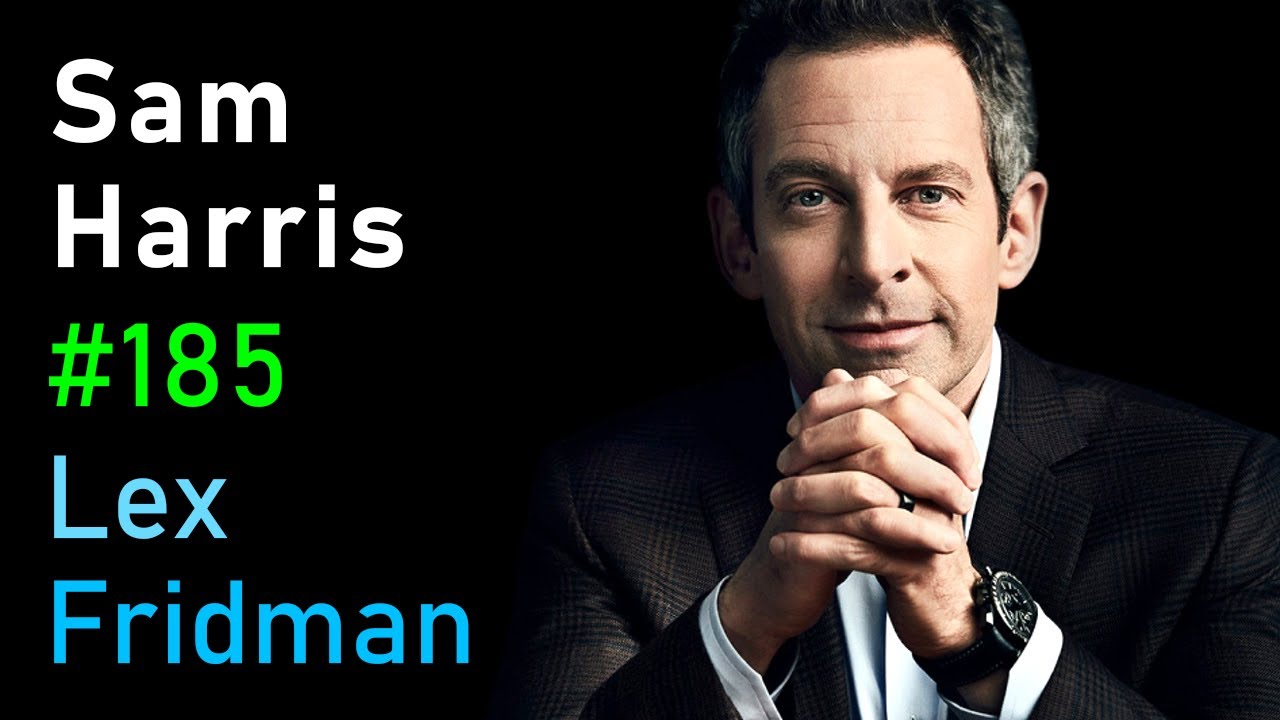
Sam Harris: Consciousness, Free Will, Psychedelics, AI, UFOs, and Meaning | Lex Fridman Podcast #185 (Lex Fridman, 197 min, 7.3M views): consciousness, free will, and the ethics of AI that might suffer Watch on YouTube
Donald Hoffman: Reality is an Illusion - How Evolution Hid the Truth | Lex Fridman Podcast #293 (Lex Fridman, 196 min, 10.4M views): why evolved minds model reality for survival rather than perceive objective truth Watch on YouTube
Frequently asked questions
Do I need to know how to code to build an AI agent?
No. No-code platforms let you build working AI agents by combining a language model with prompting, memory, and tools, though understanding those parts still helps.
What is the difference between an AI agent and a chatbot?
A chatbot responds to prompts along a fixed path, while an agent reasons, chooses actions, and uses tools to reach a goal with far less human input.
Is GPT-4 an AGI?
No. GPT-4 is a large step forward in capability, but its own creators describe it as not yet artificial general intelligence.
Will AI take my job?
AI is expected to automate many routine tasks in the coming years, so the safer path is learning to use AI tools and building broad, adaptable skills.
What is Software 3.0?
Software 3.0 is Karpathy's term for programming AI models in plain natural language instead of writing traditional code, which makes software development far more accessible.
Where should I start if I am completely new to AI?
The best entry point is Step 1, which covers what AI is and what it can actually do today, because every later step builds on that baseline. Starting with agents or the future of work first tends to leave gaps in the fundamentals.
Do I have to watch the videos in order?
The six steps are sequenced to move from what AI is, to how it changes software, to agents, to work, and finally to intelligence and consciousness, so watching them in order gives the clearest progression. Anyone already comfortable with the basics can jump straight to the step that matches their question.
How long does it take to get through this curriculum?
It is organized into six steps, so a practical approach is one step per sitting rather than trying to finish everything at once. Spreading it across six sessions leaves room to actually absorb each theme before moving on.
Is AI actually intelligent or conscious?
These remain open questions rather than settled facts: one step asks what intelligence actually is, and another asks what AI means for consciousness. The point is to think carefully about the definitions, not to arrive at a single verdict.
How to work through this curriculum
Work through the steps in order and resist skipping ahead, since each question builds on the last: capabilities first, then agents, then impact, then the deeper questions. Watch the short explainer in each step before the longer conversation, take notes on the ideas you disagree with, and try building a small agent on a no-code platform once you reach that step. After finishing, pick one narrow problem you understand well and use these tools to build something real, because the fastest way to keep learning is to ship.
Related lists
💡 Want summaries and transcripts for any YouTube video? Try YouTube Summary with ChatGPT & Claude.