What Are AI Agents and How Do They Work?
TL;DR
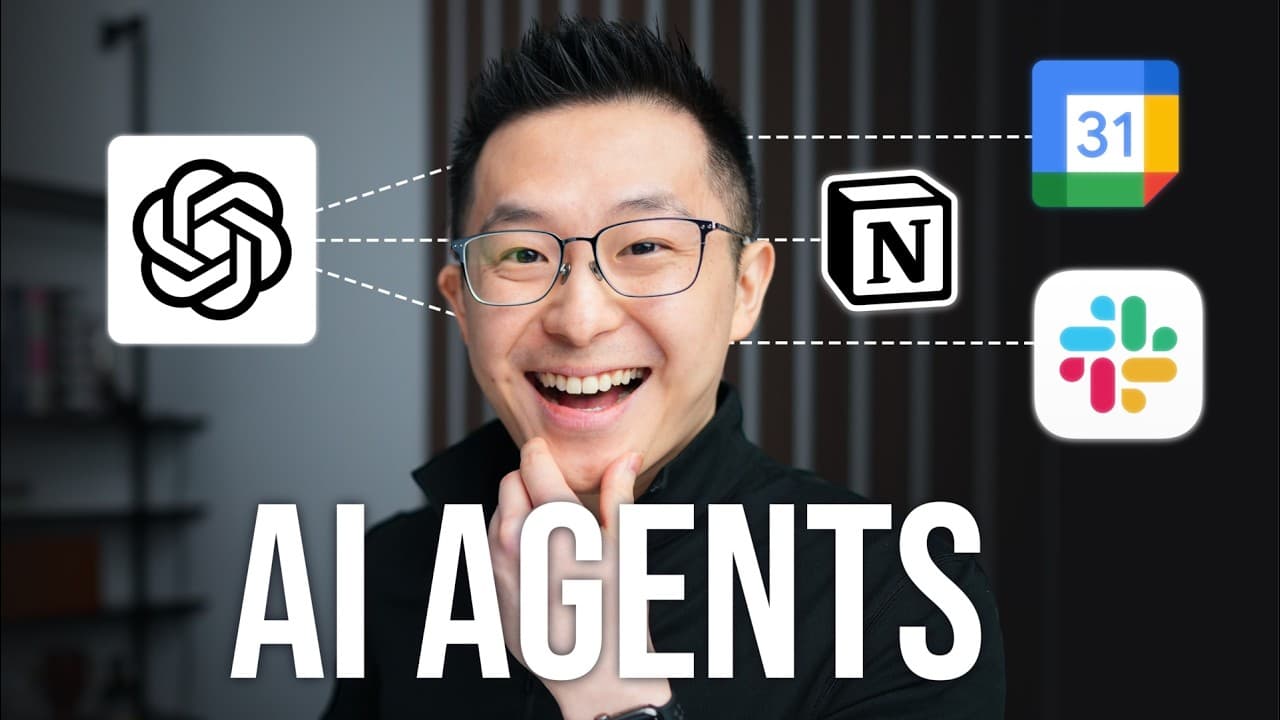
AI agents differ from basic AI workflows by being autonomous decision-makers. They reason, act, and iterate using tools to achieve goals without human intervention. Unlike simple workflows that follow predefined paths, AI agents adapt and optimize their processes, demonstrating a higher level of independence and efficiency.
Transcript
ai ai ai ai ai ai you know more agentic agentic capabilities an AI agent agents agentic workflows agents agents agent agent agent agent agentic all right most explanations of AI agents is either too technical or too basic this video is meant for people like myself you have zero technical background but you use AI tools regularly and you want to lea... Read More
Key Insights
- Large language models (LLMs) like ChatGPT are passive, responding only to user prompts without accessing proprietary data.
- AI workflows follow predefined paths set by humans, limiting their flexibility and requiring human decision-making.
- Retrieval augmented generation (RAG) is a process that allows AI models to look up information before responding.
- AI agents replace human decision-making with LLMs, allowing for autonomous reasoning and action.
- The React framework is common for AI agents, enabling them to reason and act independently.
- AI agents can autonomously iterate, improving outputs without human intervention.
- Real-world examples demonstrate AI agents identifying objects in video footage autonomously.
- AI agents can simplify complex tasks, providing users with straightforward solutions without needing to understand backend processes.
Install to Summarize YouTube Videos and Get Transcripts
Explore YouTube Video Summarizer or Get YouTube Transcript Extractor
Questions & Answers
Q: How do AI agents differ from AI workflows?
AI agents differ from AI workflows in their autonomy. While workflows follow predefined paths set by humans, AI agents replace human decision-making with LLMs. They reason, act, and iterate independently, optimizing processes without manual intervention, thus demonstrating a higher level of flexibility and efficiency.
Q: What is the React framework in AI agents?
The React framework in AI agents refers to their ability to reason and act independently. AI agents use this framework to autonomously determine the best approach to complete tasks, act using tools, and iterate to refine outputs. This framework is crucial for enabling AI agents to function without human intervention.
Q: What role does retrieval augmented generation (RAG) play in AI workflows?
Retrieval augmented generation (RAG) enhances AI workflows by enabling models to look up information before responding. This process allows AI to access external data, such as calendars or weather services, to provide more accurate and contextually relevant responses, thereby improving the workflow's effectiveness.
Q: How do AI agents optimize tasks without human input?
AI agents optimize tasks by autonomously reasoning, acting, and iterating. They use LLMs to determine efficient methods for task completion, act using various tools, and refine outputs through iterative processes. This autonomy allows AI agents to achieve goals without the need for human decision-making or intervention.
Q: What is a real-world example of an AI agent in action?
A real-world example of an AI agent is its use in identifying objects in video footage. The AI agent autonomously reasons what the object looks like, acts by scanning clips to find matches, and iterates to refine its search. This process replaces the need for manual tagging and indexing by humans.
Q: Why are large language models (LLMs) considered passive?
Large language models (LLMs) are considered passive because they only respond to user prompts without initiating actions or accessing proprietary data on their own. They rely on external inputs to generate outputs, lacking the autonomous decision-making capabilities seen in AI agents.
Q: How do AI agents use tools to achieve their goals?
AI agents use tools by integrating various APIs and software to perform tasks. They autonomously select and utilize these tools to gather information, process data, and generate outputs. This tool-based action is part of their reasoning and acting capabilities, enabling them to achieve goals efficiently.
Q: What is the significance of iteration in AI agents?
Iteration in AI agents is significant because it allows them to refine outputs autonomously. By repeatedly evaluating and adjusting their actions, AI agents improve the quality of their results. This iterative process is key to their ability to optimize tasks and achieve goals without human intervention.
Summary & Key Takeaways
-
AI agents operate autonomously, unlike basic AI workflows that require human decision-making. They reason, act, and iterate using tools to achieve goals independently. This autonomy allows AI agents to optimize processes, providing efficient solutions without manual intervention.
-
Understanding AI agents involves recognizing their ability to replace human decision-making with LLMs. They perform reasoning to determine the best approach for tasks, act using tools, and iterate to improve outputs, showcasing a higher level of independence and adaptability.
-
Real-world examples highlight AI agents' capabilities, such as identifying objects in video footage without prior human input. This demonstrates their ability to simplify complex tasks and provide users with easy-to-use solutions, emphasizing their practical applications in everyday scenarios.
Read in Other Languages (beta)
Share This Summary 📚
Summarize YouTube Videos and Get Video Transcripts with 1-Click
Try YouTube Summary with ChatGPT & Claude or YouTube Transcript Generator
Explore More Summaries from Jeff Su 📚





Summarize YouTube Videos and Get Video Transcripts with 1-Click
Try YouTube Summary with ChatGPT & Claude or YouTube Transcript Generator