10 Best Lex Fridman Interviews on AI

Jul 20, 2026
11 min read
38 views
Last updated: July 2026
This is a curated path through Lex Fridman's conversations on artificial intelligence and the deeper question of what intelligence actually is. It is built for founders who want to think clearly about AI systems, minds, and where the technology is heading, not just collect talking points.
The ten interviews run more than 26 hours in total, moving from the current frontier of AI to the biology of intelligence, the nature of consciousness, and the long-term risks. Together they form a canonical set because each guest is a primary source in their field, and the order builds one idea on top of the next.
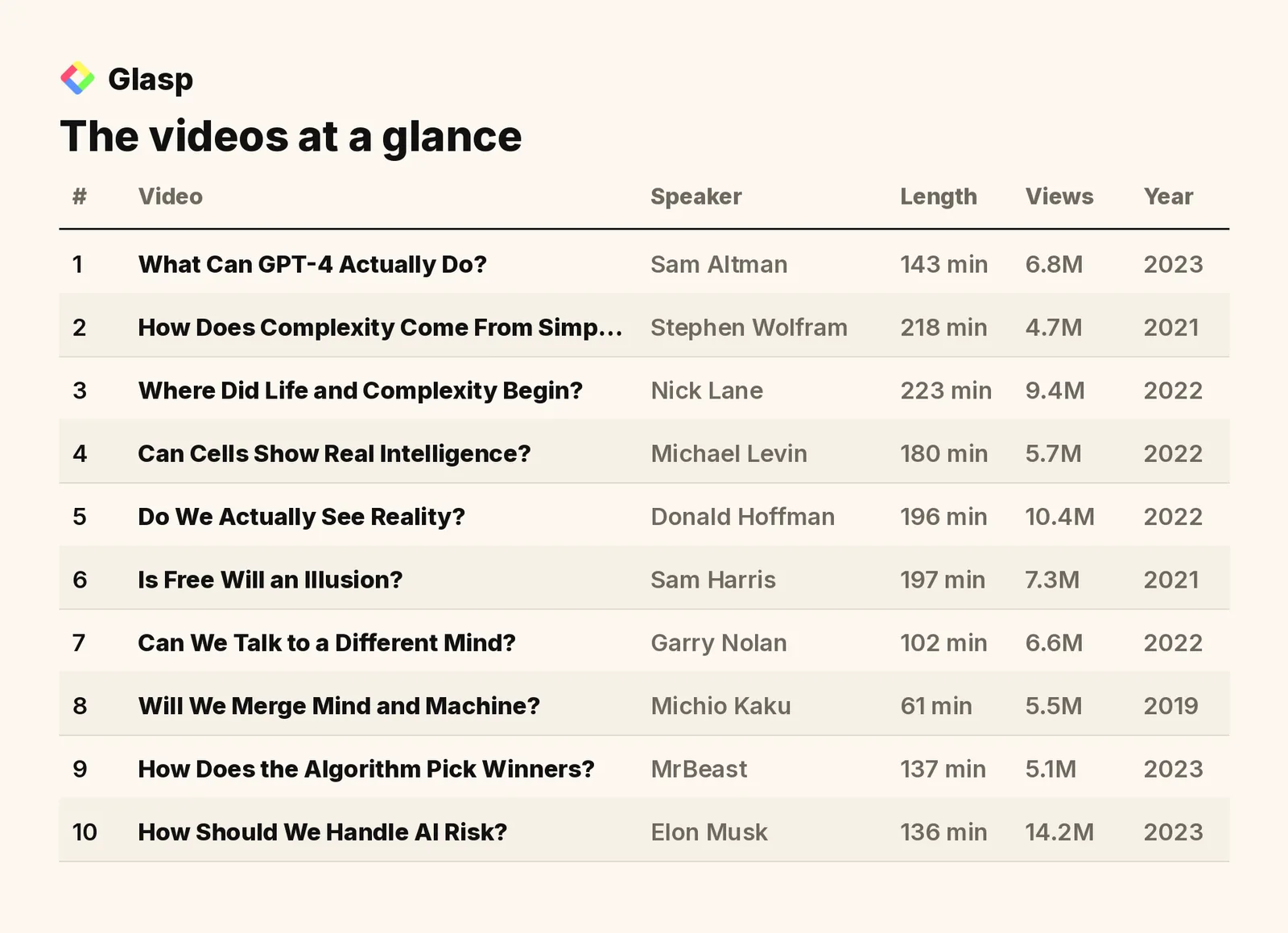
The videos on this list, in the order to watch them, are:
What Can GPT-4 Actually Do? (Sam Altman)
How Does Complexity Come From Simple Rules? (Stephen Wolfram)
Where Did Life and Complexity Begin? (Nick Lane)
Can Cells Show Real Intelligence? (Michael Levin)
Do We Actually See Reality? (Donald Hoffman)
Is Free Will an Illusion? (Sam Harris)
Can We Talk to a Different Mind? (Garry Nolan)
Will We Merge Mind and Machine? (Michio Kaku)
How Does the Algorithm Pick Winners? (MrBeast)
How Should We Handle AI Risk? (Elon Musk)
Total: 10 videos, 1593 minutes of watch time (about 27 hours), and 75.8M combined views.
1. What Can GPT-4 Actually Do?
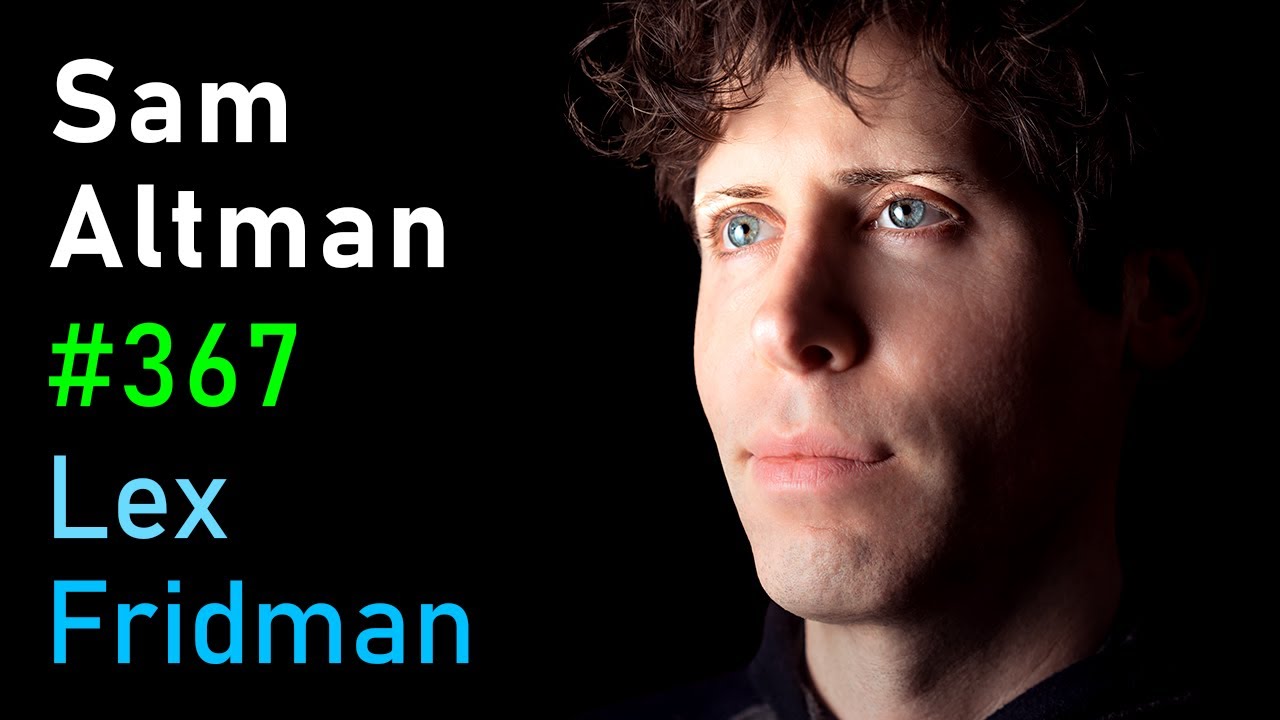
Sam Altman · 143 min · 6.8M views · 2023
In short: GPT-4 is a major step over earlier models, trained on large data and tuned with human feedback, but Altman says it is not AGI.
This is the clearest starting point because Altman leads the lab that put modern AI in front of the public. He explains what changed with GPT-4 and why capability alone does not settle the harder questions of safety and alignment.
Key takeaways
GPT-4 is a significant improvement over previous models, yet Altman is explicit that it does not qualify as artificial general intelligence.
Reinforcement learning with human feedback is central to GPT-4, improving both its usability and how well it understands what users are asking.
The rapid progress of AI raises unresolved questions about alignment, safety, and the technology's broad impact on society and work.
Fast takeoff scenarios, where AI capability grows very quickly, call for careful research rather than assuming change will arrive slowly and manageably.
Watch on YouTube · Read the summary and Q&A
2. How Does Complexity Come From Simple Rules?

Stephen Wolfram · 218 min · 4.7M views · 2021
In short: Complexity emerges when simple rules run forward and become computationally irreducible, so even minimal programs can generate patterns you cannot shortcut or predict.
Wolfram gives the computational vocabulary for the rest of the list. His work on cellular automata shows how intricate behavior arises from simple rules, which reframes how you think about intelligence, prediction, and the limits of modeling.
Key takeaways
Complexity in nature often arises from computational irreducibility, where simple rules produce behavior you cannot predict without running the process step by step.
Cellular automata such as rule 30 show how a minimal program can generate intricate patterns, giving raw material for modeling natural systems.
Wolfram models space as atoms connected in a hypergraph, and time as the computational process of repeatedly updating that network.
Consciousness, in Wolfram's view, is a subset of intelligence constrained by computational boundedness and a single thread of experience through time.
Watch on YouTube · Read the summary and Q&A
3. Where Did Life and Complexity Begin?

Nick Lane · 223 min · 9.4M views · 2022
In short: Life likely began in hydrothermal vents, where reactions between carbon dioxide and hydrogen supplied the energy that early cells needed to form.
Before intelligence, there is life, and Lane explains how it may have started from chemistry alone. Understanding how complexity bootstrapped itself from simple energy gradients grounds any conversation about how minds and general intelligence could arise.
Key takeaways
The origin of life on Earth likely began in hydrothermal vents, where carbon dioxide reacting with hydrogen may have provided the necessary energy.
Prokaryotic and eukaryotic cells were major evolutionary inventions, enabling greater complexity and the storage and propagation of genetic information.
Photosynthesis converted solar energy and water into resources that supported the evolution of larger and more complex organisms over time.
Sexual reproduction introduced genetic variation and helped drive the evolution of multicellular life, adding diversity that natural selection could act on.
Watch on YouTube · Read the summary and Q&A
4. Can Cells Show Real Intelligence?

Michael Levin · 180 min · 5.7M views · 2022
In short: Planarian flatworms regrow their brains after decapitation and live without senescence, showing problem-solving and intelligence that reach far below the level of neurons.
Levin moves intelligence out of the brain and into the cell. His work on planarians and xenobots shows goal-directed behavior in living tissue, which stretches what founders should count as intelligence when they build and reason about AI.
Key takeaways
Planarian flatworms can regenerate their brains after decapitation, showing regenerative and problem-solving abilities that operate below the level of a nervous system.
Planarians have existed for roughly 400 million years without senescence, which challenges standard theories of aging and lifespan limits.
Their true symmetry and true brain make planarians a more advanced life form than earthworms, offering clues about the origins of intelligence.
Studying planarian regeneration holds promise for regenerative medicine and for new therapeutic approaches built on how tissue rebuilds itself.
Watch on YouTube · Read the summary and Q&A
5. Do We Actually See Reality?

Donald Hoffman · 196 min · 10.4M views · 2022
In short: Natural selection tuned our senses for survival, not truth, so perception can present a useful but distorted interface rather than objective reality.
Hoffman argues that evolution optimized perception for fitness, not accuracy, which is a direct parallel to how AI systems learn representations that work rather than representations that are true. It is a sharp lesson about world models and their blind spots.
Key takeaways
Evolutionary game theory suggests our perceptions are adaptations that prioritize fitness and adaptive behavior rather than revealing objective reality.
Hoffman argues sensory systems evolved to keep us alive, so what we see may be a useful interface rather than the world as it is.
Physicists are exploring theories beyond space and time, and Hoffman connects this to the idea that reality differs from our perceptions.
The scientific method lets us test competing theories, but Hoffman stresses that our understanding of reality stays open to constant revision.
Watch on YouTube · Read the summary and Q&A
6. Is Free Will an Illusion?
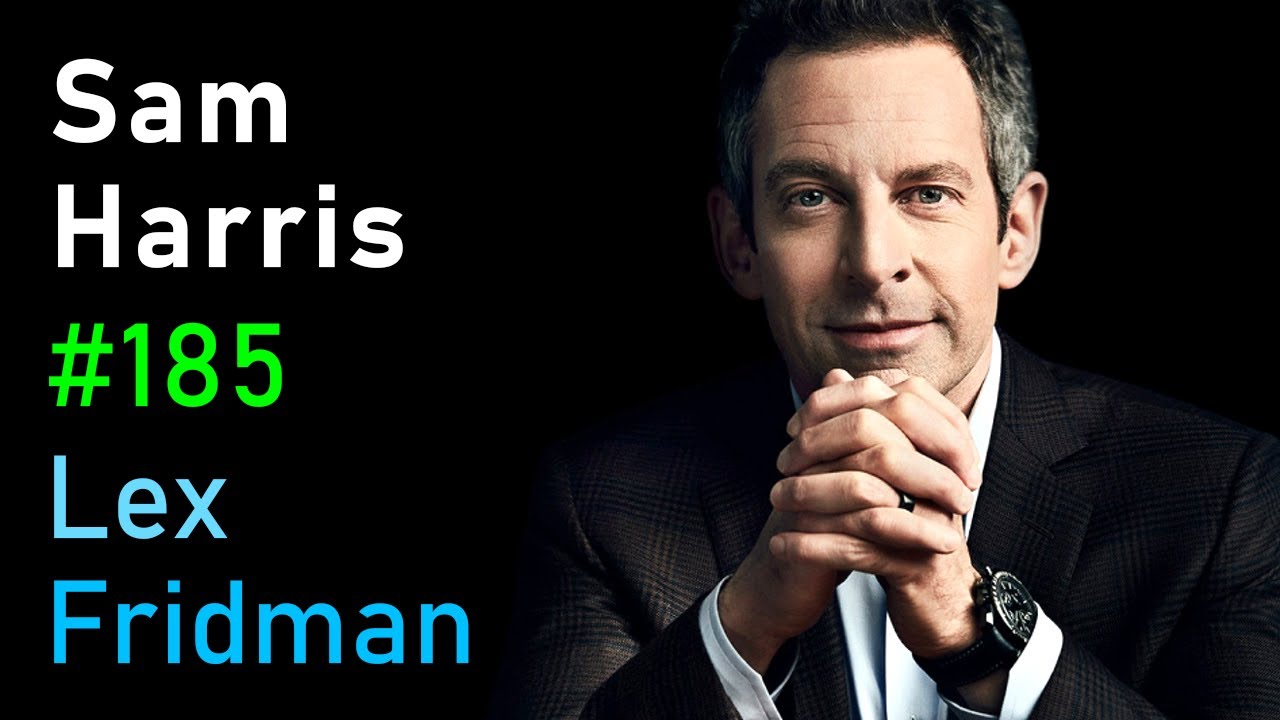
Sam Harris · 197 min · 7.3M views · 2021
In short: Harris argues thoughts arise on their own from nowhere, so the sense of authoring them, and free will itself, is an illusion.
Harris pushes on selfhood and agency, the concepts we quietly assume when we talk about conscious machines. He also raises the ethics of building AI that could suffer, which any founder working near these systems should sit with.
Key takeaways
Harris argues that thoughts emerge subjectively from nowhere and that we do not author them, which undercuts the common belief in free will.
Meditation and psychedelics, in Harris's account, can help people see through the illusion of a separate self and experience greater freedom.
If consciousness could be replicated in machines, Harris warns we must consider their capacity to suffer before treating them as tools.
Recognizing the absence of free will, Harris suggests, can increase compassion by changing how we react to others' actions and mistakes.
Watch on YouTube · Read the summary and Q&A
7. Can We Talk to a Different Mind?

Garry Nolan · 102 min · 6.6M views · 2022
In short: Communicating with a higher intelligence is hard because cognition and perception differ so deeply that both sides must first understand each other's limits.
Nolan frames the problem of communicating across radically different intelligences, which is exactly the challenge of aligning and understanding advanced AI. He approaches anomalous data with rigor, separating what is measurable from what is speculation.
Key takeaways
Communication between a higher intelligence and humans is complex and requires understanding the limits and capabilities of both parties involved.
Nolan argues anomalous biological materials and their unusual properties should be examined with rigorous science rather than dismissed or exaggerated.
Human biology at the cellular level reveals intricate computational processes and the dynamic, information-rich nature of DNA.
The vastness and diversity of the universe, Nolan suggests, leave open many possibilities for other intelligent civilizations.
Watch on YouTube · Read the summary and Q&A
8. Will We Merge Mind and Machine?
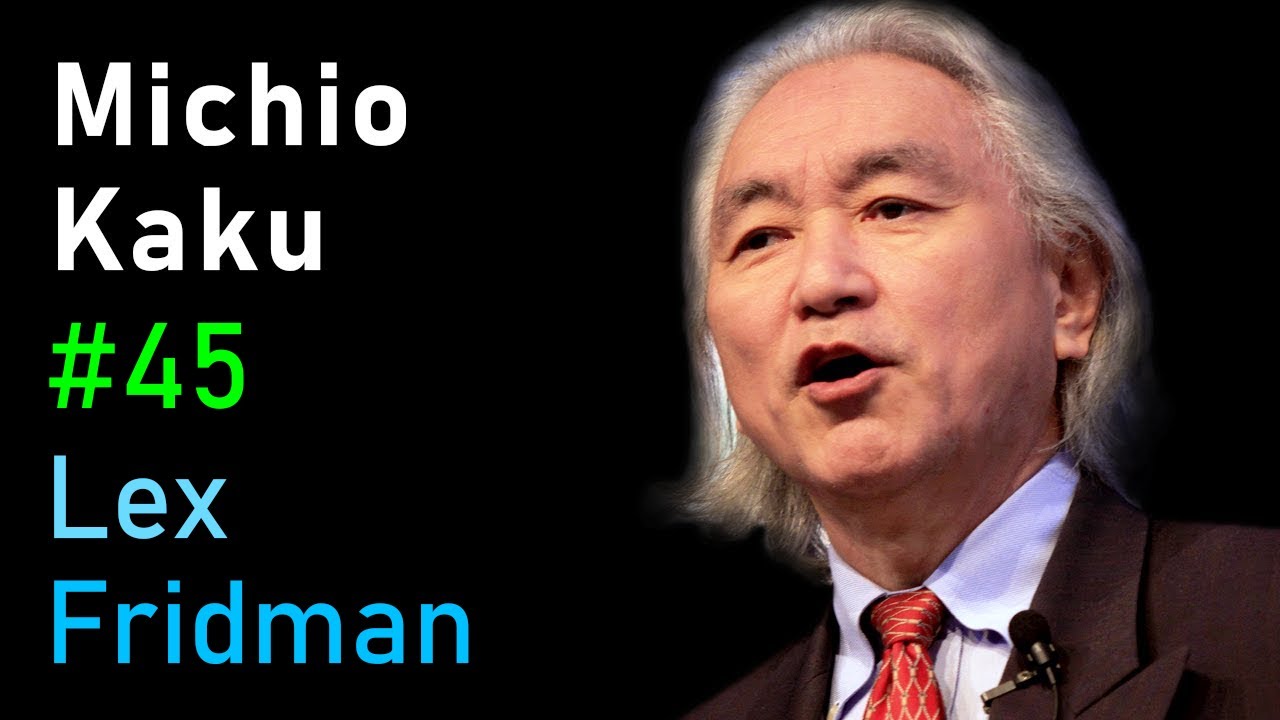
Michio Kaku · 61 min · 5.5M views · 2019
In short: Brain-machine interfaces could let people share thoughts, emotions, and sensations over the internet, moving toward telepathic communication and digitized personalities.
Kaku sketches the far edge of the mind and machine boundary, from brain interfaces to digitizing a personality. It is speculative, but it names the direction that today's AI and neurotech are pointed.
Key takeaways
Brain-machine interfaces, in Kaku's view, show promise for telepathic communication and for sharing emotions and sensations across the internet.
The Kardashev scale ranks a civilization's sophistication by how well it can harness energy and information, a useful yardstick for advanced intelligence.
Kaku expects the human future to involve genetic enhancement, digitized personalities, fusion power, and the colonization of Mars.
The abundance of Earth-sized planets, Kaku argues, raises the odds of contact with other intelligences within this century.
Watch on YouTube · Read the summary and Q&A
9. How Does the Algorithm Pick Winners?
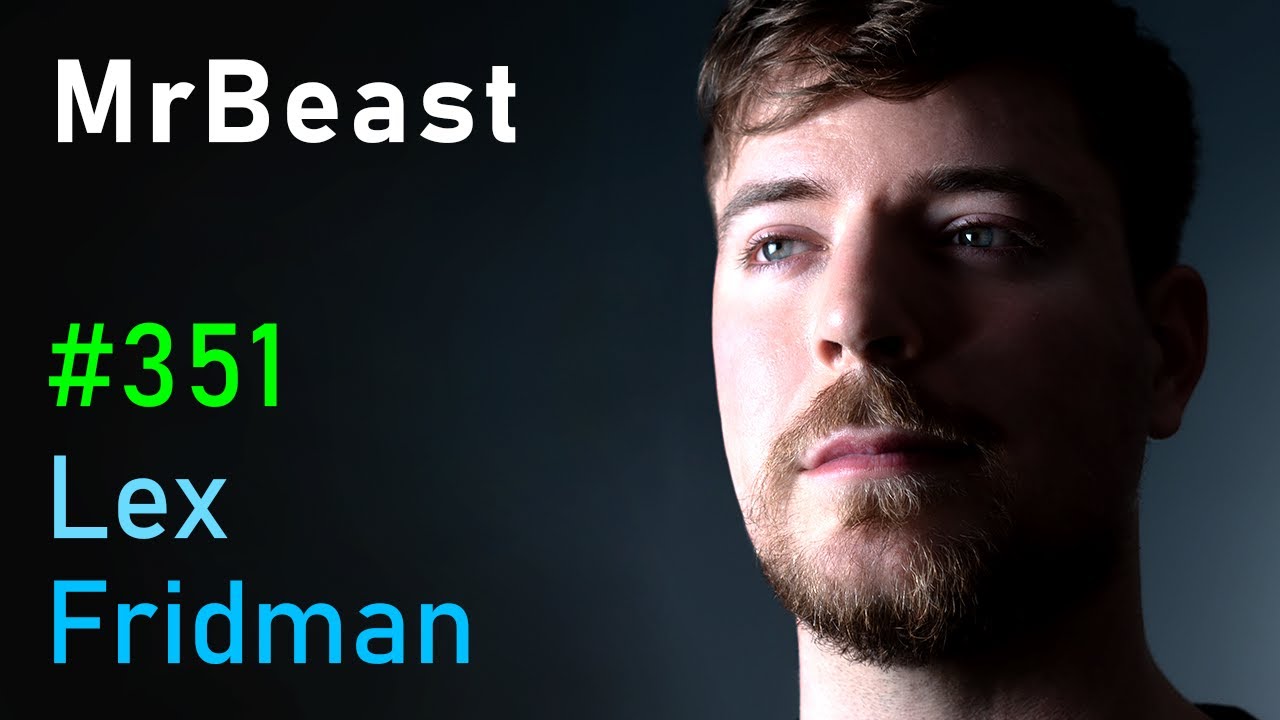
MrBeast · 137 min · 5.1M views · 2023
In short: YouTube's algorithm rewards quality, so one strong video can reach ten million views more easily than many videos reaching a hundred thousand each.
MrBeast is the clearest window into AI systems that already shape billions of people's attention. He explains what the recommendation algorithm rewards, which is a concrete case of optimizing for an objective and living with the results.
Key takeaways
MrBeast argues YouTube's algorithm favors quality, making ten million views on one video easier to reach than a hundred thousand across many videos.
Evergreen content keeps getting recommended over time, which MrBeast describes as a form of digital immortality for well-made videos.
Titles and thumbnails should be attention-grabbing, clear, and accurate, since they are how a video works with the recommendation system.
More extreme opinions or scenarios tend to attract more views, revealing how engagement-driven systems amplify intensity in content.
Watch on YouTube · Read the summary and Q&A
10. How Should We Handle AI Risk?

Elon Musk · 136 min · 14.2M views · 2023
In short: Musk sees AI as a tool to expand human understanding, and argues it should stay grounded in truth and first-principles physics to stay reliable.
Musk closes the list on the long view, tying AI to consciousness, existential risk, and the case for becoming multi-planetary. It is the widest-angle conversation, which is why it belongs at the end rather than the start.
Key takeaways
Musk sees AI as a tool to expand human consciousness and understanding, and argues it should adhere to truth and first-principles physics.
Musk believes fundamental questions about intelligence and consciousness remain unanswered, and that thought may involve more than atoms interacting.
Musk argues humanity should become multi-planetary, because staying on one planet makes eventual extinction inevitable once Earth becomes uninhabitable.
Musk considers nuclear war a low-probability but serious civilizational threat, and frames ignorance, not other humans, as the true enemy.
Watch on YouTube · Read the summary and Q&A
Frequently asked questions
Which Lex Fridman episode is best for understanding AI today?
The Sam Altman interview, episode 367, is the most direct on the state of AI, covering GPT-4, human feedback training, and why it is not yet AGI.
Did Lex Fridman interview Sam Altman about GPT-4?
Yes. In podcast 367, OpenAI CEO Sam Altman discusses GPT-4, ChatGPT, alignment, and the risks of fast AI progress.
What does Elon Musk say about AI on the Lex Fridman podcast?
In episode 400, Musk calls AI a tool to expand understanding and argues it should stay grounded in truth and first-principles physics to remain reliable.
Are these Lex Fridman AI interviews only about machine learning?
No. The list also covers consciousness, biology, perception, and computation, because understanding intelligence in living systems informs how we think about artificial intelligence.
How long does it take to watch all ten interviews?
The ten conversations run more than 26 hours in total, so most people work through them over several weeks rather than in one sitting.
Who should watch the Lex Fridman AI interviews on this list?
This list suits anyone curious about how intelligence works, not just AI engineers, since the conversations range from what GPT-4 can actually do to whether free will is an illusion and whether we truly see reality. No technical background is required to follow the discussions.
Where should I start with Lex Fridman's AI interviews?
Starting with the GPT-4 conversation makes sense if you want the most current picture of what AI systems can do, while the episodes on simple rules producing complexity and where life began are better first stops for anyone drawn to the deeper question of how intelligence emerges at all.
Do I need to watch these interviews in order?
Each conversation stands on its own, so there is no required order. The ten topics move from present day AI capability toward broader questions about biology, perception, consciousness and risk, so following the sequence gives a natural arc without being necessary.
What should I do after watching these interviews?
Pick the two or three questions that stuck with you, such as whether cells show real intelligence or how we should handle AI risk, and save highlights and notes as you rewatch. Turning long conversations into a set of quotes you can revisit is what makes the ideas usable later.
How to use this list
Use this list as a sequence rather than a menu: each conversation sets up the next, moving from today's AI to the science of intelligence and then to long-term risk. If you only have time for one, start with Sam Altman on GPT-4 for the clearest picture of where AI stands, then come back for Stephen Wolfram and Elon Musk when you want the foundations and the far view. Watch actively, take notes on the claims you disagree with, and treat the takeaways as prompts for your own thinking rather than settled conclusions.
Related lists
💡 Want summaries and transcripts for any YouTube video? Try YouTube Summary with ChatGPT & Claude.