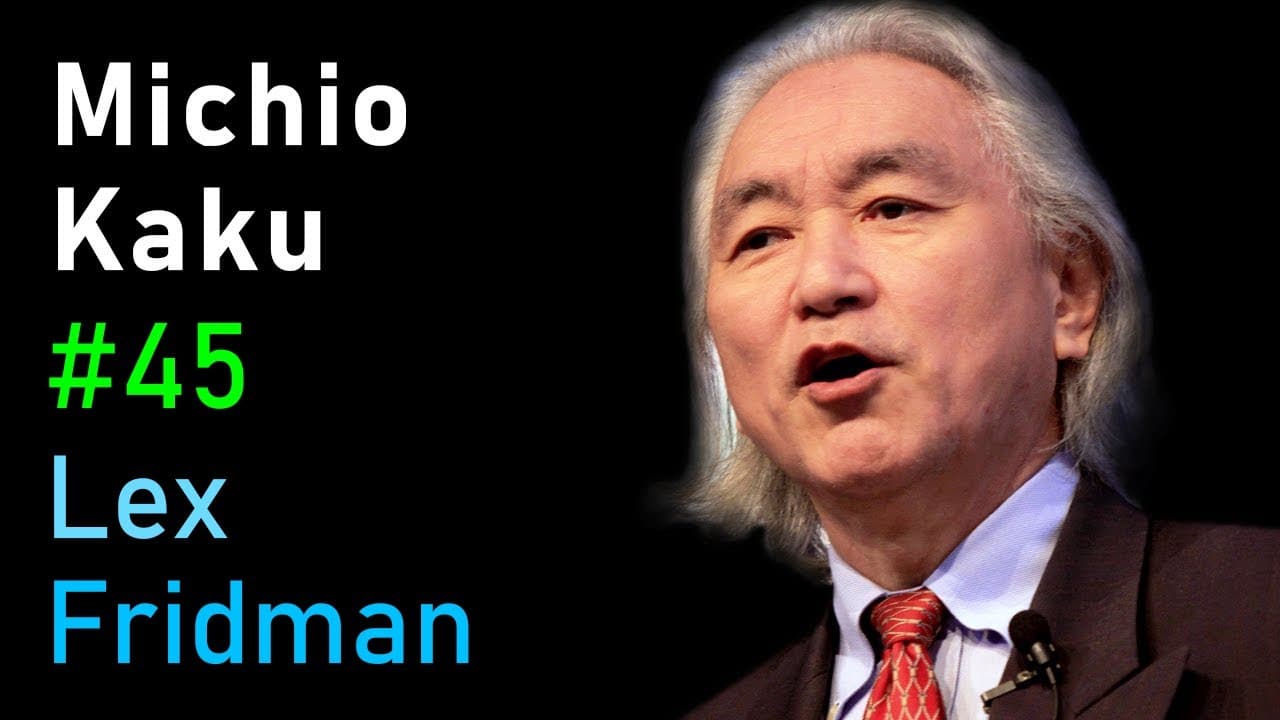
Michio Kaku: Future of Humans, Aliens, Space Travel & Physics | Lex Fridman Podcast #45
TL;DR
Contact with extraterrestrial civilizations might be achievable within this century due to the vast number of Earth-sized planets. Michio Kaku discusses advanced civilization levels, brain-machine interfaces for communication, and the potential for genetic immortality, indicating a future filled with transformative technologies like fusion power and Mars colonization.
Transcript
the following is a conversation with Michio Kaku he's a theoretical physicist futurist and professor at the City College of New York he's the author of many fascinating books that explored the nature of our reality and the future of our civilization they include Einsteins cosmos physics of the impossible feature of the mind parallel worlds and his ... Read More
Key Insights
- 👽 The abundance of potential Earth-sized planets in the universe increases the probability of contact with aliens in this century.
- 👽 The Kardashev scale can be used to determine the level of sophistication of an alien civilization based on their ability to harness energy and information.
- 🧠 Brain-machine interfaces show promise in enabling telepathic communication and sharing emotions and sensations over the internet.
- ✊ The future of humanity could involve genetic enhancements, digitizing personalities, fusion power, and the colonization of Mars.
- ✊ Fusion power, using hydrogen from seawater, has the potential to revolutionize the world's energy production.
- 🎙️ More videos with Michio Kaku:
Install to Summarize YouTube Videos and Get Transcripts
Explore YouTube Video Summarizer or Get YouTube Transcript Extractor
Questions & Answers
Q: What is the probability of making contact with aliens in this century?
According to Michio Kaku, given the abundance of potential Earth-sized planets in the universe, it is rather ridiculous to believe that we are the only intelligent life. He speculates that contact with aliens or at least picking up extraterrestrial signals is possible within this century.
Q: How can we determine the level of advancement of an alien civilization if we make contact?
Kaku explains that using the Kardashev scale, which ranks civilizations based on their ability to harness energy and information, we can decipher their level of sophistication. Looking at their ability to manipulate the weather, control stars, or roam the galaxy can give us an idea of their advancements.
Q: Will brain-machine interfaces become a reality in the near future?
Michio Kaku believes that brain-machine interfaces show promise and could allow computers to directly communicate with human brains. He mentions Elon Musk's Neuralink project as an example. He discusses how this technology could potentially lead to telepathic communication and the sharing of emotions and sensations over the internet.
Q: Is immortality possible through genetic enhancements and digitizing personalities?
Kaku explains that advancements in genetic technology and the ability to digitize memories and personalities could potentially lead to immortality. He speculates that our grandkids might have the option to reach the age of 30 and then stop aging, enjoying the benefits of age and maturity while living forever.
Q: How can fusion power revolutionize the world's energy production?
Fusion power, which utilizes hydrogen from seawater and produces helium as a waste product, can provide unlimited and clean energy. By extracting hydrogen from seawater and using it in a fusion reactor, we could have a sustainable and efficient energy source without the drawbacks of nuclear fission.
Q: When do you think humans will colonize Mars?
Michio Kaku believes that humans could reach Mars in the 2030s. He suggests that it is important to become a multi-planet species in case something catastrophic happens to Earth. He also discusses the process of terraforming Mars by raising its temperature and melting the polar ice caps.
Key Insights:
- The abundance of potential Earth-sized planets in the universe increases the probability of contact with aliens in this century.
- The Kardashev scale can be used to determine the level of sophistication of an alien civilization based on their ability to harness energy and information.
- Brain-machine interfaces show promise in enabling telepathic communication and sharing emotions and sensations over the internet.
- The future of humanity could involve genetic enhancements, digitizing personalities, fusion power, and the colonization of Mars.
- Fusion power, using hydrogen from seawater, has the potential to revolutionize the world's energy production.
- Terraforming Mars by raising its temperature and melting the polar ice caps could make colonization possible in the future.
Summary
In this conversation with Michio Kaku, he discusses a wide range of topics including the possibility of contact with aliens, different types of civilizations, the nature of dark energy, the concept of a multiverse, the mind of God, brain-machine interfaces, digitizing human memory, genetic immortality, and the idea of the universe as a computer simulation. Kaku shares his insights on these subjects and offers a perspective on their potential implications for humanity's future.
Questions & Answers
Q: You mentioned that we might make contact with aliens within this century. Can you elaborate on your intuition behind that optimism?
Kaku explains that given the large number of exoplanets discovered and the likelihood of earth-sized planets existing, it is highly unlikely that we are the only intelligent life in the universe. He believes that in the near future, we may pick up signals or communications from extraterrestrial civilizations.
Q: What criteria would we need to consider when making contact with an alien civilization?
Kaku suggests that understanding the level of sophistication of an alien civilization is crucial. By deciphering their language and determining their level on the Kardashev scale (which ranks civilizations based on their energy and information utilization), we can gauge their capabilities and potential for communication.
Q: Can you explain the different types of civilizations on the Kardashev scale?
Kaku describes the different types:
- Type 1 civilizations can harness planetary power, controlling natural phenomena like weather and earthquakes.
- Type 2 civilizations can harness the entire energy output of a star, colonizing nearby star systems.
- Type 3 civilizations have the ability to roam the galaxy and are capable of creating and manipulating vast amounts of energy.
- Type 4 civilizations could harness the power of dark energy, which constitutes 73% of the energy in the universe.
- Type 5 civilizations would be capable of utilizing energy sources outside of our universe, possibly through interaction with a multiverse.
Q: How would a Type 4 civilization harness dark energy?
Kaku explains that dark energy is the energy of the Big Bang and it causes the acceleration of the universe's expansion. Type 4 civilizations could potentially harness this energy, using it as a limitless source of power by plugging into the entire universe.
Q: Could there be civilizations that exist outside our universe in a multiverse?
Kaku discusses the idea of a multiverse, which is supported by quantum physics. He explains that multiple universes could be constantly created and that the multiverse is an infinite expanse happening in hyperspace. This concept combines the idea of nirvana, a timeless existence, and the idea of a creation moment, merging two seemingly contradictory theories into one.
Q: How would the existence of a multiverse affect the concept of God and the existence of God?
Kaku presents two differing views from Buddhism and Christianity. Buddhism sees the universe as eternal, without a beginning or an end, while Christianity believes in an instant of creation. Kaku explains that the multiverse theory could reconcile these opposing ideas by proposing that our universe had a beginning, but there could be universes existing before ours in a timeless 11-dimensional hyperspace. Furthermore, Kaku mentions Stephen Hawking's argument against the existence of God based on the universe's instant creation, which is countered by the multiverse theory.
Q: Do you think the existence of multiverses is humbling or exciting?
Kaku finds the concept aesthetically pleasing as it allows for the combination of disparate ideas and theories into a single explanation for the existence of the universe. The idea of multiple universes constantly being created adds a dimension of mystery and complexity to our existence.
Q: What factors make a species intelligent, and do you think alien life would resemble us in terms of behavior and appearance?
Kaku explains that three factors contribute to intelligence: stereo eyesight, an opposable thumb or equivalent, and language. He posits that aliens may have similar characteristics if they are descended from predatory creatures or have the ability to manipulate their environment and pass on knowledge to future generations. However, he adds that aliens could also be radically different from us in appearance and behavior.
Q: Could brain-machine interfaces and neural communication play a role in connecting with aliens?
Kaku believes that brain-net technology could enable telepathic communication and the transmission of emotions and sensations over the internet. This could change entertainment as emotions and feelings would replace traditional media, and it could also deepen personal relationships by allowing empathetic communication.
Q: Do you have concerns about the potential risks of AI?
While Kaku acknowledges the existential risks of AI, he believes that the danger is more likely to arise when robots approach the level of intelligence comparable to a dog or cat. However, he suggests that humans may also merge with technology and become part cybernetic, thus mitigating the potential risks.
Q: Do you think humans can achieve immortality through technology and genetic enhancements?
Kaku explains that the advancement of AI and genetic sequencing could lead to genetic immortality. By identifying aging-related genes and using technologies like CRISPR, it may be possible to slow or reverse the aging process. Additionally, he mentions the potential for digitizing human memory, allowing for digital immortality.
Q: Is there a meaningful aspect of human existence that is only possible because of mortality?
Kaku believes that our awareness of mortality influences every aspect of our lives, even unconsciously. The limited time we have shapes our behavior, making us prioritize certain goals and milestones. He highlights how mortality instills a sense of urgency and imparts a deeper appreciation for life.
Q: Do you think the universe could be a computer simulation?
Kaku does not believe that the universe is a computer simulation. He argues that simulating complex systems like the weather or a human would require more computational power than is feasible. He suggests that the smallest object capable of simulating a system is the system itself, making it unlikely that a supercomputer could simulate the entire universe.
Summary & Key Takeaways
-
Michio Kaku speculates that contact with aliens is possible based on the abundance of potential Earth-sized planets in the universe.
-
He explains the levels of advanced civilizations and how we could determine the level of sophistication of an alien species if we make contact with them.
-
Kaku discusses brain-machine interfaces as a promising technology and the potential for achieving immortality through genetic enhancements and digitizing personalities.
-
He shares insights on fusion power as a future energy source and the potential colonization of Mars.
Read in Other Languages (beta)
Share This Summary 📚
Summarize YouTube Videos and Get Video Transcripts with 1-Click
Try YouTube Summary with ChatGPT & Claude or YouTube Transcript Generator
Explore More Summaries from Lex Fridman Podcast 📚






Summarize YouTube Videos and Get Video Transcripts with 1-Click
Try YouTube Summary with ChatGPT & Claude or YouTube Transcript Generator