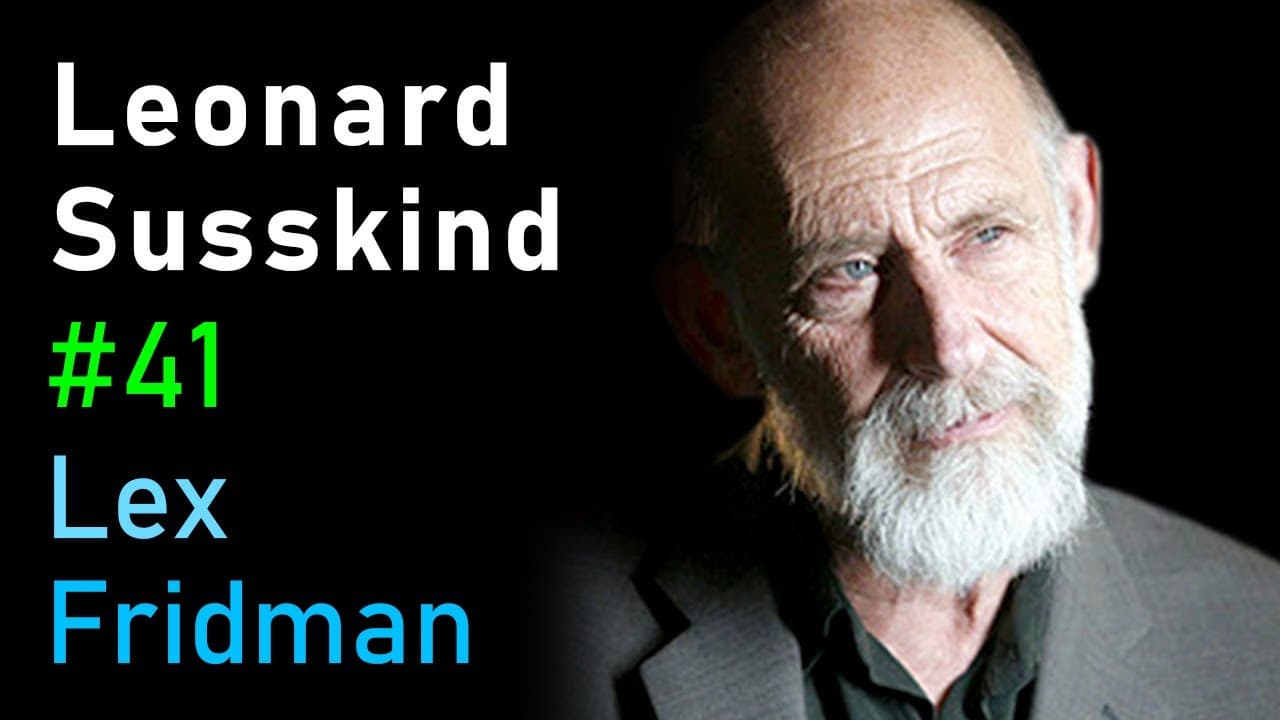
Leonard Susskind: Quantum Mechanics, String Theory and Black Holes | Lex Fridman Podcast #41
TL;DR
Intuition significantly influences quantum physics comprehension, as demonstrated by Leonard Susskind's reliance on visualization over equations. He emphasizes that although modern physics can be unintuitive, developing new intuitions is essential for grasping complex concepts like quantum mechanics.
Transcript
the following is a conversation with Leonard Susskind he's a professor of theoretical physics at Stanford University and founding director of Stanford Institute of theoretical physics he's widely regarded as one of the fathers of string theory and in general is one of the greatest physicists of our time both as a researcher and an educator this is ... Read More
Key Insights
- 🤔 Richard Feynman's intuitive approach to physics influenced and validated Susskind's own way of thinking.
- 😒 Visualization and intuition are crucial aspects of Susskind's approach to physics, outweighing the use of mathematical equations.
- 🦾 Modern physics, including quantum mechanics, can be deeply unintuitive and counterintuitive, requiring the development of new intuitions.
- 🤔 The brain's neural wiring limits our ability to visualize concepts like higher dimensions, but we can learn mathematical and abstract methods to think about and understand them.
- ⚖️ Ego can be both powerful and dangerous in science, requiring a balance of arrogance and humility.
- 🦾 Quantum computers have the potential to simulate and understand quantum systems, facilitating the study of complex phenomena in quantum mechanics.
- 🥶 The emergence of consciousness, free will, and time remains a mystery in science, with no definitive answers yet.
- ♾️ Infinity is a challenging concept to visualize and understand, and its role in physics is still under debate.
- 🖤 The recent image of a black hole from the Event Horizon Telescope confirmed the predictions of general relativity and the existence of black holes.
Install to Summarize YouTube Videos and Get Transcripts
Explore YouTube Video Summarizer or Get YouTube Transcript Extractor
Questions & Answers
Q: How did Richard Feynman influence your thinking as a physicist?
Susskind saw Feynman as someone who could do physics intuitively and successfully visualize phenomena, validating Susskind's own approach and making him realize the simplicity and directness of intuitive thinking in physics.
Q: How does Susskind approach physics, particularly in relation to quantum mechanics?
Susskind relies on intuition and visualization, prioritizing understanding the phenomena before converting it into mathematics. He believes that his way of thinking is simpler and more direct, which is essential in dealing with complex topics like quantum mechanics.
Q: Can humans develop a natural understanding of concepts like quantum mechanics and higher dimensions?
Susskind believes that humans can to some extent develop the ability to think quantum mechanically, but our neural wiring limits us from fully comprehending concepts like higher dimensions. However, through exposure and familiarity, we can develop new intuitions that make quantum mechanics more manageable.
Q: What role does ego play in science, according to Susskind?
Susskind believes that both arrogance and humility are necessary in science. Arrogance is needed to tackle difficult problems and believe in one's own abilities, while humility is vital in acknowledging limitations and the possibility of being wrong.
Key Insights:
- Richard Feynman's intuitive approach to physics influenced and validated Susskind's own way of thinking.
- Visualization and intuition are crucial aspects of Susskind's approach to physics, outweighing the use of mathematical equations.
- Modern physics, including quantum mechanics, can be deeply unintuitive and counterintuitive, requiring the development of new intuitions.
- The brain's neural wiring limits our ability to visualize concepts like higher dimensions, but we can learn mathematical and abstract methods to think about and understand them.
- Ego can be both powerful and dangerous in science, requiring a balance of arrogance and humility.
- Quantum computers have the potential to simulate and understand quantum systems, facilitating the study of complex phenomena in quantum mechanics.
- The emergence of consciousness, free will, and time remains a mystery in science, with no definitive answers yet.
- Infinity is a challenging concept to visualize and understand, and its role in physics is still under debate.
- The recent image of a black hole from the Event Horizon Telescope confirmed the predictions of general relativity and the existence of black holes.
- Science may never be able to answer questions about the existence of an intelligent agent or purpose behind the universe.
Summary
This conversation is with Leonard Susskind, a professor of theoretical physics at Stanford University and founding director of Stanford Institute of theoretical physics. He discusses his influences, the role of intuition in his work, the nature of quantum mechanics and string theory, the potential of quantum computers, and the connection between information processing and the universe. Susskind also shares his thoughts on the nature of time, consciousness, free will, and the future of physics.
Questions & Answers
Q: How did Richard Feynman influence your thinking as a physicist?
Susskind saw Feynman as someone who could do physics in a deeply intuitive way, visualizing phenomena and using simple, direct, and intuitive approaches. Feynman's success at this validated Susskind's own thinking and approach to physics.
Q: Do you use intuition and visualization in your own work?
Yes, Susskind emphasizes the importance of visualization and intuition in his approach to physics. He tends to focus on visualizing the phenomena themselves rather than getting caught up in the equations. He then converts his insights into mathematics, relying on others who are better at converting experiences into mathematics.
Q: Is quantum mechanics intuitive?
According to Susskind, very little of modern physics, including quantum mechanics, is intuitive. The concepts of quantum physics, general relativity, and quantum field theory are deeply unintuitive compared to classical physics. However, with time and familiarity, one can develop new intuitions and rewiring the brain to think more quantum mechanically.
Q: Can we create devices that naturally understand quantum mechanics?
Susskind believes that while humans have evolved the ability to think quantum mechanically to some extent, it is unlikely that we can completely rewire ourselves to fully understand difficult concepts like quantum mechanics. He uses the example of visualizing higher dimensions, which is challenging for humans who are wired to visualize in three dimensions.
Q: How does ego affect scientific research?
Susskind believes that both arrogance and humility are necessary in scientific research. Arrogance gives the confidence to tackle difficult problems, while humility recognizes that one's ideas can be limited or proven wrong. It takes a special kind of person to balance both arrogance and humility.
Q: Have you ever doubted your ability to succeed in physics?
Susskind didn't doubt his ability to succeed in physics but had doubts about his background, coming from a working-class family and feeling like an outsider in academia. However, he never worried about finding a job and always had confidence in his abilities.
Q: What is academia for? Do you feel uncomfortable in it?
Susskind acknowledges feeling like an outsider in academia for a long time, but he found his place as an insider later in life as a physicist. He didn't give much thought to academia's purpose but believes that the feeling of discomfort stems from differences in social background and ways of thinking.
Q: What are your hopes for quantum computers?
Susskind sees quantum computers as valuable tools for simulating and understanding quantum systems that are too complex to simulate classically. He believes that quantum computers will have significant applications in quantum physics, chemistry, solid-state physics, and other fields where classical computers are limited. They will allow scientists to manipulate and measure quantum systems in ways that are not possible with classical computers.
Q: Can quantum computers unlock new algorithms and complexities in problem-solving?
While quantum computers may provide exponential advantages in solving certain problems, Susskind believes that the number of such problems is limited. However, he thinks that quantum computers' primary value lies in simulating and understanding quantum systems, rather than in finding new algorithms.
Q: Can quantum computers help us understand the human brain or biological systems?
Susskind acknowledges that quantum computers can simulate quantum systems, including biological systems, more accurately than classical computers. However, he is unsure if it will lead to a complete understanding of the human brain or consciousness. He believes that neuroscience and computer science may eventually provide insights into these complex topics.
Q: What is the dream of string theory?
Susskind prefers not to separate string theory as a subject but rather sees it as part of fundamental theoretical physics. The dream of string theory, like other branches of physics, is to understand a unified theory of everything, particularly the connection between gravity and quantum mechanics. String theory provides a mathematical framework to explore these fundamental questions.
Q: Is there something deeper to be found within string theory?
Susskind believes that string theory is a useful tool for understanding the connection between gravity and quantum mechanics. It has provided a mathematical representation of how these two fundamental theories can coexist and be consistent. While there may be more profound discoveries within string theory, its present value lies in addressing fundamental questions in physics.
Q: What is the connection between information processing and the universe?
Susskind believes that all systems, including humans and the universe, are information processing systems. However, the nature of consciousness, intelligence, and the emergence of free will from the fundamental nature of reality are still puzzling. Susskind thinks that computer scientists might eventually shed new light on these topics by creating machines or simulations that can evolve and provide insights beyond introspection alone.
Q: Is there a relationship between the observer effect and consciousness?
Susskind explains that an observer, in a technical sense, is a system that records information and becomes entangled with the system being observed. While this mathematical representation helps explain the observer effect, Susskind acknowledges feeling uncomfortable with the idea of consciousness and how physical systems can give rise to it. He believes that there's still much to understand in this area.
Q: Is there a possibility of time travel or the reversal of time?
Susskind clarifies that reversing the second law of thermodynamics to make a system go backward in time is possible in theory but incredibly difficult to achieve in practice. It would require immense precision and care, making it currently impractical on a large scale. He distinguishes this idea from science-fiction-style time travel and emphasizes that it's more about reversing a system's trajectory than true time travel.
Q: How hard would it be to create a computer that runs the universe?
Susskind explains that theoretically, we could simulate certain mathematical universes on a quantum computer, particularly ones like anti-de Sitter space. However, simulating our own universe, which is de Sitter space and not fully understood quantum mechanically, is currently beyond our knowledge and capabilities.
Takeaways
In this conversation with Leonard Susskind, we gain insights into the mind of a renowned theoretical physicist. Susskind emphasizes the importance of visualizing phenomena and using intuition in physics. He discusses the nature of quantum mechanics, the potential of quantum computers, and the value of string theory in understanding gravity and quantum mechanics. Susskind also delves into the mysteries of time, consciousness, and free will, highlighting the need to remain humble in the face of profound questions and the potential for future breakthroughs in understanding the fundamental nature of reality.
Summary & Key Takeaways
-
Leonard Susskind views Richard Feynman as an influential figure in his career, validating his intuitive and visualization-based approach to physics.
-
Susskind emphasizes the use of intuition and visualization in his own work, preferring to think about the phenomena themselves rather than focusing on equations and symbols.
-
While other physicists may be better at converting intuition into mathematics, Susskind believes in the importance of developing new intuitions in understanding complex topics like quantum mechanics.
Read in Other Languages (beta)
Share This Summary 📚
Summarize YouTube Videos and Get Video Transcripts with 1-Click
Try YouTube Summary with ChatGPT & Claude or YouTube Transcript Generator
Explore More Summaries from Lex Fridman Podcast 📚





Summarize YouTube Videos and Get Video Transcripts with 1-Click
Try YouTube Summary with ChatGPT & Claude or YouTube Transcript Generator