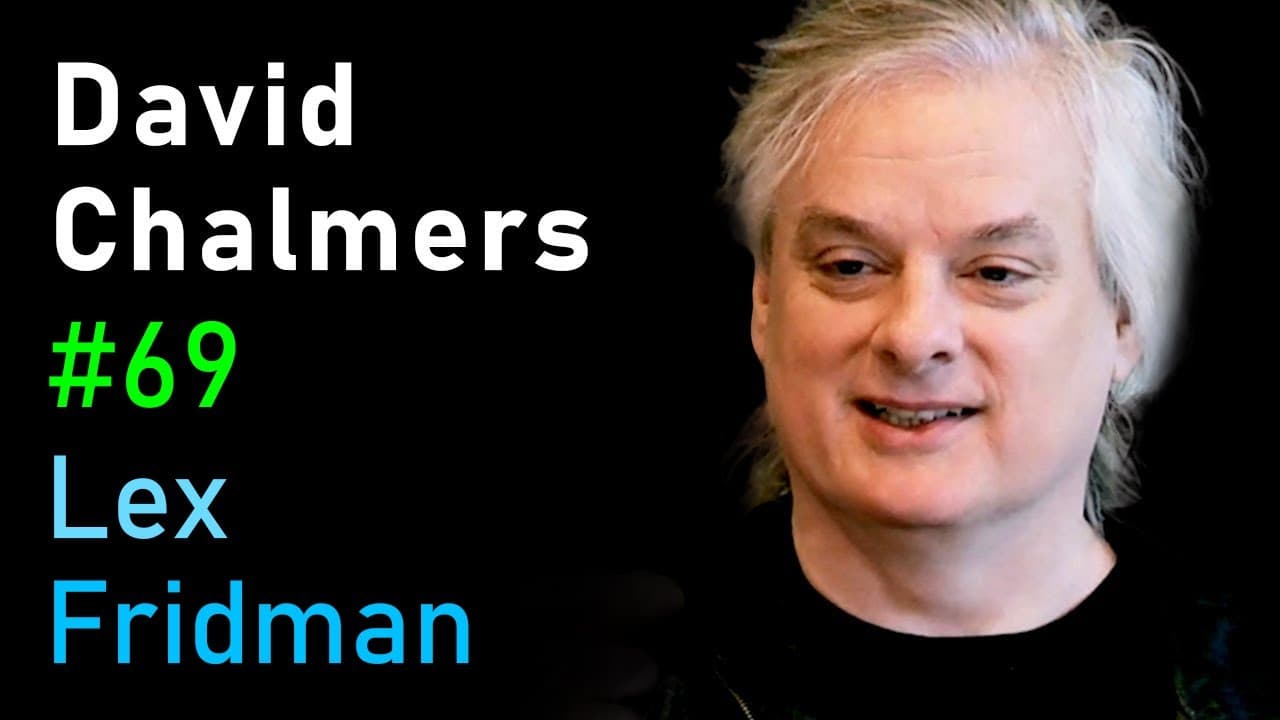
David Chalmers: The Hard Problem of Consciousness | Lex Fridman Podcast #69
TL;DR
The hard problem of consciousness questions how subjective experiences emerge from physical processes in the brain. David Chalmers discusses the implications of living in a simulation, the nature of reality, and the relationship between consciousness and the mind. He emphasizes the philosophical mysteries surrounding consciousness and virtual experiences.
Transcript
the following is a conversation with David Chalmers he's a philosopher and cognitive scientist specializing in the areas of philosophy of mind philosophy language and consciousness he's perhaps best known for formulating the hard problem of consciousness which could be stated as why does the feeling which accompanies awareness of sensory informatio... Read More
Key Insights
- 🧠 The hard problem of consciousness questions how subjective experiences emerge from physical processes in the brain.
- 👏 The simulation hypothesis raises philosophical questions about the nature of reality and consciousness.
- ❓ Consciousness is subjective experience, and it is still a mystery as to how it arises from physical processes.
- ❓ Virtual reality experiences are immersive, but current technology does not replicate genuine consciousness.
Install to Summarize YouTube Videos and Get Transcripts
Explore YouTube Video Summarizer or Get YouTube Transcript Extractor
Questions & Answers
Q: What is the hard problem of consciousness?
The hard problem of consciousness refers to the challenge of explaining how subjective experiences arise from the physical processes in the brain.
Q: Can consciousness be engineered into AI systems?
Many people believe that consciousness can and should be engineered into AI systems of the future, but it remains a mystery as to how that would be possible.
Q: How does the simulation hypothesis shed light on philosophical questions?
The simulation hypothesis raises questions about the nature of reality, knowledge, and the external world. It challenges our understanding of what is real and what it means to have consciousness within a simulated world.
Q: Can we create consciousness in virtual reality?
While current virtual reality experiences are not capable of replicating genuine consciousness, there may come a time when AI systems in virtual worlds can have their own unique consciousness.
Key Insights:
- The hard problem of consciousness questions how subjective experiences emerge from physical processes in the brain.
- The simulation hypothesis raises philosophical questions about the nature of reality and consciousness.
- Consciousness is subjective experience, and it is still a mystery as to how it arises from physical processes.
- Virtual reality experiences are immersive, but current technology does not replicate genuine consciousness.
- The meaning of life is subjective and can be found in the experiences and values that individuals hold. Consciousness plays a crucial role in giving life meaning.
Summary
In this conversation, David Chalmers, a philosopher and cognitive scientist, discusses the concept of living in a simulation, the nature of reality, and the possibility of creating consciousness in artificial intelligence (AI) systems. He also explores the idea of consciousness in virtual reality, the experience of synesthesia, and the hard problem of consciousness. Chalmers suggests that consciousness is subjective experience and that it may be a fundamental property of the universe.
Questions & Answers
Q: Do you think we're living in a simulation?
I don't rule it out. If a simulation is designed well enough, it could be indistinguishable from non-simulated reality, and any evidence against it could be simulated. I think it's a possibility.
Q: Is the thought experiment of living in a simulation interesting or useful to understand the nature of reality?
Yes, the simulation idea provides insights into philosophical questions like how we know about the external world and the nature of reality. Even if we are in a simulation, I believe it is still real, a different version of reality.
Q: What is the difference between the "real world" and the world we perceive?
The "real world" is considered to be something that exists without us, whereas the world we perceive is a simplified and distorted version of reality. The world as it seems to us is called the manifest image, while the scientific image represents the underlying reality.
Q: Does simulating the mind or the universe pose a greater challenge?
Simulating the mind is likely simpler than simulating the entire universe because the mind is part of the universe, and simulating the universe would involve simulating the brain as well. However, simulating the mind's consciousness and subjective experience is a more complex problem.
Q: What are the different levels and simulations within the simulation idea?
The simulation idea suggests the possibility of multiple levels of universes and simulations. At level zero, the universe is likely to be infinitely large or at least have a very high capacity to support simulations. By the time we reach level 42, the top level is expected to be significantly larger, while lower levels become more constrained and simplified.
Q: Do you think human beings are at the height of what a simulation could achieve?
Human beings are impressive in terms of their intelligence and the advancements they have made, but Chalmers believes there could be more sophisticated beings at higher levels of simulation. However, the potential of human beings is just starting to unfold, and there is still much to explore and achieve.
Q: Is consciousness tied to the physical brain or can it be created in virtual worlds?
Currently, virtual worlds rely on the brain outside of the virtual world to interact and control the environment. However, Chalmers speculates that in the future, with advanced AI or brain simulations, it may be possible to create consciousness within virtual worlds. The mind would still be considered separate from the virtual world, but virtual experiences could have their own level of consciousness.
Q: How do you define consciousness and qualia?
Consciousness is subjective experience and what it feels like to be a conscious being. Qualia refers to the qualities of conscious experience, such as colors, tastes, or smells. Chalmers considers consciousness as phenomenal consciousness, which deals with subjective experiences beyond the qualities or qualia.
Q: What is the hard problem of consciousness?
The hard problem of consciousness is the difficulty in explaining why and how physical processes in the brain give rise to subjective experiences. Existing physics provides explanations for the easy problems of consciousness, such as behavior, but falls short in explaining the subjective nature of consciousness.
Q: Can consciousness be a fundamental property of the universe?
Chalmers suggests exploring the possibility of panpsychism, where consciousness is a fundamental property of everything in the universe. He proposes taking consciousness as a primitive concept, like space-time, and connecting it to other fundamental aspects of reality through fundamental laws. This approach acknowledges the gaps in understanding and aims to explain the subjective experience of consciousness on its own terms.
Summary & Key Takeaways
-
David Chalmers delves into the hard problem of consciousness, which questions how subjective experiences arise from physical processes in the brain.
-
He explores the possibility of living in a simulation and the philosophical implications of the simulation hypothesis.
-
Chalmers discusses the nature of reality and the difference between the perceived world and the world as it truly is.
-
He examines the relationship between consciousness and the mind, as well as the concept of a virtual world and its potential for consciousness.
Read in Other Languages (beta)
Share This Summary 📚
Summarize YouTube Videos and Get Video Transcripts with 1-Click
Try YouTube Summary with ChatGPT & Claude or YouTube Transcript Generator
Explore More Summaries from Lex Fridman Podcast 📚


Summarize YouTube Videos and Get Video Transcripts with 1-Click
Try YouTube Summary with ChatGPT & Claude or YouTube Transcript Generator