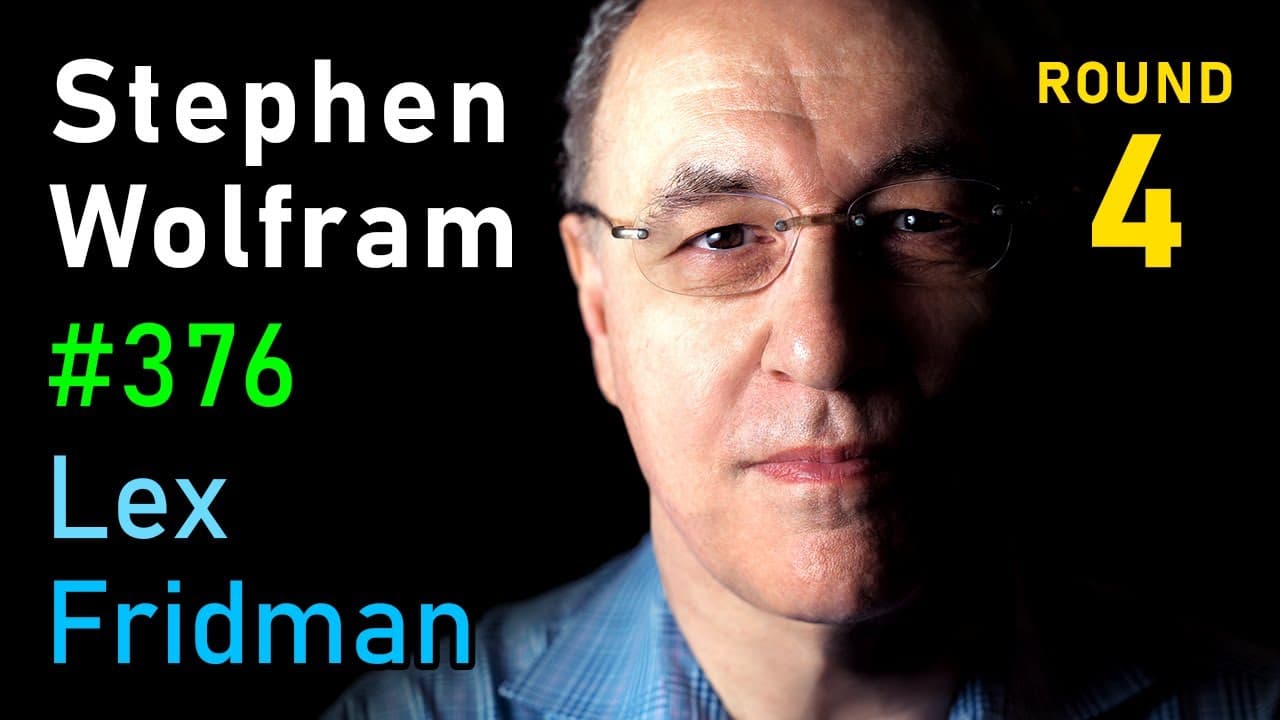
Stephen Wolfram: ChatGPT and the Nature of Truth, Reality & Computation | Lex Fridman Podcast #376
TL;DR
ChatGPT excels at understanding and generating human-like language, while Wolfram Alpha leverages symbolic programming for deep computation of formal knowledge. The integration of these systems enhances users' ability to convert natural language queries into precise, computable answers, addressing the complexities of understanding and modeling reality.
Transcript
- You know I can tell ChatGPT, create a piece of code and then just run it on my computer. And I'm like, you know, that, that sort of personalizes for me the what could, what could possibly go wrong, so to speak. - Was that exciting or scary, that possibility? - [Wolfram] It was a little bit scary actually, because it's kind of like, if you do that... Read More
Key Insights
- 👔 ChatGPT relies on natural language understanding and continuation, while Wolfram Alpha focuses on computable knowledge and deep, formal computations.
- 👤 The integration of ChatGPT and Wolfram Alpha enables users to convert natural language queries into computationally understandable language and obtain reliable answers.
- 🤨 The balance between sandboxing AI systems and maximizing their capabilities raises questions about ensuring proper constraints and control to prevent misuse while maintaining system effectiveness.
- 🎙️ More videos with Stephen Wolfram:
Install to Summarize YouTube Videos and Get Transcripts
Explore YouTube Video Summarizer or Get YouTube Transcript Extractor
Questions & Answers
Q: How does integrating ChatGPT and Wolfram Alpha benefit users?
The integration allows for the conversion of natural language queries into computational language, enabling users to obtain reliable and computable answers to their questions.
Q: How does sandboxing AI systems help address concerns about their potential misuse?
Sandboxing sets constraints on AI systems, limiting their control over weapons and other critical systems. However, Wolfram raises the important question of determining the right level of constraints to prevent malicious use while still allowing AI systems to perform effectively.
Q: How does Wolfram Language help bridge the gap between natural language and computational language?
Wolfram Language provides a formalism for representing computations that can be easily understood by both humans and computers, allowing for the exploration of deep, formal structures to compute new and unique results.
Q: What insights did Wolfram gain from his work with computational irreducibility and computational reducibility?
Wolfram emphasizes the importance of computational reducibility in understanding the limits of predictability in highly complex systems. He also discusses how observers play a role in extracting meaningful information from systems that exhibit computational irreducibility.
Key Insights:
- ChatGPT relies on natural language understanding and continuation, while Wolfram Alpha focuses on computable knowledge and deep, formal computations.
- The integration of ChatGPT and Wolfram Alpha enables users to convert natural language queries into computationally understandable language and obtain reliable answers.
- The balance between sandboxing AI systems and maximizing their capabilities raises questions about ensuring proper constraints and control to prevent misuse while maintaining system effectiveness.
- The concept of computational reducibility highlights the limits of predictability in complex systems, with pockets of reducibility offering the ability to jump ahead and make meaningful inferences. Observers play a critical role in extracting symbolic representations from natural language.
Summary
In this video, Lex Fridman interviews Stephen Wolfram, the founder of Wolfram Research. They discuss the integration of ChatGPT and Wolfram Alpha/Wolfram Language, the differences between large language models and computational systems, and the challenges of capturing the complexity of the real world in computational models. They also explore the concept of observers in the computational universe and the importance of symbolic representation in understanding and modeling the world.
Questions & Answers
Q: What are the key differences between large language models and the computational system behind Wolfram Alpha?
Large language models like ChatGPT focus on generating human-like text based on pre-existing language statistics, using neural networks to generate one word at a time. However, they do not aim to compute new and different information. On the other hand, Wolfram Alpha's computational system aims to make as much of the world computable as possible by using structured formalism and symbolic programming. It can compute new and previously uncomputed information from accumulated expert knowledge.
Q: How does computational reducibility play a role in understanding the world?
Computational reducibility is essential in understanding complex systems. Even if we have the rules of a system, predicting its long-term behavior without computation is often impossible. The value of computation lies in uncovering new information that cannot be immediately deduced. Science and other fields often seek the pockets of reducibility in order to make local predictions or abstractions within the overall computational irreducibility of the system.
Q: How is the concept of "observer" important in the computational universe?
The concept of an observer in the computational universe relates to the ability to extract and summarize information from a complex system in a way that fits within the observer's computational capabilities. Observers, including humans, reduce the detail of the world into a more manageable form, allowing them to understand specific aggregates or aspects of the system. This reduction of information enables observers to build models and narratives about the world.
Q: How does Wolfram Language try to capture the complexity of the world in symbolic representations?
Wolfram Language seeks to capture the complexity of the world by enabling precise symbolic representations that can be computed. It formalizes the description of the world, allowing for the construction of comprehensive towers of consequences and models. By converting natural language prompts into computational language, Wolfram Language provides a structured framework for computing and exploring different aspects of the world.
Q: How do natural language prompts get converted into Wolfram Language?
Wolfram Alpha acts as a front-end that converts natural language queries into Wolfram Language expressions. These queries are transformed into computational language that allows for further computation and extraction of necessary information. By curating data and having well-defined symbolic representations, Wolfram Alpha achieves a high success rate in converting natural language into computational language.
Q: Does the integration of large language models like ChatGPT enhance the conversion from natural language to computational language?
While there is still much to explore, large language models like ChatGPT have the potential to improve the conversion from natural language to computational language. From the inception of Wolfram Alpha, Stephen Wolfram has been interested in programming with natural language, and the integration of large language models may provide opportunities to further improve the conversion process.
Q: How does Wolfram Alpha achieve a high success rate in interpreting natural language queries?
Wolfram Alpha's success in interpreting natural language queries is a result of continuous improvement and a feedback loop between user queries and the system. As users input queries and receive accurate results, the system learns and adapts to better understand and interpret similar queries.
Q: Is it possible to capture the full complexity of snowflake growth in scientific models?
Scientific models strive to capture and describe specific aspects or features of complex phenomena. However, capturing the full complexity of natural systems, such as snowflake growth, can be challenging. Models often simplify and focus on specific aspects that are relevant to the desired understanding or goal. While some models may accurately represent certain features, they might not capture the complete complexity of the system.
Q: How does the underlying computational irreducibility of the universe affect modeling and understanding?
The underlying computational irreducibility of the universe means that predicting long-term behavior with complete certainty is often impossible without direct computation. However, the ability to find and exploit pockets of computational reducibility allows for local predictions and useful abstractions within the overall complexity. Modeling and understanding rely on identifying and leveraging these pockets to distill meaningful information from complex systems.
Q: Can natural language be used for programming?
Natural language has the potential to be used for programming, where queries and prompts in natural language can be directly translated into computational language. While current efforts have made significant progress, there is ongoing research and development to improve the capabilities of natural language interfaces for programming.
Q: How does Wolfram Language support the construction of towers of consequences and models?
Wolfram Language provides a structured formalism and symbolic representation that enables the construction of comprehensive towers of consequences and models. It allows users to build expressions and functions that represent different aspects of the world and to computationally manipulate and explore those representations in a systematic and rigorous manner.
Takeaways
The integration of large language models like ChatGPT with computational systems like Wolfram Alpha and Wolfram Language has the potential to enhance the conversion from natural language to computational language. While natural language prompts can be translated into computational language, Wolfram Alpha has achieved a high success rate in understanding and answering queries by converting them into precise Wolfram Language expressions. The challenge lies in capturing the complexity of the world within computational models, finding the balance between computational irreducibility and reducibility, and constructing comprehensive models that allow for the exploration of different aspects of the world. Natural language interfaces for programming and modeling continue to be an active area of research. Ultimately, the quest to understand and model the world relies on finding pockets of computational reducibility within the overall computational irreducibility of complex systems.
Summary & Key Takeaways
-
Stephen Wolfram explains the differences between ChatGPT and Wolfram Alpha, emphasizing that ChatGPT focuses on natural language understanding and continuation, while Wolfram Alpha aims to compute answers based on a formal structure of knowledge.
-
He highlights the significance of symbolic programming in Wolfram Language, which allows for deep and broad computations, providing a reliable and comprehensive computational system.
-
Wolfram discusses the importance of computational irreducibility and the need for localized pockets of reducibility to build a complete model of the universe, and how observer perspectives play a role in computational understanding.
Read in Other Languages (beta)
Share This Summary 📚
Summarize YouTube Videos and Get Video Transcripts with 1-Click
Try YouTube Summary with ChatGPT & Claude or YouTube Transcript Generator
Explore More Summaries from Lex Fridman Podcast 📚
Summarize YouTube Videos and Get Video Transcripts with 1-Click
Try YouTube Summary with ChatGPT & Claude or YouTube Transcript Generator