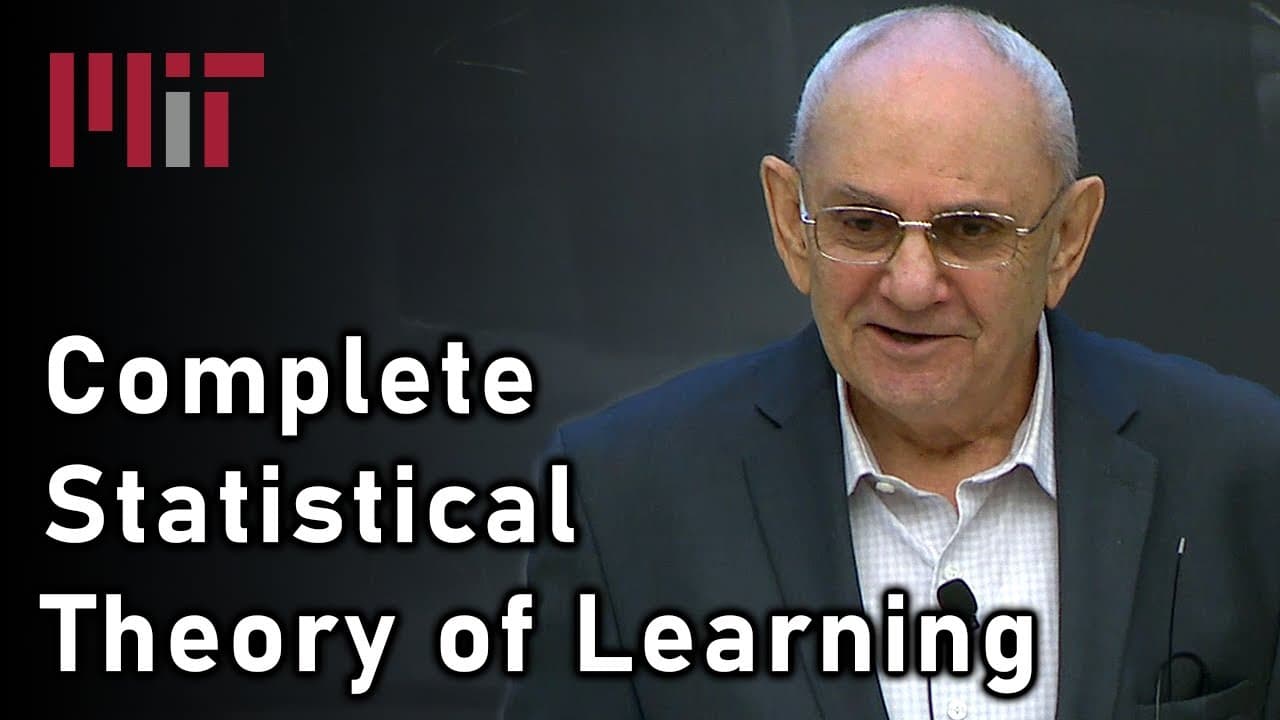
Complete Statistical Theory of Learning (Vladimir Vapnik) | MIT Deep Learning Series
TL;DR
Complete Statistical Learning Theory focuses on minimizing functions under constraints defined by admissible functions, utilizing invariants and predicates to enhance learning efficiency. The selection of smart predicates is crucial, as they impact the model's performance and understanding of the learning process. Through approaches like reproducing kernel Hilbert spaces, the theory provides frameworks for effective learning and classification.
Transcript
- Today, we're happy and honored to have Vladimir Vapnik with us, co-inventor of supported vector machines, support vector clustering, VC theory of statistical learning, and author of "Statistical Learning Theory". He's one of the greatest and most impactful statisticians and computer scientists of our time. Plus, he grew up in the Soviet Union, ev... Read More
Key Insights
- 🦮 Intelligent learning involves minimizing a functional with the help of invariants and predicates, which guide the learning process.
- 📱 The selection of smart predicates, abstract concepts that capture the essence of the problem, is crucial for improving learning performance.
- 😚 Reproducing kernel Hilbert space offers a closed-form solution to intelligent learning, while neural networks can be enhanced by incorporating smart predicates.
- 🚥 The concept of predicate symmetry, such as horizontal or vertical symmetry in images, can be used as a basis for understanding and classifying objects.
Install to Summarize YouTube Videos and Get Transcripts
Explore YouTube Video Summarizer or Get YouTube Transcript Extractor
Questions & Answers
Q: What is the main difference between invariants and predicates in intelligent learning?
Invariants are statistical patterns that ensure certain properties hold true for a given data set, aiding in the understanding of the problem. Predicates, on the other hand, are abstract concepts that serve as a basis for selecting admissible functions and guiding the learning process.
Q: How does the selection of predicates impact learning performance?
By selecting smart predicates, which capture the essence of the problem, the learning performance can be significantly improved. Smart predicates help identify invariants and allow for a better understanding of the underlying structure of the problem.
Q: Can you provide an example of a smart predicate for language classification tasks?
Smart predicates for language classification tasks could include analyzing sentence structure, syntactic patterns, semantic relationships, or word distributions. The choice of predicates depends on the specific problem and the desired properties to be captured.
Q: How can overfitting be prevented in intelligent learning?
Overfitting can be mitigated by using a larger number of predicates. Increasing the number of predicates reduces the set of admissible functions, thus controlling the complexity of the model and preventing overfitting.
Key Insights:
- Intelligent learning involves minimizing a functional with the help of invariants and predicates, which guide the learning process.
- The selection of smart predicates, abstract concepts that capture the essence of the problem, is crucial for improving learning performance.
- Reproducing kernel Hilbert space offers a closed-form solution to intelligent learning, while neural networks can be enhanced by incorporating smart predicates.
- The concept of predicate symmetry, such as horizontal or vertical symmetry in images, can be used as a basis for understanding and classifying objects.
- By carefully selecting predicates, it is possible to significantly improve learning performance and reduce overfitting.
Summary
In this video, Vladimir Vapnik discusses statistical learning theory and the importance of invariance and predicates in intelligent learning. He explains that there are two ways of convergence in Hilbert space: convergence of functions and convergence of functionals. The goal is to find the admissible set of functions that satisfy the desired invariants. Vapnik also explores the concept of predicates, which are abstract concepts that capture the essence of intelligence. He demonstrates the use of predicates in various examples, including pattern recognition and image transformation. Finally, Vapnik introduces the idea of tangent distance as a measure of symmetry and discusses its application in digit recognition.
Questions & Answers
Q: What is the difference between convergence of functions and convergence of functionals in Hilbert space?
Convergence of functions refers to the convergence of individual functions, while convergence of functionals refers to the convergence of functionals over a set of functions. In other words, it is the convergence of the inner product and norm of functions in Hilbert space, respectively. Both convergences are important in statistical learning theory.
Q: How are invariance and predicates related in intelligent learning?
Invariance is a property that remains unchanged under a certain transformation, while predicates are abstract concepts that capture specific properties or invariants. In intelligent learning, predicates are used to define the desired invariants, and the goal is to find the admissible set of functions that satisfy these invariants. In other words, predicates define the properties we want our function to have, and invariance ensures that these properties are maintained.
Q: Can you provide some examples of predicates and how they are used in learning?
Sure! Predicates can take various forms depending on the problem at hand. For example, a predicate could be a function that returns 1 when a certain condition is met and 0 otherwise. In digit recognition, a predicate could be based on the presence of certain features or patterns in the image. For instance, one could use the center of mass, Fourier coefficients, or Lie derivatives as predicates to define desired invariants. By using these invariants, one can improve the performance of learning algorithms.
Q: What is the significance of Lie derivatives in intelligent learning?
Lie derivatives are a mathematical tool that represents small linear transformations of a space. In the context of intelligent learning, Lie derivatives can be used to create clones or transformed versions of a given image or digit. By applying Lie derivatives, one can measure the closeness of two different digits or images in terms of the tangent distance. This concept of symmetry can help capture important features and patterns in the data, which can be used to improve learning algorithms.
Q: How do invariants and predicates contribute to the concept of intelligence?
Invariants and predicates play a crucial role in understanding and defining intelligence. Invariance represents properties that remain unchanged under certain transformations, while predicates capture specific features or patterns that define the desired behavior or concept. By using invariants and predicates in learning algorithms, we can obtain intelligent systems that are capable of generalizing and recognizing patterns or concepts even in the presence of noise and variations in the data.
Q: How can intelligent learning be applied to real-world problems?
Intelligent learning can be applied to a wide range of real-world problems, including pattern recognition, image classification, natural language processing, and many others. By incorporating invariants and predicates, we can improve the performance and robustness of learning algorithms in these domains. The ability to capture important features and patterns in the data is crucial for solving complex real-world problems and advancing the field of artificial intelligence.
Q: Are there any limitations or challenges associated with intelligent learning?
Like any approach, intelligent learning has its limitations and challenges. One challenge is the selection of appropriate invariants and predicates for a given problem. Choosing the right invariants and predicates requires domain knowledge and understanding of the problem at hand. Additionally, the dimensionality of the feature space and the complexity of the problem can also pose challenges. However, by combining statistical learning theory with intelligent learning principles, we can overcome these challenges and improve the performance of learning algorithms.
Q: How does intelligent learning compare to other approaches, such as deep learning?
Intelligent learning, with its focus on invariants and predicates, offers a different perspective compared to other approaches like deep learning. Deep learning relies on large-scale neural networks with many layers to learn complex representations from the data. In contrast, intelligent learning focuses on incorporating invariants and predicates to capture important features and patterns. While deep learning has achieved remarkable success in many domains, intelligent learning offers a complementary approach that can provide insights and improvements in various tasks.
Q: How can intelligent learning help improve existing machine learning algorithms?
Intelligent learning can help improve existing machine learning algorithms by providing additional insights and constraints. By incorporating invariants and predicates, we can guide the learning process and ensure that the resulting models are more interpretable, robust, and aligned with our expectations. By capturing important properties and patterns in the data, intelligent learning helps us better understand the underlying mechanisms and make more informed decisions in algorithm design and model selection.
Q: What are some practical applications of intelligent learning?
Intelligent learning can be applied in various practical applications, such as image recognition, speech recognition, natural language processing, anomaly detection, and many more. By incorporating invariants and predicates, we can improve the performance and interpretability of machine learning models in these domains. This can lead to more accurate and reliable systems that can make intelligent decisions and adapt to different contexts or environments.
Takeaways
Intelligent learning involves the use of invariants and predicates to capture important features and patterns in the data. By incorporating invariants and predicates, we can design learning algorithms that have improved performance, interpretability, and robustness. Intelligent learning offers a different perspective compared to other approaches, such as deep learning, and complements existing machine learning techniques. Additionally, intelligent learning has practical applications in various domains, including image recognition, speech recognition, and natural language processing. By focusing on invariants and predicates, we can advance the field of artificial intelligence and design more intelligent systems.
Summary & Key Takeaways
-
In intelligent learning, the goal is to minimize a functional while adhering to a set of admissible functions, with the help of invariants and predicates.
-
Invariants, derived from statistical reasoning, ensure that certain properties hold true, while predicates, abstract concepts, provide the basis for understanding and solving problems.
-
Reproducing kernel Hilbert space offers a closed-form solution for intelligent learning, while neural networks can be improved using smart predicates.
-
The choice of predicates is essential, as they determine the specific characteristics and invariants that guide the learning process.
Read in Other Languages (beta)
Share This Summary 📚
Summarize YouTube Videos and Get Video Transcripts with 1-Click
Try YouTube Summary with ChatGPT & Claude or YouTube Transcript Generator
Explore More Summaries from Lex Fridman 📚




Summarize YouTube Videos and Get Video Transcripts with 1-Click
Try YouTube Summary with ChatGPT & Claude or YouTube Transcript Generator