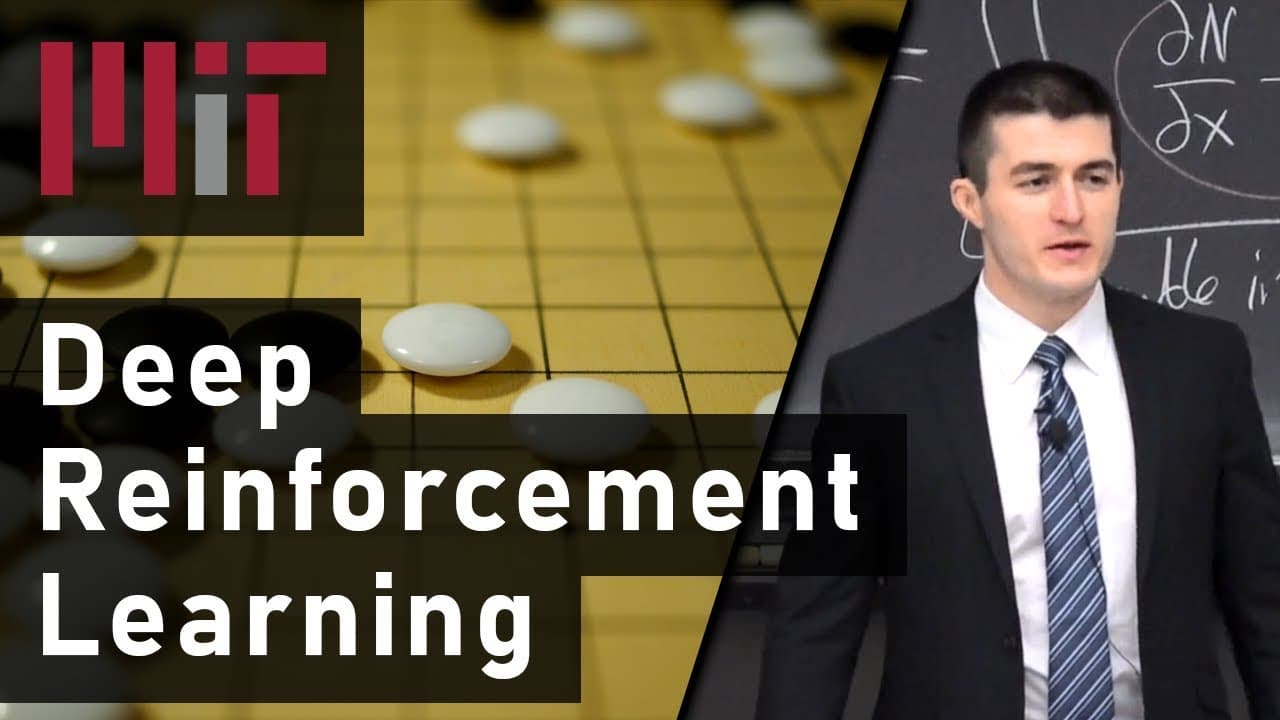
MIT 6.S094: Deep Reinforcement Learning
TL;DR
Deep reinforcement learning combines neural networks with reinforcement learning principles to help systems learn to make decisions based on raw sensory data. It translates complex input into actionable knowledge, enabling applications in video games, industrial robotics, and autonomous vehicles. This technology is significant for developing intelligent systems capable of adapting to real-world environments.
Transcript
today we will talk about deep reinforcement learning the question we would like to explore it's to which degree we can teach systems to act to perceive and act in this world from data so let's take a step back and think of what is the full range of tasks then artificial intelligence system needs to accomplish here's the stack from top to bottom top... Read More
Key Insights
- 😒 Deep reinforcement learning uses neural networks to convert raw sensor data into useful representations for decision making.
- 🧑🏭 Exploration and exploitation are important factors in learning and decision making using deep reinforcement learning.
- 🎮 Deep reinforcement learning has shown promise in video games, industrial robotics, and autonomous vehicles.
Install to Summarize YouTube Videos and Get Transcripts
Explore YouTube Video Summarizer or Get YouTube Transcript Extractor
Questions & Answers
Q: What is the main goal of deep reinforcement learning?
The main goal of deep reinforcement learning is to train systems to perceive and act in the world based on rewards and actions, using neural networks to convert raw sensor data into useful information.
Q: How does deep reinforcement learning work in video games?
In video games, the system uses deep reinforcement learning to learn from sparse reward data, taking advantage of the temporal consistency of the game's dynamics to make decisions based on limited supervision.
Q: Can deep reinforcement learning be applied to real-world tasks like autonomous vehicles?
Deep reinforcement learning has shown promise in real-world tasks like autonomous vehicles, but challenges in integrating different types of information and effectively reasoning and planning in complex environments still exist.
Q: What are some of the key insights from deep reinforcement learning?
Some key insights include the use of neural networks to learn representations from raw sensor data, the importance of exploration and exploitation in learning, and the potential for deep reinforcement learning to solve complex, high-dimensional problems.
Summary
In this video, the speaker discusses deep reinforcement learning and its application to various tasks, including games and traffic simulation. They explain the components of an artificial intelligence system that acts in the world, such as input, representation, knowledge, reasoning, and action planning. They also introduce Q-learning, which uses a neural network to estimate the value of taking an action in a state. The speaker then presents the concept of deep traffic, a simulation framework where a red car controlled by a neural network navigates a grid space to achieve the highest average speed while avoiding collisions. They explain the parameters and customization options available for deep traffic and encourage the viewer to try it themselves.
Questions & Answers
Q: What is the full stack of an artificial intelligence system that acts in the world?
The full stack includes input (sensed by sensors and converted to machine-interpretable data), representation (extracting features and structure from the data for understanding), knowledge (aggregating useful information from the representations), reasoning (connecting and making sense of the knowledge), and action planning (making plans based on objectives).
Q: What is the objective of reinforcement learning?
The objective of reinforcement learning is to learn from sparse reward data and use the temporal dynamics of the environment to propagate and generalize that information. The goal is to maximize the accumulated rewards over time.
Q: What is the difference between supervised learning and unsupervised learning?
Supervised learning requires labeled data provided by human beings, while unsupervised learning does not rely on labeled data. Reinforcement learning falls in between, with some sparse input from humans.
Q: What are some of the key tricks for successful reinforcement learning?
Some key tricks include using experience replay to randomly sample prior experiences during training, fixing the target network to stabilize the learning process, and reward clipping to simplify the reward structure. Each trick contributes to the stability and efficiency of the learning process.
Q: How is deep reinforcement learning applied to the game of Go?
Deep reinforcement learning in Go involves using Monte Carlo tree search (MCTS) in combination with neural networks. The neural network provides the intuition for which moves to explore, and MCTS evaluates the quality of those moves. Alphago and Alphago Zero are examples of successful applications of deep reinforcement learning in Go.
Q: What is Deep Traffic?
Deep Traffic is a simulation framework where a car controlled by a neural network aims to achieve the highest average speed in a micro traffic simulation. The car makes decisions such as changing lanes, speeding up, or slowing down to navigate through traffic. Users can customize parameters, train their own networks, and compete in the Deep Traffic competition.
Q: What is the state representation in Deep Traffic?
The state representation in Deep Traffic is an occupancy grid that shows the status of each grid cell on the road. Empty cells indicate clear road space, while cells with other cars show their speeds. This grid serves as the input to the neural network.
Q: How is training and evaluation performed in Deep Traffic?
Training in Deep Traffic is done using Q-learning with a neural network. Training is carried out in the browser and can be customized with different parameters. Evaluation involves averaging the speed of the car over multiple runs and taking the median speed as the final score.
Q: Can Deep Traffic networks compete with each other?
Deep Traffic networks can compete with each other in the competition by submitting the trained models for evaluation. The highest score achieved by a network is what counts in the competition.
Q: Can Deep Traffic networks be visualized with custom images?
Yes, users can load their own custom images and specify colors for visualization in Deep Traffic. They can also request a visualization of the trained network's performance, although this feature is not yet available.
Takeaways
Deep reinforcement learning has made significant advancements in various tasks, including games and traffic simulation. Neural networks, coupled with reinforcement learning algorithms, have shown great potential in learning from sparse reward data and making sense of complex environments. Deep Traffic provides a practical and customizable interface for training and evaluating neural networks in a simulated traffic simulation. The key to success in deep reinforcement learning lies in the implementation of various tricks like experience replay, fixed target networks, and reward clipping. These techniques, combined with scalable neural network architectures, enable the learning of complex behaviors and decision-making processes.
Summary & Key Takeaways
-
Deep reinforcement learning involves training systems to perceive and act in the world based on rewards and actions.
-
Neural networks are used to convert raw sensor data into higher order representations that enable the system to make decisions.
-
Applications of deep reinforcement learning include video games, industrial robotics, and autonomous vehicles.
Read in Other Languages (beta)
Share This Summary 📚
Summarize YouTube Videos and Get Video Transcripts with 1-Click
Try YouTube Summary with ChatGPT & Claude or YouTube Transcript Generator
Explore More Summaries from Lex Fridman 📚



Summarize YouTube Videos and Get Video Transcripts with 1-Click
Try YouTube Summary with ChatGPT & Claude or YouTube Transcript Generator