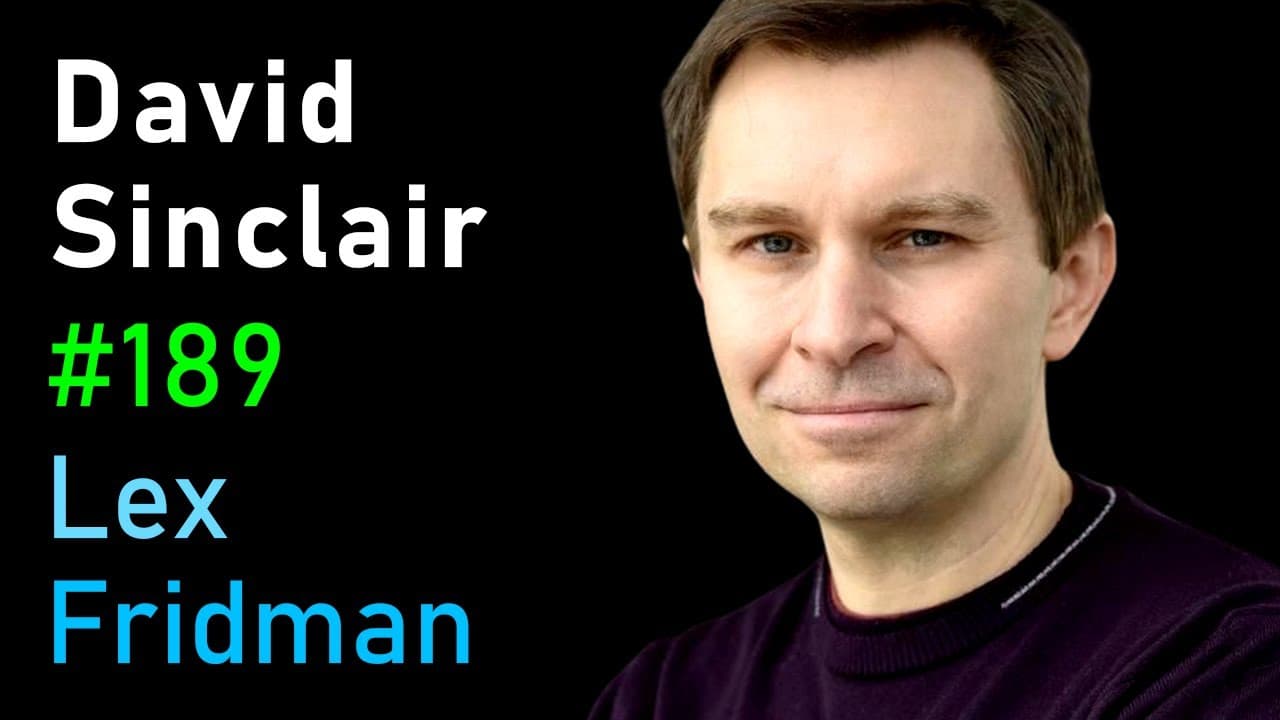
David Sinclair: Extending the Human Lifespan Beyond 100 Years | Lex Fridman Podcast #189
TL;DR
David Sinclair, a genetics professor at Harvard, discusses the potential of turning aging into an engineering problem, the impact of longevity research on society, and the use of bio wearables and AI in extending and improving human life.
Transcript
the following is a conversation with david sinclair he is a professor in the department of genetics at harvard and co-director of the paul f glenn center for the biology of aging at harvard medical school he's the author of the book lifespan and co-founder of several biotech companies he works on turning age into an engineering problem and solving ... Read More
Key Insights
- 🤕 The preservation of information and its loss due to entropy is a defining factor in aging, according to Sinclair.
- 💁 The backup copy or observer of information in the body could potentially reset the epigenome and extend lifespan.
- 😷 AI plays a crucial role in analyzing biological data, predicting health outcomes, and enhancing medical research.
- 😒 The future of healthcare includes the widespread use of wearables, monitoring devices, and personalized medicine.
- 👨🔬 Calorie restriction, intermittent fasting, and plant-based diets are among the strategies that may promote longevity, although further research is needed.
- 🐭 The tension between growth and reproduction (mouse-like) and preservation and longevity (whale-like) can be influenced by dietary choices, such as meat consumption.
- 😵 Xeno-hormetic molecules produced by plants under adversity may have cross-species health benefits and promote longevity.
Install to Summarize YouTube Videos and Get Transcripts
Explore YouTube Video Summarizer or Get YouTube Transcript Extractor
Questions & Answers
Q: How does David Sinclair view the tension between feeling like a kid internally and experiencing the physical effects of aging?
Sinclair acknowledges the tension but sees the ability to maintain a childlike wonder as a gift, which helps him approach scientific discoveries with fresh perspectives. He also mentions the need to balance maturity with the responsibilities of running a lab and other professional endeavors.
Q: What impact did Sinclair's grandmother have on his views about life, death, and love?
Sinclair's grandmother, who witnessed the worst of humanity, instilled in him the importance of maintaining a sense of innocence, wonder, and love for making humanity better. Her experiences shaped his perspective and his dedication to leaving a positive impact.
Q: How does Sinclair view the idea of bringing deceased loved ones back through artificial intelligence?
Sinclair finds the concept intriguing and thinks it could be a form of artificial immortality, especially for those who died young. However, he also acknowledges the potential challenges, such as hindering the process of moving on and the ethical considerations of preserving the best parts of a person's life.
Q: How does Sinclair view the role of wearables and data collection in improving human health and longevity?
Sinclair believes that wearables and constant monitoring can revolutionize healthcare by allowing individuals to detect health issues earlier and make more informed decisions about their well-being. He envisions a future where individual experiences and data can be replicated digitally, aiding in personalized healthcare and longevity research.
Key Insights:
- The preservation of information and its loss due to entropy is a defining factor in aging, according to Sinclair.
- The backup copy or observer of information in the body could potentially reset the epigenome and extend lifespan.
- AI plays a crucial role in analyzing biological data, predicting health outcomes, and enhancing medical research.
- The future of healthcare includes the widespread use of wearables, monitoring devices, and personalized medicine.
- Calorie restriction, intermittent fasting, and plant-based diets are among the strategies that may promote longevity, although further research is needed.
- The tension between growth and reproduction (mouse-like) and preservation and longevity (whale-like) can be influenced by dietary choices, such as meat consumption.
- Xeno-hormetic molecules produced by plants under adversity may have cross-species health benefits and promote longevity.
(Note: Due to the nature of the text, some of the proposed questions and answers lack specific details. Additional information could be added based on context and further research.)
Summary
In this conversation with David Sinclair, a professor in the Department of Genetics at Harvard and co-director of the Paul F. Glenn Center for the Biology of Aging at Harvard Medical School, they discuss the topic of aging, the preservation and loss of information in the human body, wearables and collecting biological data, and the potential of AI in biology.
Questions & Answers
Q: Do you feel the tension of being the same person but still aging?
Sinclair feels the tension of still feeling like a kid but having adult responsibilities. He believes that having a childlike wonder is important, as it allows him to see things for the first time and strive to make humanity better.
Q: How has Sinclair's grandmother influenced his thinking about life and death?
Sinclair's grandmother, who raised him partially, instilled in him a sense of wonder about the world and a desire to make humanity the best it can be. She experienced the worst of humanity during the Second World War and the Hungarian Revolution, which shaped her perspective on life.
Q: Is it possible to bring back loved ones through artificial intelligence and achieve a form of immortality?
Sinclair believes that it could be possible to bring back loved ones by replicating their experiences and thoughts through recorded data. He sees this as a form of artificial immortality and mentions a Black Mirror episode that explores a similar idea.
Q: What excites Sinclair about wearables and collecting biological data?
Sinclair, being a biologist, finds the merging of machines and humans fascinating. He envisions a future where wearables constantly monitor and provide insights about a person's health, allowing for early detection of health issues and personalized recommendations for improvement.
Q: How does aging occur from an engineering perspective?
Aging is seen as both a bug and a feature of biological machines. Evolutionarily, living organisms only live as long as they need to reproduce efficiently. Age-related diseases and the decline of the body are caused by the loss and degradation of information in the cell, which can be compared to wear and tear.
Q: What are the main causes of aging and how can they be addressed?
Sinclair mentions two main causes of aging that his research focuses on: the reorganization of the epigenome due to broken chromosomes and cell stress. By understanding and targeting these causes, it may be possible to slow down or reverse the aging process. He mentions recent research on using three embryonic genes to reset the age of tissues in mice.
Q: How can AI be utilized in biology and aging research?
Sinclair emphasizes that AI is crucial in biology and aging research. It is used to generate biological clocks, predict protein folding, assemble genomes, and predict longevity based on various factors. The amount of data generated in biology is increasing rapidly, and AI helps in analyzing and making sense of this data.
Q: How can more data be collected and shared in the field of biology?
Sinclair discusses the increasing digitization of medical records and the potential future of widespread monitoring through biosensors. He predicts that there may be a shift where it becomes one's responsibility to collect and monitor their health data, similar to how social media has become normalized over time.
Q: Is there a path forward for sharing more data in biology despite privacy concerns?
Sinclair believes that there will be a reversal in attitudes toward sharing health data. He mentions a potential future court case where not using biosensors could be seen as negligent, leading to widespread adoption of data collection and monitoring. The digitization of medical records and increasing awareness of the benefits of data sharing may also contribute to a more open environment for data collection in biology.
Q: How does Sinclair see the future of biology and aging research?
Sinclair is optimistic about the future of biology and aging research. He believes that with advancements in AI, genetic engineering, and the understanding of information preservation, it will be possible to extend human lifespan and improve overall health. He mentions ongoing human studies and the potential for significant breakthroughs within the next few years.
Takeaways
Advances in wearables and the collection of biological data provide opportunities for early detection of health issues and personalized recommendations for improvement. Aging is caused by the loss and degradation of information in the cell, which can be addressed through genetic engineering and the resetting of age-related changes. AI plays a crucial role in biology and aging research, aiding in data analysis and prediction. Sharing more data in biology may become more normalized, and a future where widespread monitoring and data collection is the norm is foreseeable. The future of biology and aging research holds promise for extending human lifespan and improving overall health.
Summary & Key Takeaways
-
David Sinclair discusses his personal experience of feeling the same internally despite aging and the tension between being a scientist and still feeling like a kid.
-
He shares the influence of his grandmother, who instilled in him a sense of wonder about the world and the importance of leaving it a better place.
-
Sinclair talks about the potential of artificial intelligence in bringing back deceased loved ones and achieving a form of artificial immortality.
Read in Other Languages (beta)
Share This Summary 📚
Summarize YouTube Videos and Get Video Transcripts with 1-Click
Try YouTube Summary with ChatGPT & Claude or YouTube Transcript Generator
Explore More Summaries from Lex Fridman Podcast 📚
Summarize YouTube Videos and Get Video Transcripts with 1-Click
Try YouTube Summary with ChatGPT & Claude or YouTube Transcript Generator