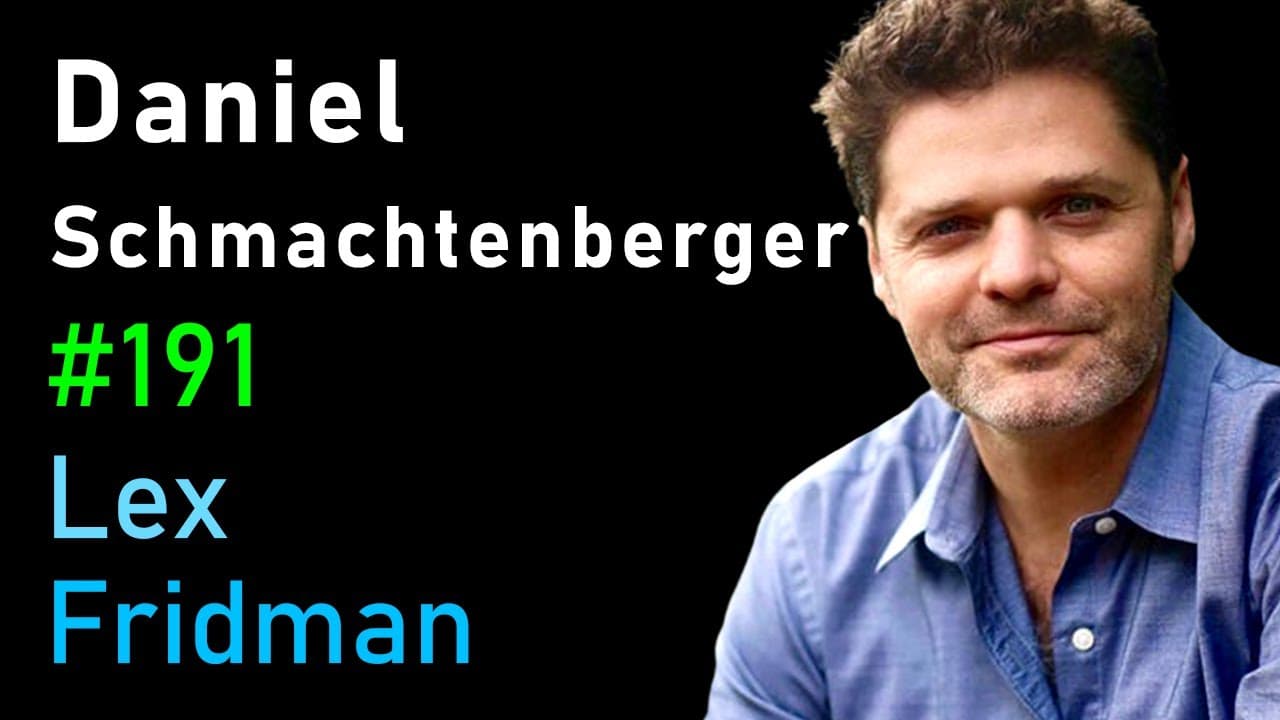
Daniel Schmachtenberger: Steering Civilization Away from Self-Destruction | Lex Fridman Podcast #191
TL;DR
Humanity's path away from self-destruction relies on understanding the mimetic theory, which posits that people imitate each other's desires, leading to both social cohesion and conflict. By recognizing the influence of our desires on behavior, we can better navigate cultural evolution and foster cooperation, rather than rivalry, among individuals and societies.
Transcript
the following is a conversation with Daniel schmachtenberger a founding member of the consilience project that is aimed at improving public sens making and dialogue he's interested in understanding how we humans can be the best version of ourselves as individuals and as collectives at all scales quick mention of our sponsors ground news netsuite fo... Read More
Key Insights
- 🥺 Mimetic theory proposes that humans learn and imitate desires and behaviors from others, leading to increased complexity and cultural evolution.
- 🥺 Mimetic desire can lead to conflict and competition among individuals as they imitate and desire what others possess.
- 💁 Mimetic theory explains the formation of social groups based on shared desires and interests.
- ❓ The concept of mimetic desire can be applied to cognitive development and learning, emphasizing the role of imitation in acquiring knowledge and skills.
Install to Summarize YouTube Videos and Get Transcripts
Explore YouTube Video Summarizer or Get YouTube Transcript Extractor
Questions & Answers
Q: How does mimetic theory explain human uniqueness compared to other animals?
Mimetic theory suggests that humans' ability to imitate and learn from others is what sets them apart, allowing for cultural evolution and increased complexity not seen in other species.
Q: Does mimetic desire lead to conflict among humans?
Yes, mimetic desire can lead to conflict as individuals imitate and desire what others possess. This can create competition and tension within social groups.
Q: How does mimetic theory explain social dynamics and the formation of social groups?
Mimetic theory suggests that individuals imitate the desires and behaviors of others, leading to the formation of social groups based on shared desires and interests.
Q: Can mimetic theory be applied to cognitive development and learning?
Yes, mimetic theory can be applied to cognitive development and learning as it emphasizes the role of imitation and learning from others in the acquisition of knowledge and skills.
Key Insights:
- Mimetic theory proposes that humans learn and imitate desires and behaviors from others, leading to increased complexity and cultural evolution.
- Mimetic desire can lead to conflict and competition among individuals as they imitate and desire what others possess.
- Mimetic theory explains the formation of social groups based on shared desires and interests.
- The concept of mimetic desire can be applied to cognitive development and learning, emphasizing the role of imitation in acquiring knowledge and skills.
- Seeking dialectical synthesis and embracing diverse perspectives can lead to greater personal and societal growth.
Summary
In this video, Lex Friedman interviews Daniel Schmachtenberger, a founding member of the Consilience Project. They discuss various topics including the possibility of intelligent alien civilizations, the nature of consciousness, and the emergence of complexity from simple rules.
Questions & Answers
Q: If aliens were observing Earth throughout history, how do you think they would summarize human civilization?
If aliens were observing Earth, they would probably distill human civilization into a concise summary. However, it is important to consider that aliens may have different sensory perceptions and consciousness compared to humans. Assuming they are technologically advanced beings, they might not view Earth as a planet capable of intergalactic survival due to our history of destruction and lack of progress in guiding and governing technological advancements.
Q: Do you think there are intelligent alien civilizations out there?
It is hard to think otherwise. With the number of Kepler planets and the discovery of life forms with different building blocks, it is unlikely that Earth is the only planet with intelligent life. There may be explanations and phenomenon that we have yet to discover, such as the presence of UFOs.
Q: Do you think governments would keep possession of or information about alien spacecraft secret or share it with the public?
Governments may choose to keep possession or information about alien spacecraft secret for a variety of reasons, ranging from national security concerns to bureaucratic incompetence. Some scientists have conducted research on recovered material from supposed alien crash sites, suggesting the existence of advanced alien technology. While these claims require further study, it is important to approach these topics with curiosity and an open mind.
Q: What do you make of the rich human psychology regarding the belief in UFOs and extraterrestrial life?
The belief in UFOs and extraterrestrial life has gained popularity recently, with numerous witness accounts and sightings. While some instances can be written off as natural phenomena or military technology, there are also credible reports from trained observers such as fighter pilots and astronauts. It is intriguing to consider these accounts and their potential implications, but further investigation is needed to separate fact from fiction.
Q: Is consciousness a consequence of our social connections and interactions?
Consciousness is a complex topic that is difficult to define. While many believe that consciousness emerges from biology and neural networks, others, like Daniel Schmachtenberger, argue that consciousness is not an emergent property but rather an inherent aspect of reality. He suggests that consciousness evolves alongside greater complexity within the domains of first-person and third-person experiences. The human brain, being a unique biological structure with intricate neural networks, allows for more advanced forms of consciousness. However, it is important to acknowledge that our understanding of consciousness is still limited, and there may be unknown factors at play.
Q: Could robots become conscious by simulating or imitating human consciousness?
The possibility of robots becoming conscious through simulation or imitation of human consciousness is an open question. Some argue that consciousness may not be fundamental or that it is an illusion. Others propose that robots can achieve consciousness by convincingly imitating human traits through complex algorithms and neural networks. Ultimately, our understanding of consciousness and the potential for artificial consciousness is still in its early stages, and further research is needed.
Q: How does the emergence of complexity from simple rules in systems like cellular automata relate to the complexity of human consciousness?
The emergence of complexity from simple rules, as seen in systems like cellular automata, is awe-inspiring. These systems showcase how simple interactions between cells can give rise to intricate and seemingly intelligent behaviors. This emergence occurs due to the underlying rules governing the interactions and coordination of the cells. While these systems may not directly relate to the complexity of human consciousness, they highlight the potential for complex behavior to emerge from simple rules. It emphasizes the importance of understanding the fundamental rules and principles that govern complex systems.
Takeaways
The conversation between Lex Friedman and Daniel Schmachtenberger covers a wide range of thought-provoking topics. They explore the possibility of intelligent alien civilizations, the nature of consciousness, and the emergence of complexity in various systems. While many questions remain unanswered, it is clear that these areas are still shrouded in mystery and require further investigation. The complexity and interconnectedness of these subjects highlight the need for a deeper understanding of ourselves and the world around us.
Summary & Key Takeaways
-
Mimetic theory proposes that humans learn desires and behaviors by imitating others, leading to conflict and social dynamics.
-
Humans are unique in their ability to learn and adapt through mimesis, allowing for cultural evolution and increased complexity.
-
Mimetic desire influences individual wants and behaviors, shaping our relationships and societal structures.
Read in Other Languages (beta)
Share This Summary 📚
Summarize YouTube Videos and Get Video Transcripts with 1-Click
Try YouTube Summary with ChatGPT & Claude or YouTube Transcript Generator
Explore More Summaries from Lex Fridman Podcast 📚





Summarize YouTube Videos and Get Video Transcripts with 1-Click
Try YouTube Summary with ChatGPT & Claude or YouTube Transcript Generator