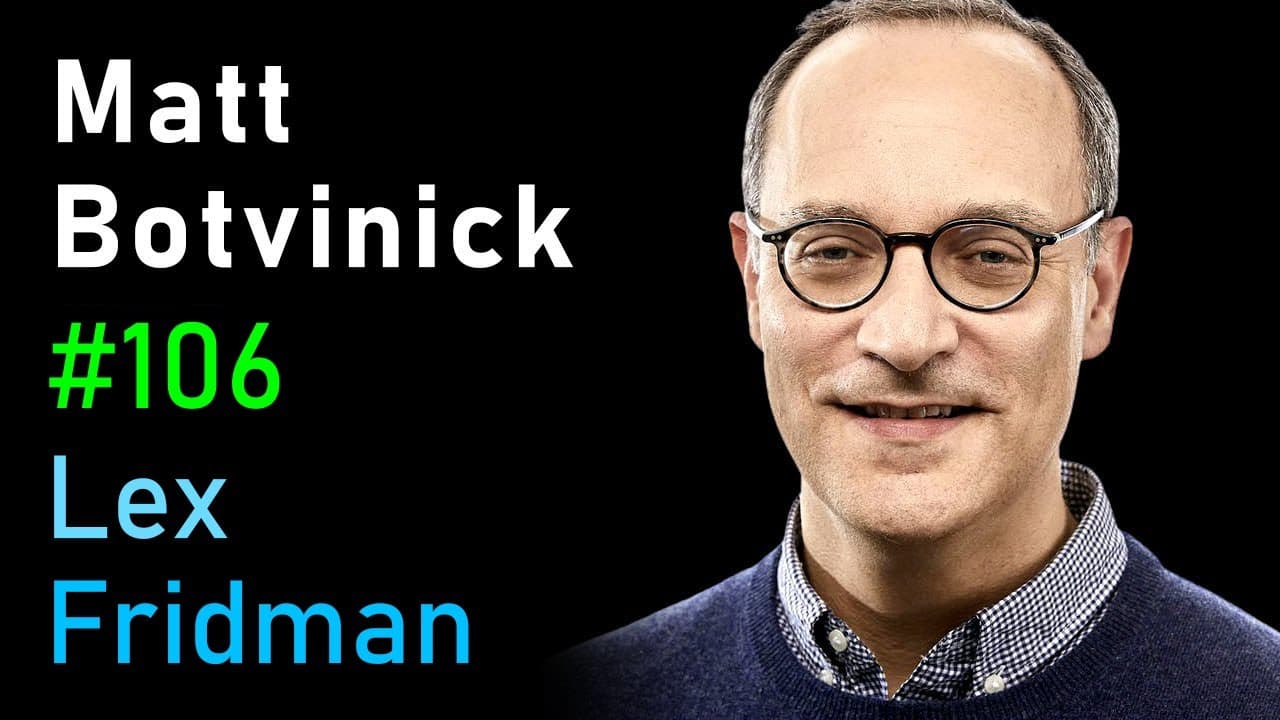
Matt Botvinick: Neuroscience, Psychology, and AI at DeepMind | Lex Fridman Podcast #106
TL;DR
The prefrontal cortex is essential for flexible, goal-directed behavior, enabling adaptation and the ability to override habitual actions in response to new situations. This brain region functions like a reinforcement learning system, where dopamine signaling influences decision-making and the continuous updating of behaviors based on experiences.
Transcript
the following is a conversation with Matt Botvinnik director of neuroscience research deep mind he's a brilliant cross-disciplinary mind navigating effortlessly between cognitive psychology computational neuroscience and artificial intelligence quick summary of the ads to sponsors the Jordan Harbinger show and magic spoon cereal please consider sup... Read More
Key Insights
- 🧠 The prefrontal cortex is important for flexible and goal-directed behavior, allowing us to override habits and adapt to new situations.
- 🌐 Meta-learning, or learning to learn, is a key concept in both neuroscience and artificial intelligence, where experience in one task makes us better at learning something new.
- 🌊 The prefrontal cortex operates using recurrent connectivity, which allows for the retention of information and the ability to update behavior over time.
- 💡 The dynamics of recurrent neural networks can give rise to a learning algorithm, where the slow learning process shapes the network's activity patterns and creates a form of meta-learning.
- 🔄 The prefrontal cortex's activity-based memory and reinforcement learning may play a role in shaping its recurrent dynamics, with dopamine being a potential mediator of synaptic-level mechanisms.
- 📚 Deep learning models show similarities to the brain's communication through rate coding, where the frequency of neuronal spiking carries information.
- 💭 The brain's communication mechanisms are still a topic of exploration, and new techniques are uncovering additional information about voltage fluctuations and potential non-spike-based communication.
Install to Summarize YouTube Videos and Get Transcripts
Explore YouTube Video Summarizer or Get YouTube Transcript Extractor
Questions & Answers
Q: How does the prefrontal cortex contribute to flexible behavior and adaptation?
The prefrontal cortex is believed to function as a reinforcement learning system, allowing for the updating of behavior based on expected rewards and punishments. Through the modulation of synaptic weights and neuronal connectivity, guided by dopamine signaling, the prefrontal cortex shapes the activation patterns and dynamics necessary for flexible behavior and adaptation.
Q: How do the activation patterns in the prefrontal cortex emerge as a learning algorithm?
The prefrontal cortex's activation patterns emerge as a learning algorithm through a two-step process. First, a slow learning algorithm adjusts the synaptic weights of the recurrent neural network in the prefrontal cortex, shaping the network dynamics over time. Second, these dynamics become a learning algorithm in and of themselves, allowing for the optimization of behavior based on rewards and punishments.
Q: What role does dopamine play in shaping the dynamics of the prefrontal cortex?
Dopamine is believed to play a crucial role in shaping the dynamics of the prefrontal cortex. Dopamine signaling modulates the synaptic weights and connectivity of neurons in the prefrontal cortex, affecting the activation patterns and activity-based memory necessary for reinforcement learning and flexible behavior.
Q: How does the understanding of the prefrontal cortex as a reinforcement learning system contribute to our understanding of learning and decision-making in the brain?
Viewing the prefrontal cortex as a reinforcement learning system provides insights into the mechanisms of learning and decision-making in the brain. It highlights the importance of neuronal connectivity, synaptic plasticity, and dopamine signaling in shaping behavior and adaptation. Understanding these processes can help unravel the complexities of cognitive function and inform the development of artificial intelligence models.
Summary
In this conversation, Matt Botvinnik, director of neuroscience research at DeepMind, discusses his views on understanding the human brain and intelligence. He explains that while we have made progress in neuroscience at a high level, there is still much we do not understand about the neuronal mechanisms underlying brain functions. Botvinnik argues for the importance of studying the brain in the context of behavior and emphasizes the need to bridge the gap between psychology, neuroscience, and cognitive science. He also explores the beauty and mystery of the human brain, the challenges of studying intelligence in groups, and the role of the prefrontal cortex in flexible behavior.
Questions & Answers
Q: How much of the human brain do we understand?
We understand a lot about the brain at a high level, but only at a very coarse level. While we have made progress in identifying the functions and behaviors of the brain, we still lack a deep understanding of the neuronal mechanisms underlying these processes.
Q: What is the relationship between cognitive psychology, neuroscience, and artificial intelligence?
Botvinnik argues that there should not be a distinction between psychology and neuroscience. Neuroscience, for him, is the study of what the brain is for, while psychology is about understanding the structure of brain function. He believes that these disciplines are interconnected and necessary for a comprehensive understanding of the brain and intelligence.
Q: Can we understand the mind without delving into the messy details of neuroscience?
While Botvinnik acknowledges the value of psychology, he believes that a full understanding of the mind requires studying the brain at a mechanistic level. He sees the brain as a computational device and wants to uncover the basic computations that underlie human cognition.
Q: Are there limitations to psychology in terms of studying human behavior?
Botvinnik recognizes the limitations of highly controlled experiments in psychology. While such experiments provide insight into the structure of the mind, they often miss out on the richness and complexity of real-world behavior. He suggests that studying humans in their natural environments, such as through online data analysis, can offer a more comprehensive view of behavior.
Q: Is there something beautiful or profound about the mechanics of the human brain?
Botvinnik finds the human brain fascinating due to its ability to create the entirety of our experiences. He is captivated by the paradox of how the brain, which seems distant and mysterious, is responsible for making everything obvious and familiar. The subjective nature of the human experience is also of great interest to him.
Q: How does the prefrontal cortex contribute to intelligence?
The prefrontal cortex, located in the front part of the brain, is responsible for flexible behavior and overriding habitual actions. It allows us to adapt to new experiences, change our behaviors according to the context, and reason about appropriate behavior. Damage to the prefrontal cortex can lead to difficulties in adapting to new situations and changing habitual actions.
Q: Is intelligence solely an individual characteristic or does it involve group behavior?
While group behavior influences human cognition, Botvinnik believes that intelligence is primarily an individual characteristic. However, he acknowledges that understanding intelligence in the context of groups is important and that the structure of the environment plays a significant role in shaping cognitive processes.
Q: What are some differences between artificial neural networks and biological neural networks?
One notable difference is the flexibility of human behavior compared to artificial neural networks. Human intelligence shows readiness to adapt and change behaviors according to the context, which is lacking in current AI systems. Botvinnik suggests that studying self-play mechanisms in AI can shed light on the importance of competition and adaptability in intelligence.
Q: Is there a fundamental role for large groups and community behavior in intelligence?
While Botvinnik acknowledges the role of communities in human behavior, he personally sees intelligence as an individual characteristic. However, he believes that a serious effort to understand intelligence should consider the structure of the environment and the interaction between individuals and communities.
Q: What is known about the prefrontal cortex in other animals?
Research on the prefrontal cortex in other animals, such as mice and fruit flies, is still ongoing. There are disagreements about the cognitive capabilities of these animals, with some arguing for the presence of cognitive flexibility and abstractions. More studies using technologies like neural monitoring and manipulation techniques are needed to gain a clearer understanding.
Summary & Key Takeaways
-
The prefrontal cortex is a region of the brain responsible for flexible behavior and adaptation to new experiences.
-
It functions as a reinforcement learning system, allowing for the updating of behavior based on the expected rewards and punishments associated with specific actions.
-
The activation patterns and dynamics of the prefrontal cortex are shaped by the connectivity of neurons and the modulation of synaptic weights, guided by dopamine signaling.
-
This understanding of the prefrontal cortex as a reinforcement learning system provides insights into the mechanisms of learning and decision-making in the brain.
Read in Other Languages (beta)
Share This Summary 📚
Summarize YouTube Videos and Get Video Transcripts with 1-Click
Try YouTube Summary with ChatGPT & Claude or YouTube Transcript Generator
Explore More Summaries from Lex Fridman Podcast 📚





Summarize YouTube Videos and Get Video Transcripts with 1-Click
Try YouTube Summary with ChatGPT & Claude or YouTube Transcript Generator