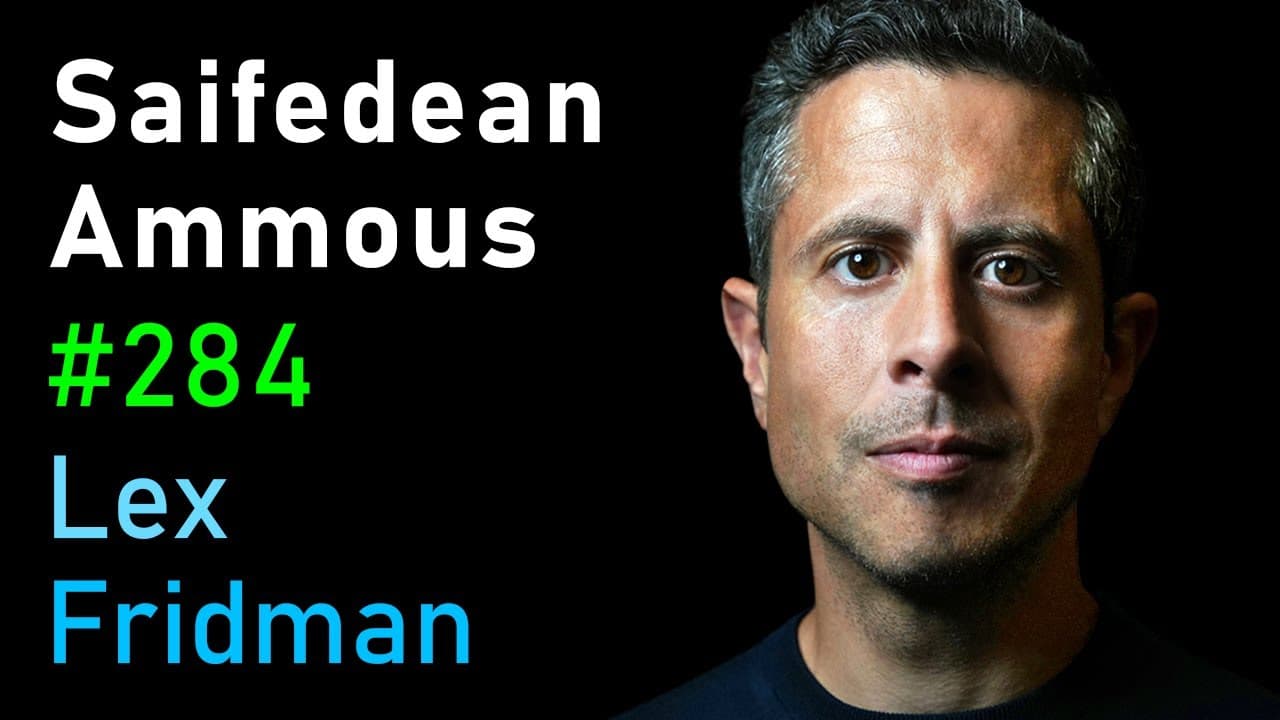
Saifedean Ammous: Bitcoin, Anarchy, and Austrian Economics | Lex Fridman Podcast #284
TL;DR
Money serves as a medium of exchange that enables the division of labor and market growth. Hard money, like gold, maintains its value over time, while soft money, such as fiat currencies, is easily inflated and can lead to economic instability. Understanding these distinctions is crucial for grasping economic principles.
Transcript
you can't have permanent war without fiat and i also think there's a case to be made that you can't really have fiat without war the following is a conversation with safety in a moose one of the central and most impactful economists philosophers and educators in the world of bitcoin he's an austrian economist an anarchist and the author of the bitc... Read More
Key Insights
- 🤑 Money serves as a medium of exchange and allows for the division of labor in a market system.
- 🤑 Hard money, like gold, retains its value over time and provides stability in the economy.
- 🤑 Soft money, such as fiat currency, is easily producible and prone to inflation, leading to uncertainties and economic instability.
- 🖤 Keynesian economics, which advocates for moderate inflation, lacks empirical evidence and fails to address the negative consequences of inflation.
- 🎙️ More videos with Saifedean Ammous:
Install to Summarize YouTube Videos and Get Transcripts
Explore YouTube Video Summarizer or Get YouTube Transcript Extractor
Questions & Answers
Q: What is the distinction between hard money and soft money?
Hard money refers to currencies that are difficult to produce, such as gold, while soft money is easily producible, like fiat currency. Hard money retains its value over time, while soft money is prone to inflation and devaluation.
Q: What is the main critique of Keynesian economics?
The main critique is that Keynesian economics promotes inflation as a solution to economic problems, but historical evidence suggests that high inflation rates lead to economic instability and unemployment.
Q: Can you provide an example of a country that experienced high inflation and high unemployment?
The 1970s in the United States and other Western economies is a prime example of a period when high inflation coincided with high unemployment, refuting the Keynesian notion that increased spending can result in both low unemployment and low inflation.
Q: Is there any validity to the argument that a little inflation stimulates spending?
There is little empirical evidence to support this claim. Inflation can erode purchasing power and create uncertainty, leading individuals to save rather than spend. Additionally, moderate inflation can easily spiral into high inflation without providing any sustainable economic benefits.
Key Insights:
- Money serves as a medium of exchange and allows for the division of labor in a market system.
- Hard money, like gold, retains its value over time and provides stability in the economy.
- Soft money, such as fiat currency, is easily producible and prone to inflation, leading to uncertainties and economic instability.
- Keynesian economics, which advocates for moderate inflation, lacks empirical evidence and fails to address the negative consequences of inflation.
- The notion that increased spending alone can solve economic problems is oversimplified and ignores the complexities of market dynamics.
Summary
In this conversation, podcast host Lex Friedman interviews Saifedean Ammous, an economist and author known for his work on Bitcoin. They discuss the concept of money, its role in human civilization, and the differences between hard money and soft money. They also touch on Austrian economics and its focus on marginal analysis. Saifedean shares his views on the fiat standard, the history of money, and the importance of scarcity in determining the value of a currency.
Questions & Answers
Q: What is the role of money in human civilization?
Money is a medium of exchange that allows for the division of labor and the development of trade and specialization. Without money, it would be difficult to have a sophisticated economy with a large degree of specialization because it would be challenging to find people who have what you want and want what you have. Money solves the problem of coinciding wants and enables individuals to trade and acquire goods more efficiently.
Q: What defines money?
Money is distinguished from other goods by its purpose. Unlike consumption goods or capital goods, money is not acquired for its own sake or for production purposes. It is acquired purely to be exchanged later for other goods, making it a market good. While people may have a hard time grasping the concept of money as a market good, it functions as a medium of exchange that allows trade and facilitates the division of labor.
Q: How does money allow for the division of labor?
In a small society of only a few individuals, there are limited opportunities for specialization and trade. However, as the economy grows and more people are involved, the division of labor becomes crucial. Money enables individuals to specialize in a particular task or production, allowing them to focus on what they do best. They can then exchange their specialized product or service for the goods they need, fostering economic development and efficiency.
Q: How does money store value for the future?
As humans develop the ability to think for the future, our production of durable goods increases. Money becomes the best mechanism for storing value into the future because it holds its value relatively well and offers liquidity. Unlike other goods that may decay or lose value over time, money remains a reliable means of exchange. By accumulating money, people can plan and provide for their future needs, making them more future-oriented and reducing uncertainty.
Q: What is hard money and soft money?
Hard money refers to a form of money that is difficult to produce in large quantities. Historically, it has often been a commodity with limited supply growth, such as gold. Soft money, on the other hand, is relatively easy to produce and has a higher supply growth rate. Unlike commodities like gold, soft money lacks the scarcity necessary to maintain its value over time. Hard money tends to be more reliable as a store of value and has played a substantial role in international trade and financial systems.
Q: How does scarcity influence the value of money?
Scarcity is a vital factor in determining the value of a currency. The harder it is to produce or acquire a particular form of money, the higher its value will be. Money with a limited supply growth rate, such as gold, tends to hold its value better over time. In contrast, money with a higher supply growth rate, like copper or soft fiat currencies, loses value more rapidly. Empirical evidence supports the idea that currencies with lower supply growth rates, like the U.S. dollar or the euro, tend to maintain their value better than currencies with higher supply growth rates.
Q: What is the gold standard?
The gold standard refers to a monetary system in which money is backed by gold or redeemable in gold. Under the gold standard, governments issued currencies that were convertible into a specific quantity of gold. The value and credibility of a currency were linked to the amount of gold it represented. The gold standard allowed for stable international exchange rates and limited the ability of governments to manipulate their currencies. However, the gold standard gradually faded away as governments moved towards fiat currencies, which are not backed by a tangible asset.
Q: What is fiat money?
Fiat money is a form of currency that derives its value from government regulation or decree. Unlike commodity-backed money, such as gold or silver, fiat money has no intrinsic value and is not redeemable for a physical asset. Its value is determined solely by the trust and confidence people have in the issuing government and its ability to maintain stability. Fiat money is predominantly digital in the modern world, with physical banknotes representing only a small fraction of the total money supply.
Q: Why do governments adopt fiat money?
Governments typically transition to fiat money as a way to gain control and power over the monetary system. Fiat money allows the government to manipulate the money supply and implement monetary policies to manage the economy. By controlling the money supply, governments can influence interest rates, stimulate economic growth, or manage inflation. However, the downside of fiat money is that it can be subject to abuse and mismanagement, leading to inflation, devaluation, and economic instability.
Q: How does Austrian economics differ from Keynesian economics?
Austrian economics and Keynesian economics are two contrasting schools of economic thought. Austrian economics, rooted in the work of economists like Carl Menger, focuses on studying economics historically and emphasizes marginal analysis. It emphasizes the importance of individual decision-making, the role of scarcity in value, and the market forces of supply and demand. Keynesian economics, influenced by the ideas of John Maynard Keynes, emphasizes government intervention, fiscal policy, and demand management to stimulate economic growth and stabilize economies. The two schools have different views on government intervention, the role of markets, and the effects of monetary policy on the economy.
Q: How does marginal analysis contribute to economic understanding?
Marginal analysis is a key concept in Austrian economics that helps explain economic decision-making. It recognizes that individuals make choices at the margin, focusing on the next unit or the immediate situation. By analyzing choices at the margin, economists can better understand how individuals weigh the costs and benefits of different options and make rational decisions. Marginal analysis explains phenomena such as the different prices of goods like water and diamonds, as individuals value each unit of goods differently based on their current circumstances and available alternatives.
Takeaways
Money plays a crucial role in human civilization by functioning as a medium of exchange and enabling the division of labor and trade. Money allows individuals to specialize and trade their specialized products or services for the goods they need. It also serves as a mechanism for storing value into the future, reducing uncertainty, and enabling long-term planning. Hard money, characterized by its scarcity and limited supply growth, tends to hold its value better over time, while soft money loses value more rapidly. The gold standard was a historical monetary system that linked money to gold, providing stability and limited government manipulation. Fiat money, the predominant form of currency today, derives its value from government regulation and lacks intrinsic value. Austrian economics, known for its emphasis on marginal analysis, studies economics historically and recognizes the importance of individual decision-making and the market forces of supply and demand.
Summary & Key Takeaways
-
Money is a medium of exchange that allows for the division of labor and the development of market systems.
-
Hard money refers to currencies that are difficult to produce and maintain their value, while soft money is easily producible and prone to inflation.
-
Keynesian economics promotes the idea that a little inflation is good for the economy, but this perspective is criticized for its lack of empirical evidence and failure to recognize the negative consequences of inflation.
Read in Other Languages (beta)
Share This Summary 📚
Summarize YouTube Videos and Get Video Transcripts with 1-Click
Try YouTube Summary with ChatGPT & Claude or YouTube Transcript Generator
Explore More Summaries from Lex Fridman Podcast 📚





Summarize YouTube Videos and Get Video Transcripts with 1-Click
Try YouTube Summary with ChatGPT & Claude or YouTube Transcript Generator