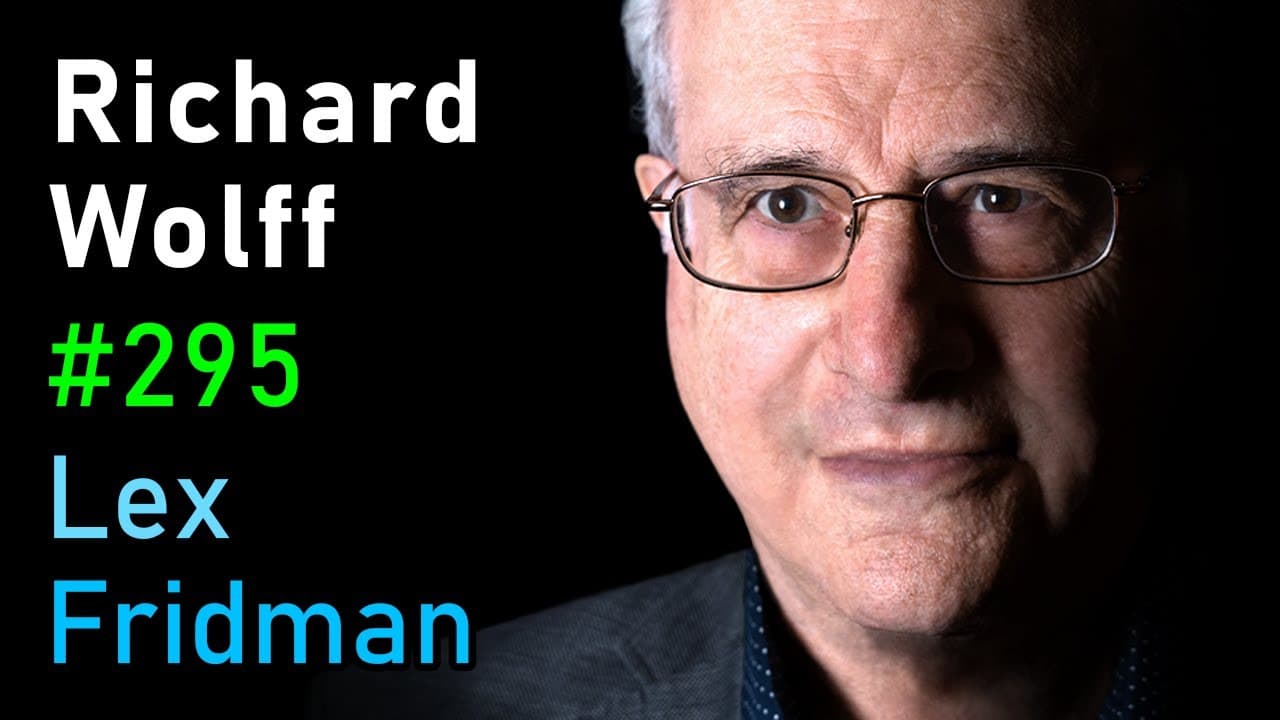
Richard Wolff: Marxism and Communism | Lex Fridman Podcast #295
TL;DR
Marxism critiques capitalism and argues that human society can and should surpass it. Over time, various interpretations have emerged worldwide, influenced by different cultural and economic contexts, leading to both critical analyses of capitalism and discussions on alternative societal structures.
Transcript
slaves produces surplus which the master gets serfs produces surplus which the lord gets employees produce a surplus which the employer gets it's very simple these are exploitative class structures because one class produces a surplus appropriated distributed by another group of people not the ones who produced it which creates hostility enmity env... Read More
Key Insights
- 💦 Marxism is a tradition that takes inspiration from the works of Karl Marx and critiques capitalism.
- 🚨 Different interpretations of Marxism emerged globally due to varying cultural and economic conditions.
- 🖐️ The Russian Revolution played a significant role in shaping Marxism as a theory of societal organization.
- ❓ There is a distinction between the critique of capitalism and the alternative society proposed by Marxism.
- 🎙️ More videos with Richard Wolff:
Install to Summarize YouTube Videos and Get Transcripts
Explore YouTube Video Summarizer or Get YouTube Transcript Extractor
Questions & Answers
Q: What is the fundamental idea of Marxism?
The fundamental idea of Marxism is that human society can do better than capitalism and should strive for a post-capitalist society.
Q: How did different interpretations of Marxism emerge?
Marxism spread globally and interacted with different cultural, religious, and economic conditions, resulting in diverse interpretations.
Q: What is the difference between early Marxism and later interpretations?
Initially, Marxism focused on critiquing capitalism, but after events like the Paris Commune and the Russian Revolution, it also became a theory of organizing a post-capitalist society.
Q: How did the Russian Revolution shape the understanding of Marxism?
The Russian Revolution transformed Marxism into a plan for organizing a new society and influenced subsequent interpretations in other countries such as China, Cuba, and Vietnam.
Key Insights:
- Marxism is a tradition that takes inspiration from the works of Karl Marx and critiques capitalism.
- Different interpretations of Marxism emerged globally due to varying cultural and economic conditions.
- The Russian Revolution played a significant role in shaping Marxism as a theory of societal organization.
- There is a distinction between the critique of capitalism and the alternative society proposed by Marxism.
- Exploitative class structures are a central concern of Marxism, leading to class struggles.
Summary
In this podcast, Lex Friedman interviews Richard Wolff, a Marxist economist and philosopher, to discuss the key concepts of Marxism and its various implementations throughout history. They explore the defining characteristics of Marxism, the influence of different cultural and historical contexts on its interpretations, and the relationship between Marxism and the concept of exploitation. They also delve into the role of the state in Marxism and the debate between reformism and revolution within the Marxist framework. Furthermore, they touch upon the unique elements of different implementations of Marxism, such as Leninism, Trotskyism, Stalinism, and Maoism.
Questions & Answers
Q: What is Marxism and how has it spread globally?
Marxism is a tradition that takes its founding inspiration from the works of Karl Marx. Over the past 140 years, Marxism has become a major school of thought in nearly every country on Earth, with different interpretations developing based on cultural, religious, and economic circumstances.
Q: What were the initial focuses of Marxism?
In its early years, Marxism primarily focused on critically analyzing capitalism rather than prescribing specific models of socialism or communism. Marx himself didn't write extensively on these topics and was primarily concerned with understanding and critiquing capitalist structures.
Q: How did the Paris Commune impact Marxism?
The Paris Commune of 1871, in which the working class of Paris briefly took control of the city, shifted Marxism from being solely a critique of capitalism to actively considering how to organize a society differently. Although the Paris Commune was short-lived, it showcased the potential for workers' control and informed later Marxist movements.
Q: What major changes occurred in Russia in 1917 that influenced Marxism?
The Russian Revolution in 1917 led to a group of Marxists, led by Lenin and Trotsky, seizing power and attempting to establish a socialist society. This pivotal moment marked a significant shift in Marxism, as it moved from being primarily a critique of capitalism to developing a plan for organizing society beyond capitalism.
Q: How did the interpretations of Marxism differ among different countries?
Marxism was interpreted differently in various countries due to different cultural histories, religious backgrounds, and economic conditions. For example, the Russian interpretation of Marxism influenced later Marxist movements in Cuba, China, Vietnam, and Korea, but each of these implementations had unique elements and responded to specific historical contexts.
Q: What are the defining characteristics of Leninism, Trotskyism, Stalinism, and Maoism?
Leninism focused on the concept of a vanguard party, with a small group of knowledgeable individuals leading the way towards the transition to socialism. Stalinism emphasized nationalism and the strength of the nation, while Maoism prioritized agricultural and rural aspects of society. Trotskyism is primarily known as an anti-Stalinist ideology. Each of these interpretations of Marxism had its own unique elements, but they were all reactions to the original interpretations in Russia.
Q: How did the Russian interpretation of Marxism differ from Marx's original critique of capitalism?
The Russian interpretation of Marxism went beyond Marx's original focus on critiquing capitalism and seeking an alternative society. The Russian Marxists had to transition from being critics of capitalism to being the leaders who had to decide how to govern and organize a socialist society. This transformation required trial and error to determine the best path forward.
Q: What is the relationship between exploitation and Marxism?
Exploitation is a crucial concept in Marxism and is defined as the surplus produced by workers being appropriated and distributed by a different group of people. Slavery, serfdom, and wage labor are all examples of exploitative class structures. These exploitative relationships often lead to class struggle, which encompasses feelings of hostility, enmity, envy, anger, and resentment.
Q: Can communism and the absence of exploitation naturally emerge from human nature?
The idea that communism and the absence of exploitation go against human nature is a common argument brought forth by defenders of various systems throughout history. However, historical evidence shows that societies have constantly evolved, repressing certain types of behaviors to maintain social order. The suppression of exploitative behaviors is not about going against human nature but rather shaping it to ensure social harmony.
Q: What about the argument that capitalists take on risk and deserve rewards for their efforts?
Risk is present in nearly all human endeavors, and it is not unique to capitalists. The idea that capitalists deserve rewards solely because they took on risk overlooks the risks taken by workers and assumes a biased perspective. In reality, risk exists for individuals across the social spectrum, and the distribution of rewards should be a collective decision based on the contributions of everyone involved.
Q: How does central planning fit into Marxism?
Central planning is often associated with Marxism due to its focus on analyzing the relationships within the production process. However, central planning is not an intrinsic part of Marx's original writings. Marxism centers on the relationships between people in the workplace and the appropriation and distribution of surplus value. The role of the state is secondary to this core focus.
Takeaways
Marxism encompasses a wide range of interpretations and implementations across different historical and cultural contexts. It is a tradition of thought inspired by Karl Marx's critique of capitalism and the class struggles inherent within exploitative systems. The spread of Marxism globally has led to diverse understandings and applications of its concepts. Understanding the historical nuances and debates within Marxism is crucial to accurately grasp its key ideas. Exploitation, surplus value, class struggle, and the relationship between workers and the means of production are fundamental aspects of Marxism. The relationship between the state and communism in Marxist thought is a complex topic, with different interpretations emphasizing various strategies for societal change. Finally, the notion of human nature and the feasibility of achieving a post-capitalist society are ongoing debates within Marxist theory and practice.
Summary & Key Takeaways
-
Marxism is a tradition rooted in the works of Karl Marx, focused on the critique of capitalism and advocating for a society beyond it.
-
Different interpretations of Marxism have emerged globally, influenced by cultural, religious, and economic factors.
-
Marxism originated as a critique of capitalism and later developed into a theory of how to organize society differently.
Read in Other Languages (beta)
Share This Summary 📚
Summarize YouTube Videos and Get Video Transcripts with 1-Click
Try YouTube Summary with ChatGPT & Claude or YouTube Transcript Generator
Explore More Summaries from Lex Fridman Podcast 📚






Summarize YouTube Videos and Get Video Transcripts with 1-Click
Try YouTube Summary with ChatGPT & Claude or YouTube Transcript Generator