What Is Quantum Computing and Its Impact on the Future?
TL;DR
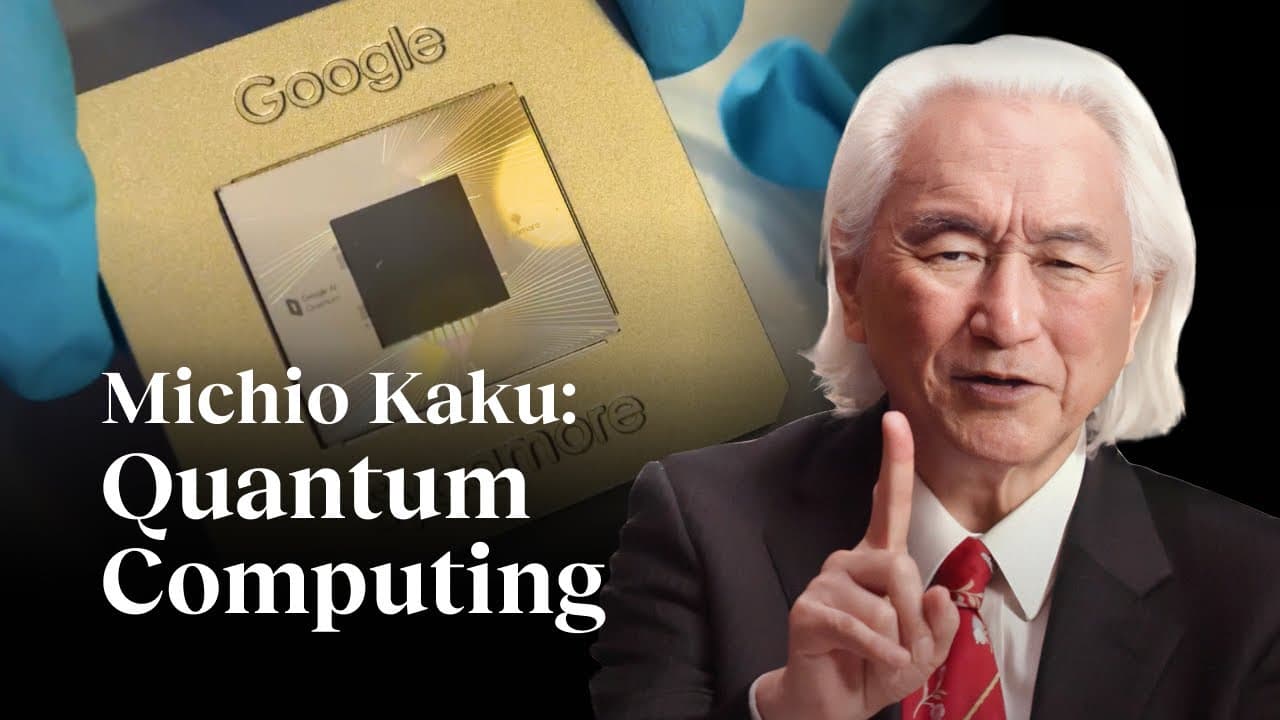
Quantum computing operates on atoms and can process vast amounts of information by existing in multiple states simultaneously, unlike traditional digital computers. Despite challenges like decoherence, quantum technology holds transformative potential in medicine, energy, and food supply, promising to revolutionize complex problem-solving and even unravel cosmic mysteries.
Transcript
- We all know that digital computers changed virtually every aspect of our life. Well, the arrival of quantum computers could be even more historic than that. We're now in the initial stages of the next revolution. We're talking about a new generation of computers: the ultimate computer, a computer that computes on atoms, the ultimate constituents ... Read More
Key Insights
- 🦾 Quantum computers operate on atoms and particles, using quantum mechanics for computation on parallel universes.
- 😎 Challenges like decoherence limit the current capabilities of quantum computers, requiring advanced cooling methods.
- 🏑 Quantum computers have vast potential in fields like medicine, energy, and agriculture, revolutionizing how we approach complex problems.
- 🤵 Nature's coherence abilities at room temperature inspire solutions for quantum computing challenges.
- ✊ The shift from digital to quantum computers represents a significant leap in computational power.
- 💻 Richard Feynman's vision of quantum computers computing on atoms paved the way for the development of this revolutionary technology.
- 🖤 Quantum computers offer the potential to solve complex mysteries of the universe, like black holes and galactic evolution.
- 🎙️ More videos with Michio Kaku:
Install to Summarize YouTube Videos and Get Transcripts
Explore YouTube Video Summarizer or Get YouTube Transcript Extractor
Questions & Answers
Q: What sets quantum computers apart from traditional digital computers?
Quantum computers operate on atoms and particles, using quantum mechanics to compute on parallel universes, vastly increasing their processing power compared to binary-based digital computers.
Q: How do quantum computers handle coherence and decoherence?
Quantum computers rely on coherence, where particles vibrate in unison, but face challenges with decoherence or noise, requiring extremely low temperatures to maintain optimal conditions for calculations.
Q: What potential applications do quantum computers have in fields like medicine?
Quantum computers can model diseases at the molecular level, offering new possibilities in curing diseases like Alzheimer's, Parkinson's, and cancer that are currently beyond the reach of traditional computers.
Q: What are the key challenges facing the growth of quantum computers?
One of the major challenges is maintaining coherence to avoid noise, requiring advanced technology and cooling methods to operate at near absolute zero temperatures.
Summary & Key Takeaways
-
Quantum computers represent a new era in computing, operating on atoms and waves instead of traditional transistors.
-
The power of quantum computers lies in their ability to exist in multiple states simultaneously, computing on parallel universes.
-
While challenges like decoherence exist, the benefits of quantum computing in fields like food supply, energy, and medicine are immense.
Read in Other Languages (beta)
Share This Summary 📚
Summarize YouTube Videos and Get Video Transcripts with 1-Click
Try YouTube Summary with ChatGPT & Claude or YouTube Transcript Generator
Explore More Summaries from Big Think 📚


Summarize YouTube Videos and Get Video Transcripts with 1-Click
Try YouTube Summary with ChatGPT & Claude or YouTube Transcript Generator