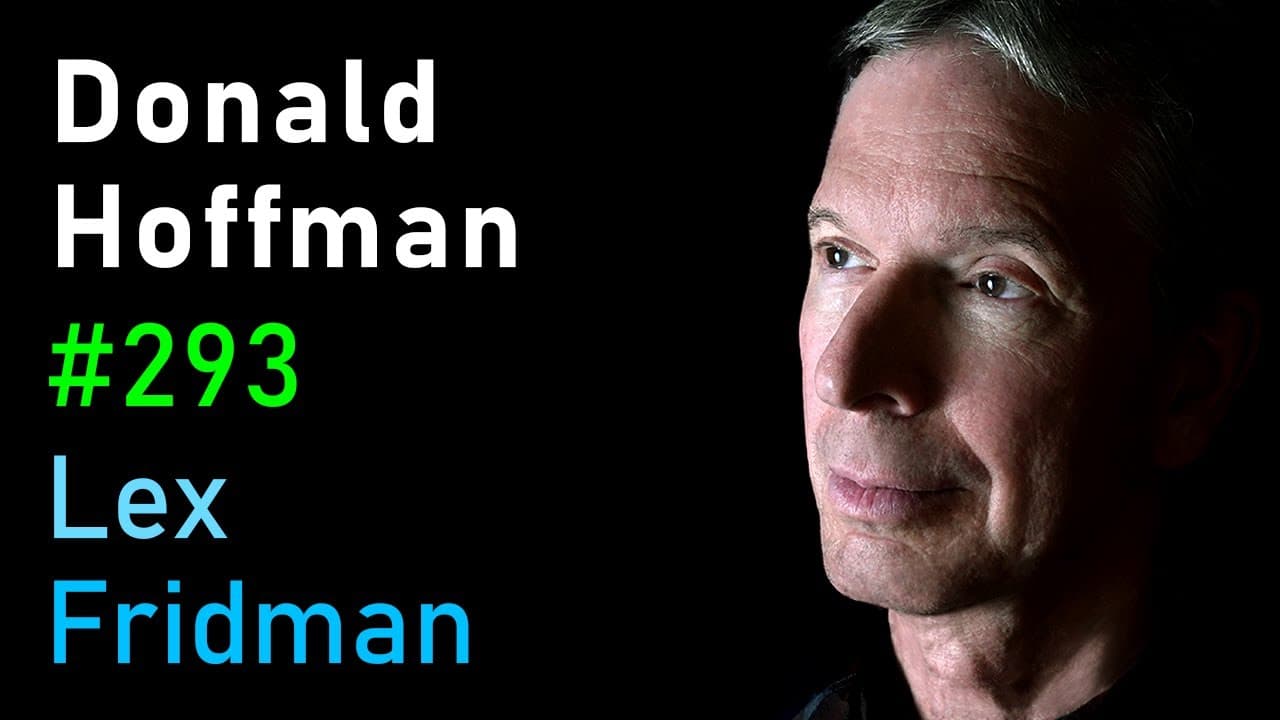
Donald Hoffman: Reality is an Illusion - How Evolution Hid the Truth | Lex Fridman Podcast #293
TL;DR
Natural selection has shaped our senses to prioritize survival over perceiving objective reality, meaning our perceptions may provide a distorted view of what truly exists. Donald Hoffman argues that our sensory systems are not designed to uncover the truth but to maintain fitness in our environment, leading scientists to explore theories that go beyond traditional concepts of space-time.
Transcript
whatever reality is it's not what you see what you see is is just an adaptive fiction the following is a conversation with donald hoffman professor of cognitive sciences at uc irvine focusing his research on evolutionary psychology visual perception and consciousness he's the author of over 120 scientific papers on these topics and his most recent ... Read More
Key Insights
- 👾 Evolutionary game theory demonstrates that our perceptions are adaptations that prioritize fitness and guide adaptive behavior rather than reveal objective reality.
- 👾 The current understanding of reality, including space-time, is being challenged by physicists who are exploring theories beyond space-time, leading to new insights and potential technological advancements.
- 👻 The scientific method allows for the exploration of different theories, but it is important to recognize the limitations and constant need for improvement and revision in our understanding of reality.
- 🎙️ More videos with Donald Hoffman:
Install to Summarize YouTube Videos and Get Transcripts
Explore YouTube Video Summarizer or Get YouTube Transcript Extractor
Questions & Answers
Q: How does evolutionary theory challenge our understanding of reality?
Evolution by natural selection suggests that our perceptions are not a true representation of objective reality, but adaptations that prioritize survival and guide adaptive behavior.
Q: Why did Donald Hoffman and his team conclude that our perceptions do not reflect objective reality?
Through simulations and mathematical proofs, they found that the probability of perceiving objective reality is zero for any generic structure, suggesting that our perceptions are not designed to reveal truth.
Q: What is the relationship between space-time and our perceptions?
Space-time is considered an interface or user interface through which we perceive reality. Our perceptions construct the experience of space-time, but it does not necessarily reflect the true nature of reality.
Q: Can we ever truly understand reality beyond our perceptions?
The understanding of reality may transcend conceptual thought, as suggested by spiritual traditions, where being in contact with the deep ground of being provides a glimpse of a truth that cannot be fully comprehended conceptually.
Key Insights:
- Evolutionary game theory demonstrates that our perceptions are adaptations that prioritize fitness and guide adaptive behavior rather than reveal objective reality.
- The current understanding of reality, including space-time, is being challenged by physicists who are exploring theories beyond space-time, leading to new insights and potential technological advancements.
- The scientific method allows for the exploration of different theories, but it is important to recognize the limitations and constant need for improvement and revision in our understanding of reality.
- The pursuit of scientific knowledge may lead to the discovery of deeper truths about reality, but it is also essential to find a balance between exploration and being present in the here and now.
Summary
In this video, Donald Hoffman, a professor of cognitive sciences, challenges the traditional understanding of reality. He argues that what we see with our eyes is not a representation of objective reality, but rather an adaptive fiction shaped by evolution. According to Hoffman, natural selection does not prioritize the perception of truth, but rather focuses on adaptive behavior. He also discusses the limitations of space-time and reductionism, suggesting that our current scientific theories may not provide a complete understanding of reality. Instead, he proposes the exploration of new mathematical structures and a dynamic theory of consciousness to uncover deeper truths about the nature of reality.
Questions & Answers
Q: According to Donald Hoffman, is the world we see with our eyes a representation of objective reality?
Hoffman argues that the world we see with our eyes is not a representation of objective reality. Instead, it is an adaptive fiction shaped by evolution.
Q: What did Hoffman and his team find when they examined the probability of natural selection shaping sensory systems to perceive objective reality?
Hoffman and his team found that the probability of natural selection shaping sensory systems to perceive objective reality is precisely zero for any generic structure of the world. Sensory systems are shaped to guide adaptive behavior, not to perceive truth.
Q: Is the evolutionary process focused on maximizing truth or fitness?
The evolutionary process, according to Hoffman, focuses on maximizing fitness rather than truth. Fitness beats truth, and it does not necessarily have to be connected to truth.
Q: Does our perception of reality guide adaptive behavior or reveal objective truth?
Our perception of reality is shaped to guide adaptive behavior, not to reveal objective truth. Perception acts as a user interface that hides the truth, allowing us to navigate and survive in our environment.
Q: What analogy does Hoffman use to explain the adaptive nature of perception?
Hoffman uses the analogy of a computer user interface. Just as the user interface hides the complexity of the underlying hardware, perception hides the complexity of objective reality, allowing us to interact with the world more effectively.
Q: Can perceptions and abstractions be completely detached from the underlying reality?
Perceptions and abstractions are not completely detached from the underlying reality. They are adaptive sets of perceptions that serve a purpose in guiding behavior. While they may not represent the objective truth, they still have a tether to reality.
Q: How are scientific theories tethered to reality despite the idea that perception is an adaptive fiction?
Scientific theories are tethered to reality through empirical testing and experimentation. While perception may be an adaptive fiction, scientists can still make accurate predictions and understand certain aspects of reality through their theories.
Q: Can science lead to a theory of everything that provides a final and complete understanding of reality?
Hoffman believes that science will never achieve a theory of everything that provides a final and complete understanding of reality. He suggests that this is limited by mathematical reasoning and the assumptions we make in our theories.
Q: What is reductionism, and why is it considered dead by Hoffman?
Reductionism is a scientific explanation that seeks to understand complex phenomena by breaking them down into simpler, more fundamental components. Hoffman argues that reductionism is considered dead because our best theories indicate the need to move beyond space-time and explore deeper structures in order to understand reality.
Q: How does the exploration of new mathematical structures and dynamics play a role in understanding reality?
Hoffman suggests that the exploration of new mathematical structures and dynamics is essential in uncovering deeper truths about reality. By moving beyond space-time and developing a dynamic theory of consciousness, scientists can gain a deeper understanding of the relationship between consciousness, the brain, and the physical world.
Takeaways
Donald Hoffman challenges the conventional understanding of reality, arguing that what we see with our eyes is not a true representation of objective reality. Instead, our perception is an adaptive fiction shaped by evolution to guide adaptive behavior. He suggests that the traditional framework of space-time and reductionism has limitations and that science should explore new mathematical structures and dynamics to uncover deeper truths about reality. While our scientific theories tether us to empirical testing and experimentation, they may never provide a final and complete understanding of reality, as reality may always transcend our conceptual theories.
Summary & Key Takeaways
-
According to Donald Hoffman's research, the probability that natural selection shaped sensory systems to perceive true properties of objective reality is precisely zero.
-
Evolutionary processes prioritize fitness over truth, meaning that our perceptions are designed to guide adaptive behavior rather than reveal objective reality.
-
Scientists are exploring theories beyond space-time that challenge the traditional understanding of reality, leading to deep insights and the potential for new technological advancements.
Read in Other Languages (beta)
Share This Summary 📚
Summarize YouTube Videos and Get Video Transcripts with 1-Click
Try YouTube Summary with ChatGPT & Claude or YouTube Transcript Generator
Explore More Summaries from Lex Fridman Podcast 📚


Summarize YouTube Videos and Get Video Transcripts with 1-Click
Try YouTube Summary with ChatGPT & Claude or YouTube Transcript Generator