10 Best AI Agent Videos on YouTube

Jul 20, 2026
11 min read
996 views
Last updated: July 2026
This is a curated path through the ten YouTube videos that best explain AI agents, ordered as a deliberate learning journey rather than by view count. It is built for founders who want to understand what agents are, how to build them, and what they mean for a business.
The full set runs about 12 hours, moving from ten-minute primers to long-form conversations with the people building and debating this technology. Together the videos cover foundations, architecture, design patterns, real-world case studies, and the economic and safety questions that come with autonomous systems.
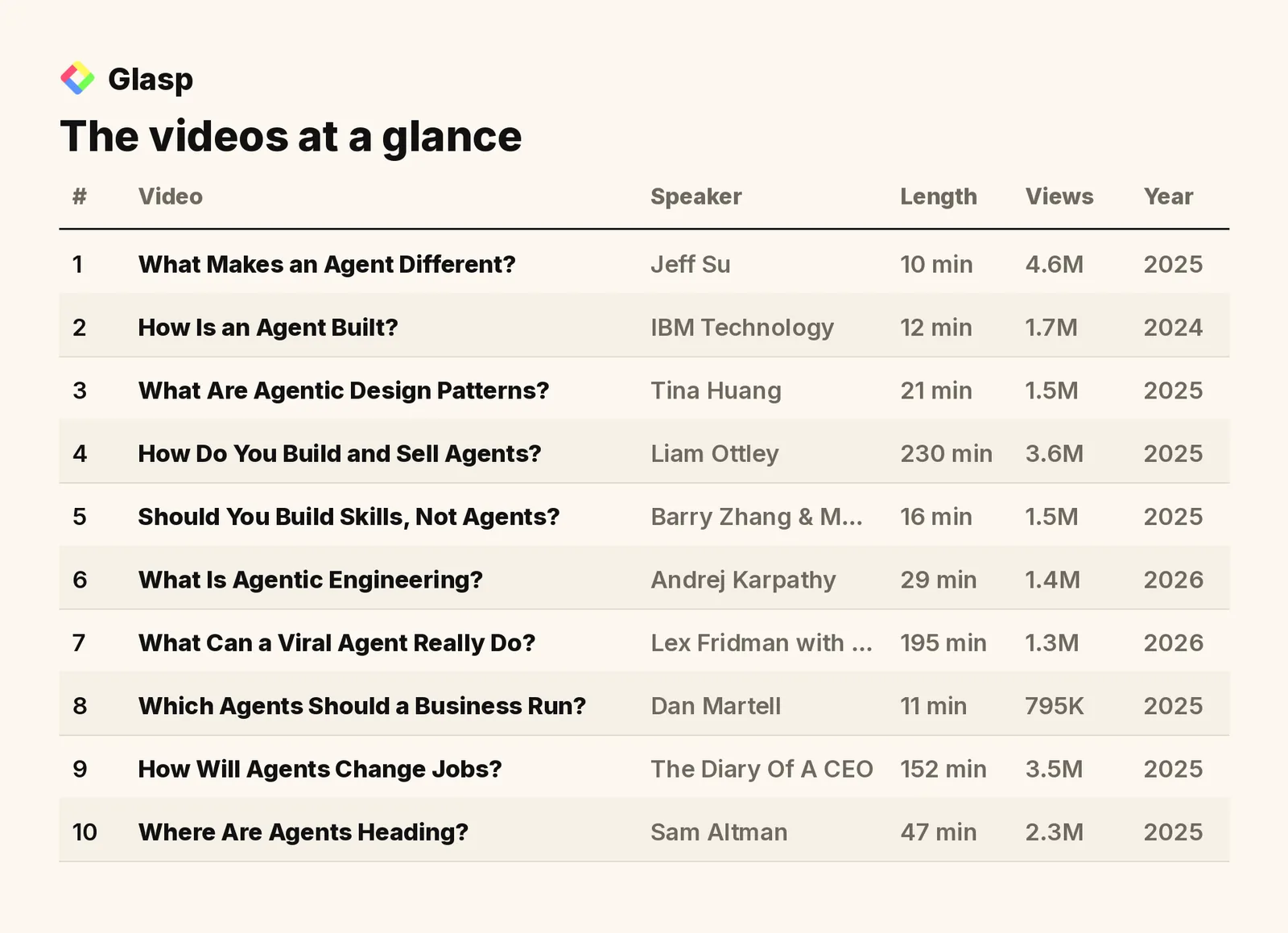
The videos on this list, in the order to watch them, are:
What Makes an Agent Different? (Jeff Su)
How Is an Agent Built? (IBM Technology)
What Are Agentic Design Patterns? (Tina Huang)
How Do You Build and Sell Agents? (Liam Ottley)
Should You Build Skills, Not Agents? (Barry Zhang & Mahesh Murag, Anthropic)
What Is Agentic Engineering? (Andrej Karpathy)
What Can a Viral Agent Really Do? (Lex Fridman with Peter Steinberger)
Which Agents Should a Business Run? (Dan Martell)
How Will Agents Change Jobs? (The Diary Of A CEO)
Where Are Agents Heading? (Sam Altman)
Total: 10 videos, 723 minutes of watch time (about 12 hours), and 22.2M combined views.
1. What Makes an Agent Different?

Jeff Su · 10 min · 4.6M views · 2025
In short: AI agents replace human decision-making with an LLM, so they reason, act, and iterate toward a goal without predefined paths.
This is the fastest clean answer to what an AI agent actually is. Jeff Su separates a passive chatbot and a fixed workflow from a true agent that reasons, acts, and iterates on its own. It earns the first slot because every later video assumes this distinction.
Key takeaways
Large language models like ChatGPT are passive and respond only to user prompts, without accessing proprietary data on their own.
AI workflows follow predefined paths set by humans, which limits flexibility and keeps humans making the key decisions.
The ReAct framework is common for AI agents because it lets them reason and act independently as they work.
Retrieval augmented generation lets an AI model look up information before responding, improving answers with data it did not memorize.
Watch on YouTube · Read the summary and Q&A
2. How Is an Agent Built?

IBM Technology · 12 min · 1.7M views · 2024
In short: AI agents pair large language models with external tools, memory, and reasoning so they can plan and solve complex problems.
Once you know what an agent is, IBM shows how one is put together. The video breaks agents into models, tools, memory, and reasoning, and explains the ReAct pattern that ties them together. It answers how an agent is built without requiring you to write code.
Key takeaways
Compound AI systems combine multiple components, including models, databases, and external tools, for modular problem-solving that adapts to each task.
Memory in an AI agent stores process logs and conversation history, which enables personalized interactions across a session.
The ReAct framework combines reasoning and acting components so agents can execute tasks with better accuracy.
For narrow, well-defined problems, a programmatic approach is more efficient than an agentic one, since autonomy varies by scope.
Watch on YouTube · Read the summary and Q&A
3. What Are Agentic Design Patterns?

Tina Huang · 21 min · 1.5M views · 2025
In short: Agentic workflows use iterative planning, reflection, tool use, and multi-agent teams, letting agents revise their steps instead of following a line.
This video moves from single agents to the patterns that make them useful. Tina Huang walks through reflection, tool use, planning, and multi-agent teams, and shows how work can be split across specialized agents. It answers what design choices sit behind a capable agentic system.
Key takeaways
Agentic design patterns include reflection, tool use, planning, and multi-agent systems, where each agent takes a specialized role like a human team.
Non-agentic workflows are linear, while agentic workflows loop through planning and revising until the task reaches its goal.
Multi-agent systems can be arranged as hierarchical, sequential, hybrid, parallel, or asynchronous, depending on how the work should flow.
No-code tools such as n8n let non-coders build agentic workflows, opening agent development beyond software engineers.
Watch on YouTube · Read the summary and Q&A
4. How Do You Build and Sell Agents?

Liam Ottley · 230 min · 3.6M views · 2025
In short: You can build agents on no-code platforms using LLMs, prompting, memory, and tools, then sell them to automate real business tasks.
This is the practical bridge from theory to shipping. Liam Ottley covers the pieces every agent needs and shows how to assemble them on no-code platforms, then how to sell the result. It answers how a non-engineer can turn agents into a real service.
Key takeaways
AI agents act as digital workers that understand instructions and perform tasks, functioning much like digital employees inside a business.
Building an agent requires knowledge of large language models, prompting, memory, external knowledge, and tools that connect it to systems.
Tools in an AI agent are APIs that let it act online, such as querying databases or sending emails.
No-code platforms like Relevance AI and n8n let people build and integrate agents without writing code.
Watch on YouTube · Read the summary and Q&A
5. Should You Build Skills, Not Agents?

Barry Zhang & Mahesh Murag, Anthropic · 16 min · 1.5M views · 2025
In short: Skills package domain expertise as organized, shareable files, giving agents the procedural knowledge they usually lack for real-world tasks.
Anthropic's Barry Zhang and Mahesh Murag argue that the missing piece is often not a smarter agent but better skills. They show how packaging procedural knowledge as shareable files gives agents the domain expertise they lack. It answers what to build when an agent keeps failing at real tasks.
Key takeaways
Skills are organized collections of files that package procedural knowledge, giving agents the domain expertise they often lack.
Skills are simple, shareable, and versioned, so both humans and agents can read, reuse, and modify them.
Progressive disclosure lets skills load only what is needed, protecting the context window while keeping components composable.
Non-technical people can create skills, which makes agents more accessible for everyday tasks across many domains.
Watch on YouTube · Read the summary and Q&A
6. What Is Agentic Engineering?
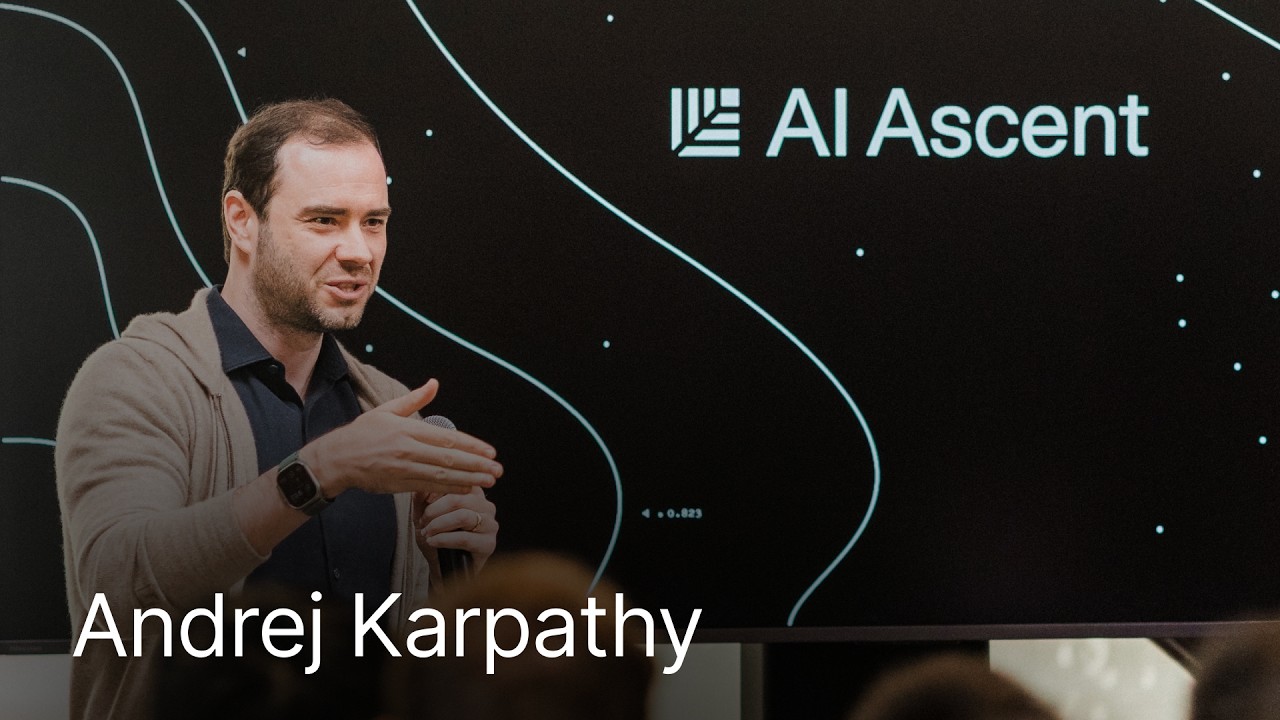
Andrej Karpathy · 29 min · 1.4M views · 2026
In short: Agentic engineering is a discipline that uses AI agents to build software while keeping quality through verification and human direction.
Karpathy names the shift from casual vibe coding to a disciplined practice he calls agentic engineering. He explains why quality now depends on verification and human direction rather than writing every line. It answers what changes when agents do the coding and you do the steering.
Key takeaways
Agentic engineering is a new discipline focused on maintaining quality while using AI agents to build professional software.
Vibe coding widens access to software creation, but agentic engineering is what keeps the resulting software reliable.
Verifiability is central to automation, since models perform best in domains where their outputs can be easily checked.
Understanding stays a human domain, because you can outsource thinking to AI but not the comprehension needed to direct it.
Watch on YouTube · Read the summary and Q&A
7. What Can a Viral Agent Really Do?

Lex Fridman with Peter Steinberger · 195 min · 1.3M views · 2026
In short: OpenClaw is an open-source agent that integrates with messaging apps, modifies its own software, and acts on personal data autonomously.
This is the case study of an agent that went viral in the wild. Peter Steinberger explains how OpenClaw self-modifies, plugs into messaging apps, and acts on personal data, and why that mix drew both excitement and alarm. It answers what an unleashed, open-source agent looks like in practice.
Key takeaways
OpenClaw is an open-source AI agent that integrates with messaging apps like Telegram and WhatsApp to run tasks.
OpenClaw can modify its own software, which its creator frames as a leap toward autonomous, action-oriented AI.
OpenClaw reached over 180,000 stars on GitHub, a sign of how quickly the project was adopted.
The agent's power to access and control personal data raises real security concerns alongside its capabilities.
Watch on YouTube · Read the summary and Q&A
8. Which Agents Should a Business Run?

Dan Martell · 11 min · 795K views · 2025
In short: Five agent types, Closer, Assistant, Workflow, Amplifier, and Money, automate sales, admin, operations, marketing, and finance so you scale without hiring.
This video maps agents onto the functions of a business. Dan Martell names five agent types across sales, admin, operations, marketing, and finance, and shows how each replaces manual work. It answers where a founder should point agents first to scale without hiring.
Key takeaways
The Closer Agent automates lead generation, qualification, and sales calls, handling work traditionally done by a sales team.
An Assistant Agent manages emails, calendars, and bookings, freeing executive time for strategic tasks and growth activities.
Workflow Agents maintain and update business processes without human intervention, which keeps operations consistent as a company scales.
Money Agents monitor cash flow, automate financial operations, and detect fraud, giving real-time insight without manual oversight.
Watch on YouTube · Read the summary and Q&A
9. How Will Agents Change Jobs?

The Diary Of A CEO · 152 min · 3.5M views · 2025
In short: Agents are expected to replace routine jobs within a few years, causing displacement while also opening new wealth-creation opportunities.
This debate zooms out to what agents mean for work and the economy. The panel argues routine jobs will fall while new wealth and roles appear, and stresses education as the hedge. It answers how to think about agents as an employer and a citizen, not just a builder.
Key takeaways
AI is expected to replace routine jobs over the next few years, which could cause displacement and new wealth creation at once.
Agents can handle work autonomously, from customer service to complex processes like mergers and acquisitions across many industries.
Education systems must adapt toward lifelong learning and generalist skills to prepare people for a fast-changing job market.
A divide may grow between those who use AI effectively and those who do not, which raises the stakes of AI literacy.
Watch on YouTube · Read the summary and Q&A
10. Where Are Agents Heading?

Sam Altman · 47 min · 2.3M views · 2025
In short: Altman sees agents accelerating creativity and science, but insists on strong safety measures and governance as autonomous systems grow.
Sam Altman closes the list with where this is heading. He is optimistic about agents accelerating science and creativity, but insistent that safety and governance keep pace with autonomy. It answers what the people building frontier systems are actually worried about.
Key takeaways
Sam Altman argues AI can accelerate scientific research, contributing to breakthroughs that improve human life and well-being.
Agentic AI calls for stringent safety measures so autonomous systems stay trusted while performing tasks for users.
Democratizing creativity through AI challenges traditional industries and demands new frameworks for intellectual property and economic models.
Altman stresses that innovation and safety must coexist, with robust protocols as AI integrates into society.
Watch on YouTube · Read the summary and Q&A
Frequently asked questions
What is an AI agent?
An AI agent is a system that uses a large language model to reason, act with tools, and iterate toward a goal without following a predefined human path.
What is the difference between an AI agent and an AI workflow?
An AI workflow follows fixed steps set by humans, while an AI agent decides its own steps and adapts as it works.
Can you build AI agents without coding?
Yes. No-code platforms like Relevance AI and n8n let you build agents and connect them to business systems without writing code.
What is the ReAct framework in AI agents?
ReAct combines reasoning and acting, so an agent thinks through a problem and takes actions with tools in the same loop.
Will AI agents replace jobs?
AI agents are expected to replace many routine jobs within a few years, while also creating new opportunities that reward AI literacy.
Who should watch this list of AI agent videos?
This collection suits anyone trying to move past the hype around AI agents: developers who want to build them, business owners deciding which agents to run, and people wondering how agents will change their jobs. The sections cover both technical ground like design patterns and agentic engineering, and practical ground like selling agents and where the field is heading.
Where should I start if I know nothing about AI agents?
Start with what makes an agent different from other software, then move to how an agent is actually built. Those two ideas come first for a reason: the design patterns, engineering practices, and business questions that follow only make sense once you know what an agent is and what its parts do.
Do I need to build a full agent, or is something simpler enough?
Not every problem needs a full agent. One of the more useful counterpoints in this space is the argument for building skills rather than agents, meaning narrow, well defined capabilities can solve a task without the overhead of an autonomous system.
What is agentic engineering?
Agentic engineering is the practice of designing, building, and operating systems where AI takes actions rather than just producing text. It sits alongside agentic design patterns as the working discipline behind agents that do real tasks, as opposed to demos that look impressive once.
How to use this list
Watch these in order to build understanding layer by layer, starting with clear definitions and ending with the bigger questions about work and safety. If you only have ten minutes, start with Jeff Su's AI Agents, Clearly Explained, which draws the line between a simple workflow and a true agent faster than anything else on the list. From there, IBM's What are AI Agents gives you the architecture, and you can go deeper into building, business use, and the economic questions as time allows.
Related lists
💡 Want summaries and transcripts for any YouTube video? Try YouTube Summary with ChatGPT & Claude.