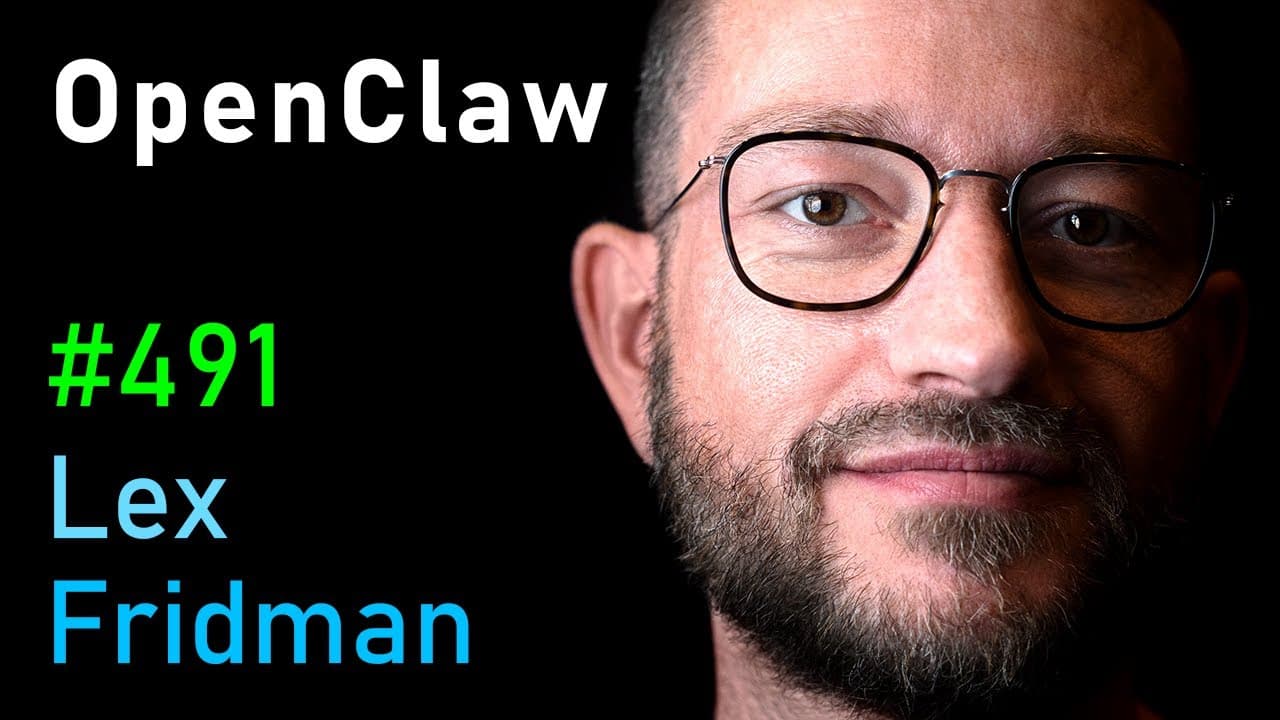
What Is OpenClaw, the Viral AI Agent? Peter Steinberger | Lex Fridman Podcast #491
TL;DR
OpenClaw is Peter Steinberger’s open-source, autonomous AI assistant that runs on a user’s computer and takes actions through messaging clients such as Telegram, WhatsApp, Signal, and iMessage. It can use models including Claude Opus 4.6 and GPT 5.3 Codex, modify its own software, and access personal data when permitted. Its rise past 180,000 GitHub stars reveals both its usefulness and serious security risks. Read on to understand its capabilities and tradeoffs.
Transcript
- I watched my agent happily click the "I'm not a robot" button. I made the agent very aware. Like, it knows what his source code is. It understands th- how it sits and runs in its own harness. It knows where documentation is. It knows which model it runs. It understands its own system that made it very easy for an agent to... Oh, you don't like an... Read More
Key Insights
- OpenClaw is an open-source AI agent that integrates with messaging apps like Telegram and WhatsApp.
- The AI agent can modify its own software, representing a leap in autonomous technology.
- OpenClaw gained over 180,000 stars on GitHub, signifying its rapid adoption and influence.
- The project's power lies in its ability to access and control personal data, raising security concerns.
- OpenClaw exemplifies the transition from language-based AI to action-oriented AI.
- The project sparked discussions about AI's role in society, blending excitement with genuine concern.
- Peter Steinberger, the creator, emphasizes the balance between AI's capabilities and user responsibility.
- The AI's success is attributed to its community-driven development and innovative approach to agency.
Install to Summarize YouTube Videos and Get Transcripts
Explore YouTube Video Summarizer or Get YouTube Transcript Extractor
Questions & Answers
Q: What is OpenClaw, the viral AI agent discussed on Lex Fridman Podcast #491?
OpenClaw is an open-source, autonomous AI assistant created by Peter Steinberger. It lives on a user’s computer, communicates through messaging clients, and can take actions using the data and permissions the user gives it.
Q: What can OpenClaw do?
OpenClaw can perform tasks on a user’s computer, interact through messaging apps, and work with personal data when access is granted. Steinberger also made the agent aware of its source code, documentation, operating harness, and underlying model, allowing it to modify its own software when prompted.
Q: Which messaging apps and AI models can OpenClaw use?
The transcript names Telegram, WhatsApp, Signal, and iMessage among the messaging clients through which OpenClaw can communicate. It can use a model selected by the user, including Claude Opus 4.6 and GPT 5.3 Codex.
Q: Why did OpenClaw become popular so quickly?
OpenClaw combined existing AI-agent ingredients into a useful, open-source, community-driven assistant that moved from generating language to taking actions. It took over the tech world within days and surpassed 180,000 stars on GitHub.
Q: Can OpenClaw modify its own software?
Yes. Steinberger says the agent understands its source code, documentation, operating harness, and the model it runs, so a user can prompt it to change its own software.
Q: What security risks does OpenClaw create?
OpenClaw can receive access to a user’s files and permission to act on them, making it powerful but dangerous. The transcript describes an AI agent with system-level access as a security minefield and says users are responsible for protecting their data from cybersecurity threats and vulnerabilities.
Q: How does OpenClaw differ from language-focused AI systems?
OpenClaw is presented as a step from language to agency and from ideas to actions. Rather than only producing responses, it acts as a personal assistant that can operate on a computer, use granted data, and learn from its user.
Q: Who created OpenClaw, and what did he build before it?
Peter Steinberger created OpenClaw after returning to programming following a three-year absence. Before that, he spent 13 years building PSPDF Kit, software described in the transcript as being used on a billion devices.
Summary & Key Takeaways
-
OpenClaw is an AI agent that quickly became popular due to its ability to autonomously perform tasks by integrating with various messaging platforms. It allows users to grant it access to personal data, which it can use to execute commands and learn from interactions. This capability, while powerful, also poses significant security risks, emphasizing the need for careful management of AI technology.
-
The project was developed by Peter Steinberger, who previously created PSPDF Kit. OpenClaw is considered a major milestone in AI development, similar to the introduction of ChatGPT. It represents a shift from AI being a tool for generating language to one that can take action based on user input, thereby marking the beginning of an 'agentic AI revolution.'
-
OpenClaw's open-source nature and community involvement have been crucial to its growth, enabling rapid iteration and improvement. However, the potential for misuse and security vulnerabilities requires users to be vigilant in protecting their data. The project demonstrates both the potential and challenges of integrating AI deeply into personal and professional settings.
Read in Other Languages (beta)
Share This Summary 📚
Summarize YouTube Videos and Get Video Transcripts with 1-Click
Try YouTube Summary with ChatGPT & Claude or YouTube Transcript Generator
Explore More Summaries from Lex Fridman 📚


Summarize YouTube Videos and Get Video Transcripts with 1-Click
Try YouTube Summary with ChatGPT & Claude or YouTube Transcript Generator