How to Become a Startup Founder: An 11-Hour YouTube Curriculum

Jul 19, 2026
10 min read
57 views
Last updated: July 2026
This curriculum takes you from zero to the fundamentals of starting a startup, using talks from founders and investors at Y Combinator and beyond. It is for aspiring founders who have no company yet, and by the end you will know how to choose an idea, talk to users, build a first version, grow it, and fund it.
The steps follow the real order of a founder's journey, from deciding whether to start, to finding an idea, building, growing, funding, and then sustaining yourself for the long run. Video-first learning works here because these lessons come straight from people who built and funded the companies, so you hear the reasoning and the tradeoffs in their own words.
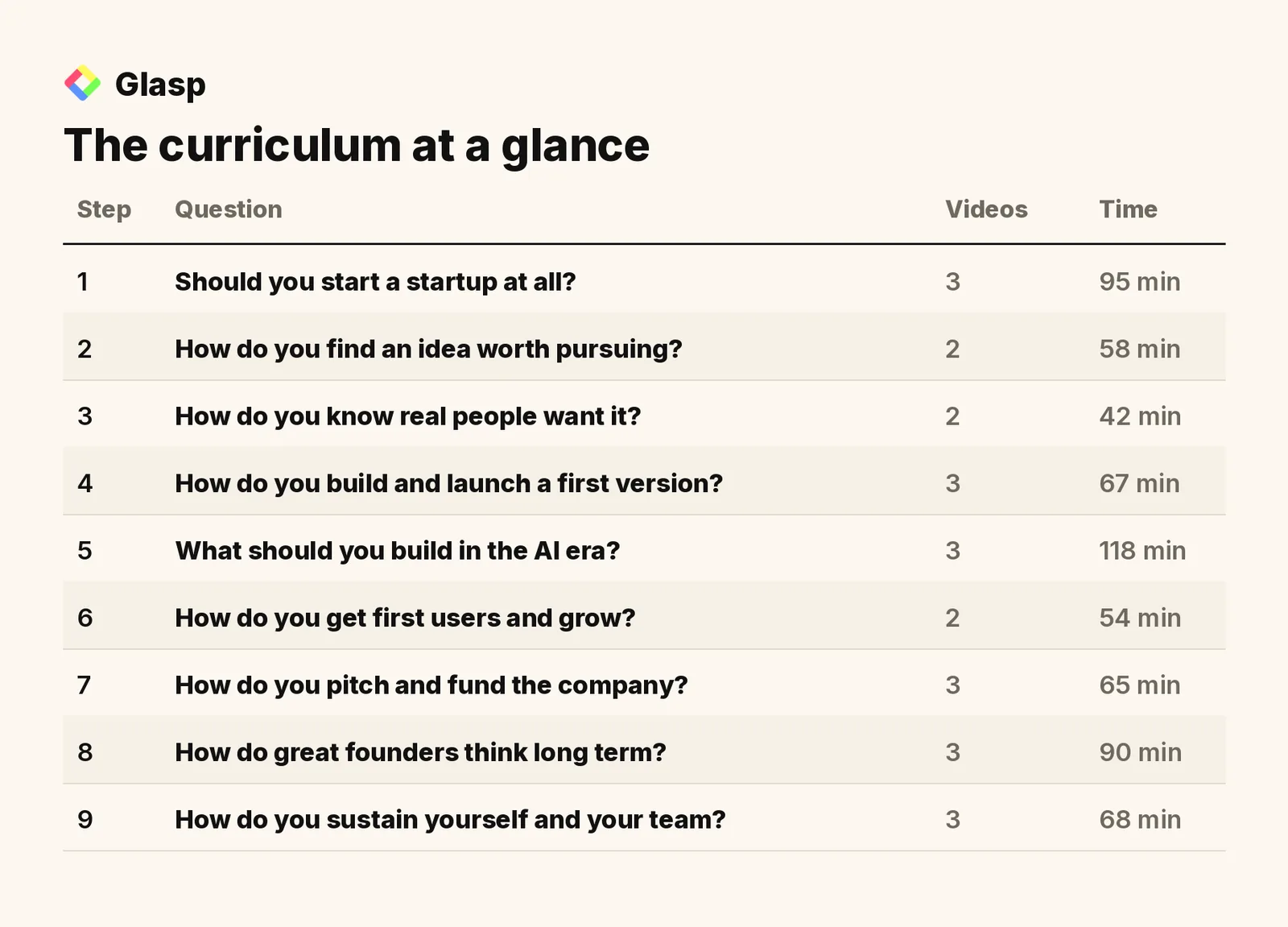
The steps in this curriculum are:
Should you start a startup at all? (3 videos, 95 min)
How do you find an idea worth pursuing? (2 videos, 58 min)
How do you know real people want it? (2 videos, 42 min)
How do you build and launch a first version? (3 videos, 67 min)
What should you build in the AI era? (3 videos, 118 min)
How do you get first users and grow? (2 videos, 54 min)
How do you pitch and fund the company? (3 videos, 65 min)
How do great founders think long term? (3 videos, 90 min)
How do you sustain yourself and your team? (3 videos, 68 min)
Total: 24 videos, 657 minutes of watch time (about 11 hours), and 21.6M combined views.
Step 1: Should you start a startup at all?
In short: Start a startup when you feel compelled by a specific problem and can honestly live with the worst-case outcome, because passion and resilience are what carry you through the stress. Your initial motivation matters less than an enduring interest in the problem and the people you work with.

These talks set expectations before you commit, showing that founders come from many backgrounds and that resilience matters more than any stereotype. They also frame how to choose meaningful work, so you begin with clear reasons rather than hype.
Should You Start A Startup? | Startup School (Y Combinator, 17 min, 561K views): Weighs the worst-case scenario and the role of resilience before you commit Watch on YouTube
Lecture 1 - How to Start a Startup (Sam Altman, Dustin Moskovitz) (YC Root Access, 43 min, 5.3M views): Explains why deep passion for a problem drives startup success Watch on YouTube
Sam Altman on Choosing Projects, Creating Value, and Finding Purpose (Y Combinator, 35 min, 480K views): Helps you choose meaningful projects and avoid the deferred life plan Watch on YouTube
Step 2: How do you find an idea worth pursuing?
In short: Focus on real problems that are urgent, costly, and frequent rather than trendy solutions, and test each idea against questions about market size, competition, and founder fit. Ideas that look hard or boring are often the best opportunities because most founders avoid them.

Both videos give you frameworks to separate real problems from superficially plausible ones and to spot tar pit ideas. Together they turn idea selection into a skill you can practice instead of a lucky guess.
How to Get and Evaluate Startup Ideas | Startup School (Y Combinator, 32 min, 1.6M views): A framework of key questions to evaluate ideas and avoid tar pits Watch on YouTube
Kevin Hale - How to Evaluate Startup Ideas (Y Combinator, 26 min, 740K views): Shows how to pair a real problem with an unfair advantage Watch on YouTube
Step 3: How do you know real people want it?
In short: Talk to users at every stage, because they reveal genuine problems even when they suggest bad solutions. Building personal, unscalable relationships with early customers teaches you the market before you try to scale.
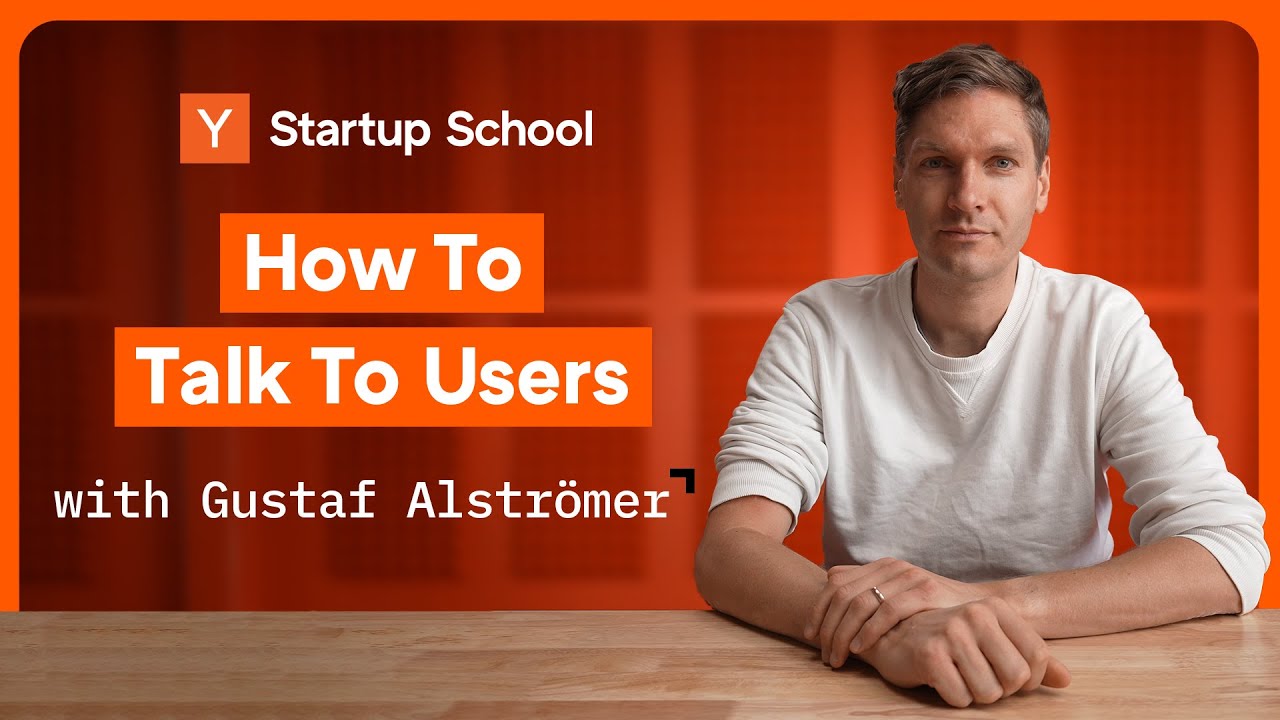
One video teaches how to find users and ask open questions that surface problems rather than features. The other shows why manual, unscalable work early on gives you insight and loyalty that scalable tactics cannot.
How To Talk To Users | Startup School (Y Combinator, 17 min, 317K views): How to find users, ask good questions, and turn answers into an MVP Watch on YouTube
Startup Experts Discuss Doing Things That Don't Scale (Y Combinator, 25 min, 223K views): Why doing things that don't scale wins early customers and insight Watch on YouTube
Step 4: How do you build and launch a first version?
In short: Build a ridiculously simple MVP, launch it quickly, and iterate on feedback instead of pivoting to new problems. AI tools now let small teams build faster, but learning to code still builds the taste and craftsmanship a good product needs.

These videos take you from planning a lean MVP to actually building it with AI assistance and version control. They keep the focus on shipping something basic fast, then improving it with real user feedback.
Michael Seibel - How to Plan an MVP (Y Combinator, 13 min, 830K views): How to keep an MVP simple, launch fast, and iterate Watch on YouTube
How To Get The Most Out Of Vibe Coding | Startup School (Y Combinator, 16 min, 352K views): Practical vibe coding with tests and version control for non-coders too Watch on YouTube
10 People + AI = Billion Dollar Company? (Y Combinator, 38 min, 216K views): Why small AI-assisted teams can build big, and why coding still matters Watch on YouTube
Step 5: What should you build in the AI era?
In short: Some of the biggest current openings are vertical AI agents that automate specialized, admin-heavy work, which could be larger than traditional SaaS. Software is shifting toward natural-language programming, so founders can build for a market where AI models are core.

These talks map where the opportunities are, from Karpathy's view of Software 3.0 to concrete cases for vertical AI agents. They help you aim your idea at a market that is expanding rather than shrinking.
Andrej Karpathy: Software Is Changing (Again) (Y Combinator, 39 min, 2.5M views): Frames Software 3.0 and building products for AI models Watch on YouTube
Vertical AI Agents Could Be 10X Bigger Than SaaS (Y Combinator, 42 min, 991K views): Argues vertical AI agents could be far bigger than SaaS Watch on YouTube
Why Vertical LLM Agents Are The New $1 Billion SaaS Opportunities (Y Combinator, 37 min, 444K views): A legal-tech case study of a vertical LLM agent finding fit Watch on YouTube
Step 6: How do you get first users and grow?
In short: Find product-market fit and measure retention before spending on growth tactics. Products people spontaneously share, aimed at markets growing quickly, grow because users tell their friends.

One video details how growth teams measure retention and run experiments once fit exists. The other lays out the traits, from an evangelical founder to real momentum, that let a product spread on its own.
Gustaf Alströmer - Growth for Startups (Y Combinator, 38 min, 160K views): How to measure retention and grow through experiments after finding fit Watch on YouTube
Sam Altman - How to Succeed with a Startup (Y Combinator, 16 min, 2.3M views): What makes products spread: love, growth, momentum, and an advantage Watch on YouTube
Step 7: How do you pitch and fund the company?
In short: Pitch by leading with a clear problem, solution, and insight, stated simply enough that anyone can repeat it. Most businesses should bootstrap, and you should raise venture capital only when you need upfront capital and can grow quickly.

These videos cover how to describe your idea so investors and users understand it, how to decide between bootstrapping and venture capital, and how to apply to an accelerator. Together they demystify the money side of building a company.
Kevin Hale - How to Pitch Your Startup (Y Combinator, 27 min, 418K views): How to pitch clearly by leading with problem, solution, and insight Watch on YouTube
Should Your Startup Bootstrap or Raise Venture Capital? (Y Combinator, 14 min, 217K views): When bootstrapping beats raising venture capital Watch on YouTube
How to Apply And Succeed at Y Combinator | Startup School (Y Combinator, 24 min, 383K views): How to apply to Y Combinator and why it is worth doing Watch on YouTube
Step 8: How do great founders think long term?
In short: Great founders start with a meaningful problem, hold an ambitious long-term vision, and stay flexible on tactics while remaining obstinate about the mission. Customer obsession and constant learning from feedback turn early struggle into durable companies.

These journeys, from Facebook to a venture builder's playbook to DoorDash, show vision and adaptability in practice. They connect the earlier tactical steps to the mindset that carries a company through years, not weeks.
Mark Zuckerberg : How to Build the Future (Y Combinator, 25 min, 2.1M views): Start with a problem and a mission, not just a company Watch on YouTube
Vinod Khosla : How to Build the Future (Y Combinator, 34 min, 210K views): Hold the vision firmly while staying flexible on tactics and team Watch on YouTube
DoorDash CEO: Customer Obsession, Surviving Startup Death & Creating A New Market (Y Combinator, 31 min, 208K views): Customer obsession and resilience through repeated near-death moments Watch on YouTube
Step 9: How do you sustain yourself and your team?
In short: Founders reduce setbacks by protecting sleep, health, and supportive relationships, and by building the resilience to handle rejection. Fair equity and a real seat at the decision table keep the founding team healthy, and even failure leaves valuable skills behind.

One video audits the daily habits that keep founders steady, while another helps technical founders avoid unfair equity and exclusion. A final backstory shows how a failed startup can still lead to a career-defining product.
Most Important Lifestyle Habits Of Successful Founders (Y Combinator, 32 min, 473K views): Lifestyle habits that prevent and absorb founder setbacks Watch on YouTube
How To NOT Get Screwed As A Software Engineer (Y Combinator, 17 min, 232K views): How technical founders protect fair equity and decision power Watch on YouTube
How David Lieb Turned a Failing Startup Into Google Photos | Backstory (Y Combinator, 19 min, 354K views): A failed startup that turned into Google Photos through pivoting Watch on YouTube
Frequently asked questions
How long is this startup curriculum?
It runs roughly eleven hours across nine steps, so you can finish it in a week of focused evenings or spread it across a month.
Do I need to know how to code to start a startup?
No, you can start by learning basic coding, using AI vibe-coding tools, or finding a co-founder who codes, but building a first version yourself remains valuable for taste and craftsmanship.
Should I bootstrap or raise venture capital?
Most businesses should bootstrap, since venture capital fits only companies that need large upfront capital and can grow very quickly.
What makes a good startup idea?
A good idea solves a problem that is real, urgent, costly, and frequent, and gives you an unfair advantage, instead of starting from a trendy solution.
How do I get my first users?
Reach out to people you already know have the problem, do unscalable things to serve them personally, and gather feedback to keep improving the product.
Who is this startup curriculum for?
This curriculum is for aspiring founders who have no company yet, and by the end you will know how to choose an idea, talk to users, build a first version, grow it, and fund it. It uses talks from founders and investors at Y Combinator and beyond, covering 24 videos in nine steps.
Where should I start if I want to become a startup founder?
Start by deciding whether to start a startup at all, since the honest question is whether you feel compelled by a specific problem and can live with the worst-case outcome. Only after that does it make sense to hunt for an idea, talk to users, and build something.
Do I need a startup idea before I begin?
No, finding an idea is itself one of the early steps, and it can be treated as a skill you practice rather than a lucky guess. The approach is to look for problems that are real, urgent, costly, and frequent, then test each one against questions about market size, competition, and founder fit.
What should I do after watching startup videos?
Watch each video with a notebook open and, after every step, write down one concrete action for your own idea: talk to a potential user, sketch an MVP, or draft a pitch. Once you finish, apply to an accelerator, build and launch something small, and revisit the growth and fundraising material as your company reaches each new stage.
How to work through this curriculum
Work through the steps in order, watch each video with a notebook open, and after every step write down one concrete action you can take on your own idea. Do not just consume the talks: talk to a potential user, sketch an MVP, or draft a pitch as you move through the material. After finishing, apply to an accelerator, build and launch something small, and return to the growth and fundraising steps as your company reaches each new stage.
Related lists
💡 Want summaries and transcripts for any YouTube video? Try YouTube Summary with ChatGPT & Claude.