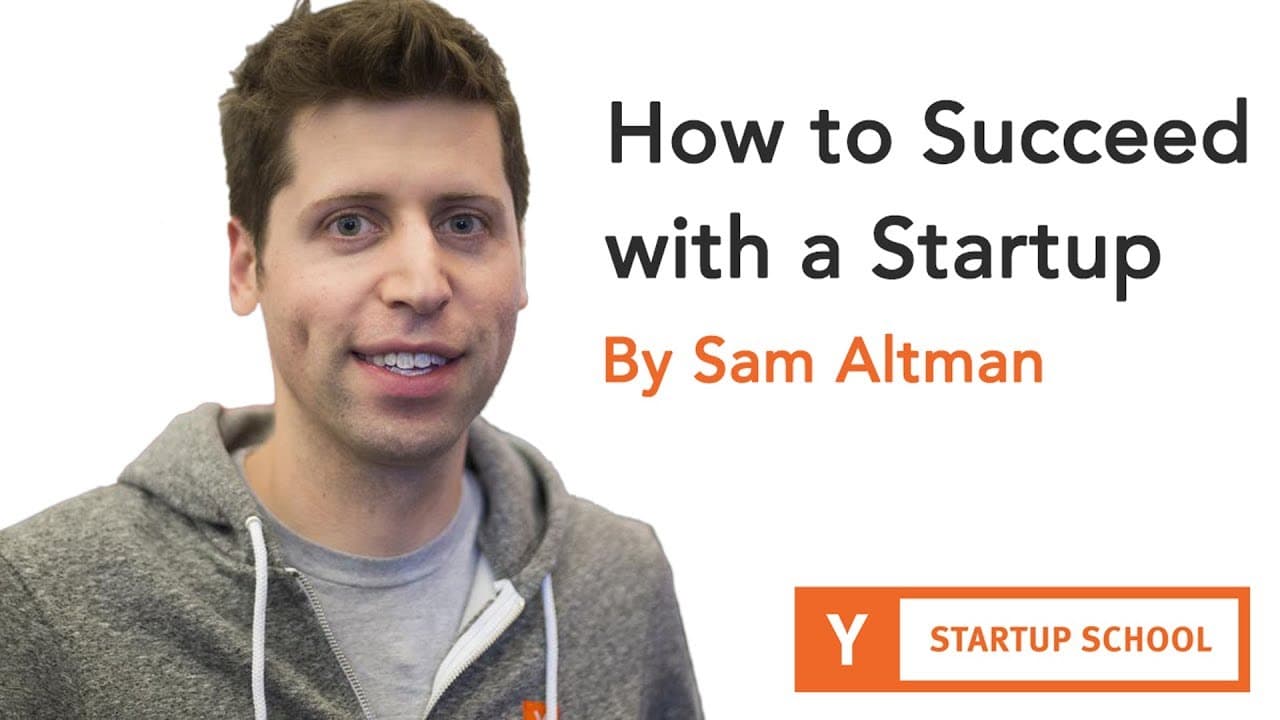
Sam Altman - How to Succeed with a Startup
TL;DR
According to Sam Altman, the biggest factor in startup success is building a product so good that people spontaneously tell their friends about it, which he says covers 80% of the work. He also says to pick a market about to grow exponentially, tell real trends from fake ones (the iPhone versus VR in 2018), and have at least one evangelical founder. Read on for why he thinks a hard startup can be easier to build than an easy one.
Transcript
okay today I'm going to talk about how to succeed with a startup obviously more than can be said here in 20 minutes but I will do the best I can the most important thing the number one lesson we try to teach startups is that the degree to which you're successful approximates the degree to which you build a product that is so good people spontaneous... Read More
Key Insights
- 📢 The most important lesson for startups is to build a product that people spontaneously tell their friends about, just like Google and Facebook.
- 🌍 Startups should target markets that are experiencing exponential growth, even if they are currently small, to maximize their chances of success.
- 📱 Products that are easy to explain and understand have a higher chance of success, indicating a need for simplicity and clarity in startup offerings.
- 👥 Startups need at least one charismatic founder who can evangelize the company's products, recruit talent, and raise funds to drive growth.
- 💡 Having an ambitious vision that excites and attracts talent is crucial, as it sets a startup apart from others and encourages people to join the team. ⏩ Startups need to maintain momentum and continuously deliver results. Losing momentum can be detrimental to their success.
- 🔒 Startups should aim to develop a competitive advantage and have a clear long-term plan to ensure sustainability and profitability.
- 💰 A sensible business model and a well-thought-out growth strategy are essential for startups to thrive and attract investors.
Install to Summarize YouTube Videos and Get Transcripts
Explore YouTube Video Summarizer or Get YouTube Transcript Extractor
Questions & Answers
Q: What is the most important lesson for succeeding with a startup, according to Sam Altman?
Sam Altman says a startup's success roughly matches how far it builds a product so good that people spontaneously tell their friends about it. If you can do that, he says, you have done 80% of the work needed to be a really successful startup. He notes that most people found out about Google or Facebook because a friend told them to try it.
Q: Why should a startup's product be simple to explain?
Altman says a product that is simple to explain and easy to understand is an important sign that people will love it. If you can't explain what you do in a few words, and at least some people don't respond with "that's pretty interesting," that is usually a mistake. He says it usually points to unclear thinking or a need that isn't big enough.
Q: Why should startups target a market that is about to grow exponentially?
Altman says the most important startups often begin in small markets that are growing very quickly, so judging only by today's market size (TAM) is a big mistake. He points out that 11 years before the talk, the market for iPhone apps was zero dollars. The goal is to find a market that grows every year and ride that "up elevator."
Q: How can you tell a real technology trend from a fake one?
Altman's test is that in a real trend, early adopters use the new platform obsessively and tell their friends how much they love it. In a fake trend, people may buy the product but don't use it, or don't use it enough. He says you should check this before making a big bet on a new platform.
Q: Why does Sam Altman call the iPhone a real trend and VR a fake one?
When the iPhone launched, many people dismissed it because only one or two million sold that year, but owners used it for hours every day and told their friends to get one. Altman calls VR a fake trend as of August 2018: he believes it will be big someday, but most headset owners he knew used them never or very rarely. VR lacked the heavy use per early adopter he wants to see before a big bet.
Q: What is an evangelical founder and why does a startup need one?
Altman says a startup needs at least one evangelical founder, usually the CEO, who recruits, sells the product, talks to the press and raises money. This person has to fill the whole world with enthusiasm for what the company is trying to do and act as its chief evangelist. He says it is very hard to succeed wildly, or even to build a team at all, without one.
Q: How ambitious should a startup's vision be?
Altman advises never being grandiose, because that turns people off. Instead, let the vision grow more ambitious over time, and as long as that happens organically, people will respond. He says ambitious visions are exciting and fun to work on, and they help recruit talent.
Q: Why does Sam Altman say a hard startup is easier to start than an easy one?
Altman says that in 2018 Silicon Valley, raising capital may be relatively easy but everything else is hard, because there are so many promising startups competing for talent. For a modestly successful idea, you can get the first two people to join with a lot of equity, but later hires ask why they should join you instead of doing something else. He says an ambitious problem that matters if it succeeds answers that question and draws people in.
Summary & Key Takeaways
-
Building a successful startup is heavily reliant on creating a product that people love and share with their friends, as this serves as the foundation for success.
-
Targeting a market that is either experiencing or expected to undergo exponential growth is crucial for startup success.
-
Having at least one evangelical founder who can recruit, sell the product, and raise money is key, as is developing an ambitious vision that attracts talent and defines the startup's purpose.
Read in Other Languages (beta)
Share This Summary 📚
Summarize YouTube Videos and Get Video Transcripts with 1-Click
Try YouTube Summary with ChatGPT & Claude or YouTube Transcript Generator
Explore More Summaries from Y Combinator 📚


Summarize YouTube Videos and Get Video Transcripts with 1-Click
Try YouTube Summary with ChatGPT & Claude or YouTube Transcript Generator