10 Y Combinator Videos Every Founder Should Watch

Jul 16, 2026
10 min read
198 views
Last updated: July 2026
Y Combinator has published hundreds of talks, but ten of them cover the entire arc of building a startup: deciding whether to start, finding an idea, shipping an MVP, talking to users, doing things that don't scale, growing, pitching, funding, and building something people love. This list puts those ten in the order a founder actually needs them, with a short summary and a full Q&A for each one.
Together they run about four hours. That is a single afternoon, and it is close to the whole Startup School curriculum in condensed form. You can also browse every Y Combinator video summary on Glasp in one place.
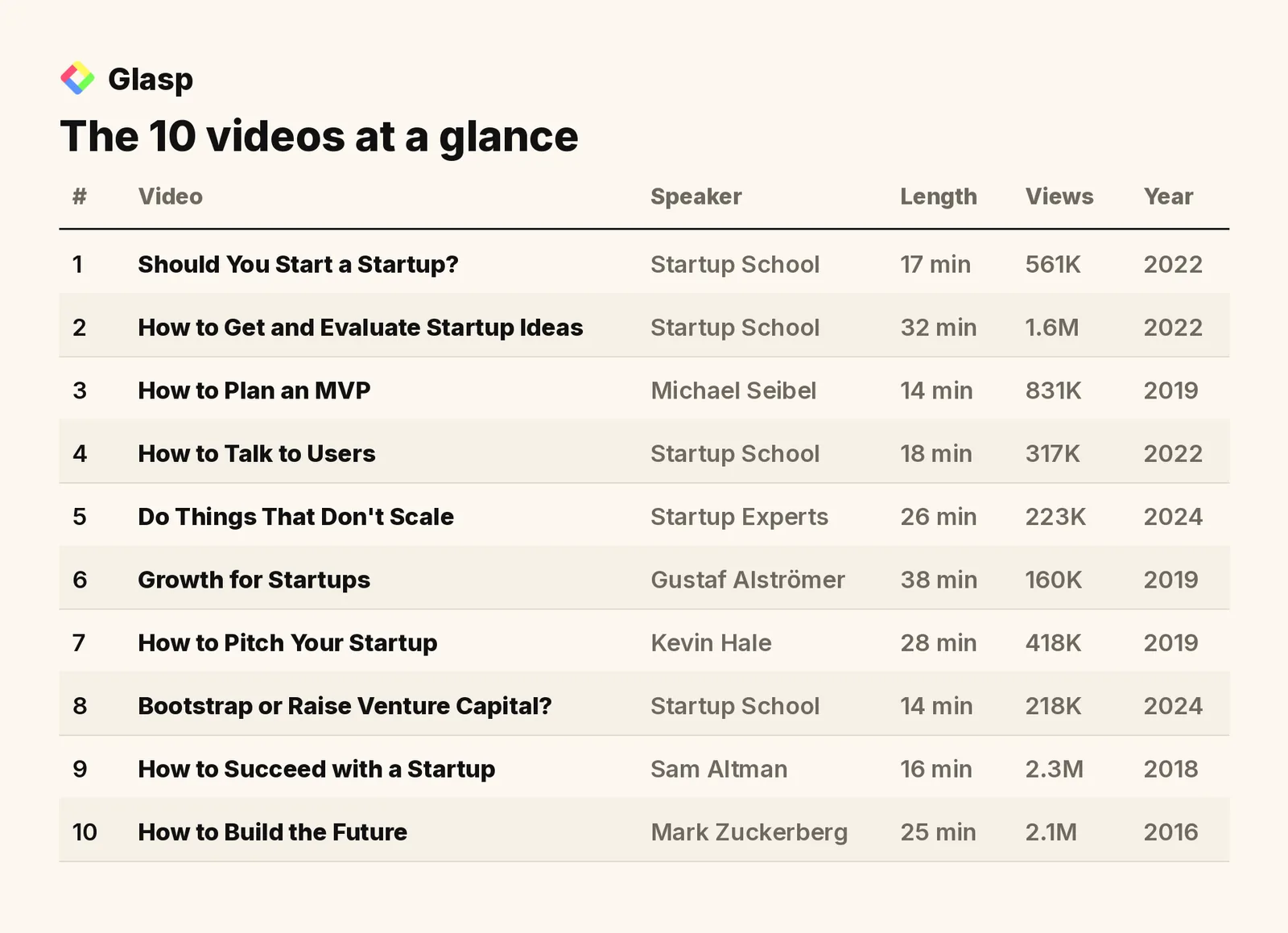
The 10 Y Combinator videos every founder should watch, in the order to watch them, are:
Should You Start a Startup? (Startup School)
How to Get and Evaluate Startup Ideas (Startup School)
How to Plan an MVP (Michael Seibel)
How to Talk to Users (Startup School)
Do Things That Don't Scale (Startup Experts Discuss)
Growth for Startups (Gustaf Alströmer)
How to Pitch Your Startup (Kevin Hale)
Bootstrap or Raise Venture Capital? (Startup School)
How to Succeed with a Startup (Sam Altman)
How to Build the Future (Mark Zuckerberg)
Total: 10 videos, 228 minutes of watch time (just under 4 hours), and 8.7M combined views.
1. Should You Start a Startup?

Startup School · 17 min · 561K views · 2022
In short: Start a startup only if you can live with the worst case. Resilience predicts success better than any founder stereotype.
Start here, because the honest answer is sometimes no. This talk drops the founder stereotypes (the brilliant dropout programmer, the natural salesperson) and replaces them with the only trait that reliably predicts survival: the ability to keep going after rejection.
Key takeaways
Founders come in many types, and the usual stereotypes predict very little about who succeeds.
Resilience matters more than the idea. You will spend a long time being rejected by early users and investors.
Your initial motivation is less important than your enduring one. Starting for money or curiosity is fine.
Before you start, look at the worst case honestly and decide whether you can live with it. Give it at least a year.
Watch on YouTube · Read the summary and Q&A
2. How to Get and Evaluate Startup Ideas

Startup School · 32 min · 1.6M views · 2022
In short: Fall in love with a real problem, not a solution, and avoid familiar tar pit ideas that look easy but quietly kill startups.
The most watched idea talk YC has made, and the one that names the trap most first-time founders fall into. Good ideas are found by falling in love with a problem, not by brainstorming solutions that sound plausible in a pitch.
Key takeaways
The common failure is building on an idea that does not solve a real problem, only a superficially plausible one.
Fall in love with a problem, not a solution. High quality problems are the raw material of good startups.
Beware tar pit ideas: the familiar ones that look easy, attract many founders, and quietly kill all of them.
Avoid both extremes. Do not marry your first idea, and do not wait forever for a perfect one.
Watch on YouTube · Read the summary and Q&A
3. How to Plan an MVP

Michael Seibel · 14 min · 831K views · 2019
In short: Keep the first version ridiculously simple, get it to people you already know have the problem, and launch as fast as possible.
Fourteen minutes, and it will save you six months. Seibel's argument is that founders overbuild the first version because building is more comfortable than talking to users.
Key takeaways
Keep the MVP ridiculously simple. It only has to deliver basic value to your first users.
Talk to users before you build, even if it is only a handful of them.
Get your first customers from people you already know have the problem. If you are your own user, this is easier.
For a pre-launch startup, the goal is to launch as fast as possible. Launch something.
Watch on YouTube · Read the summary and Q&A
4. How to Talk to Users
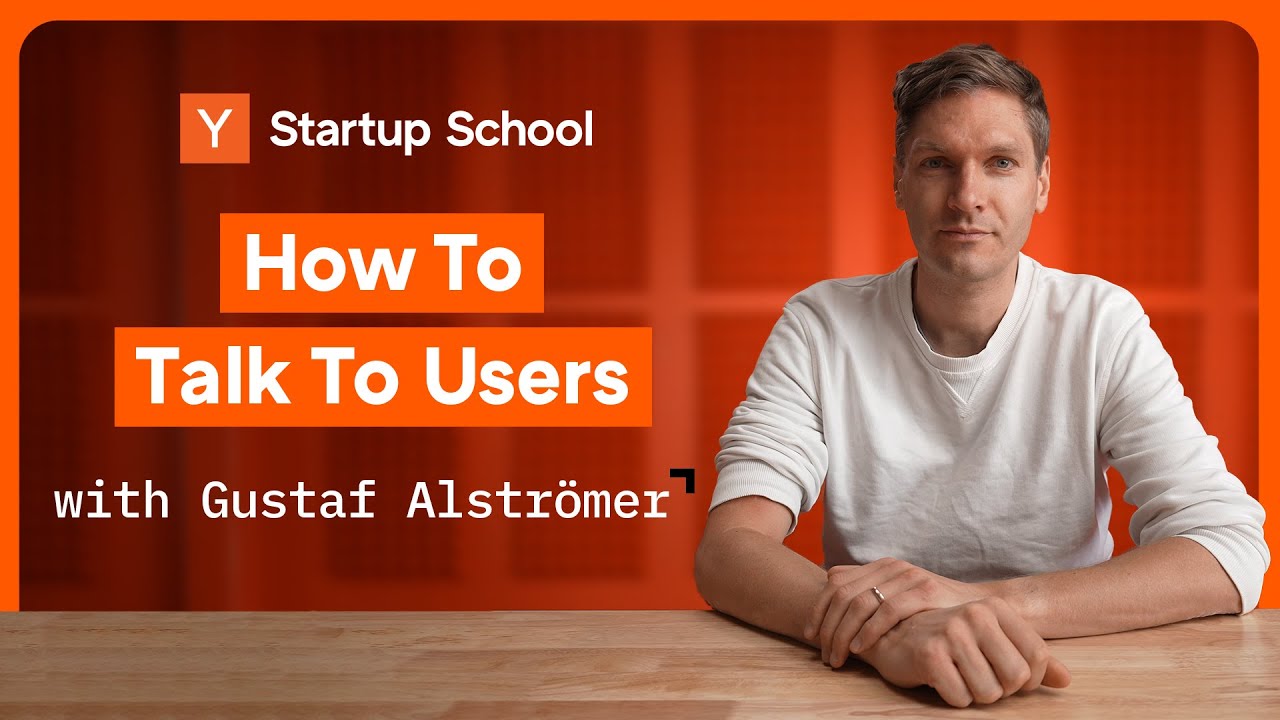
Startup School · 18 min · 317K views · 2022
In short: Talk to users through the entire life of the company, and take their problems seriously while ignoring their proposed solutions.
Every founder agrees they should talk to users. Almost none do it well. This is the practical mechanics: where to find people, what to ask, and how to hear what they actually mean.
Key takeaways
Talk to users for the entire life of the company, not just at the start. It keeps you accountable to reality.
Find them through personal networks, coworkers, online communities, forums, and in-person events.
Build rapport, ask open-ended questions, and listen for problems and motivations rather than pitching.
Users have good problems but usually suggest bad solutions. Take the problem, not the feature request.
Watch on YouTube · Read the summary and Q&A
5. Do Things That Don't Scale

Startup Experts Discuss · 26 min · 223K views · 2024
In short: Do manual, unscalable work early because it is the fastest way to learn what the market actually wants.
Paul Graham's essay turned into a working discussion. The point is not that manual work is charming. It is that manual work is how you learn things your competitors never see.
Key takeaways
Early on, prioritize learning and solving immediate problems over building for scale.
Personal contact with early customers, including founders doing support themselves, is a real advantage.
Unscalable work lets you experiment, fail fast, and pivot before you have burned the runway.
Airbnb and Instacart both grew out of manual, unglamorous tasks that taught them the market.
Watch on YouTube · Read the summary and Q&A
6. Growth for Startups

Gustaf Alströmer · 38 min · 160K views · 2019
In short: Work on growth only after retention proves product-market fit. Before that, growth tactics do not compound.
Alströmer ran growth at Airbnb, and his first message is a warning: growth tactics applied before product-market fit are wasted motion. Retention comes first, then channels, then data.
Key takeaways
Work on growth only after launching and finding product-market fit. Before that, it does not compound.
Most startups overestimate their product-market fit. Measure retention objectively instead of guessing.
Understand how to reach your audience and get known in a crowded market.
Decision making becomes the bottleneck once the team grows, so make it data driven early.
Watch on YouTube · Read the summary and Q&A
7. How to Pitch Your Startup

Kevin Hale · 28 min · 418K views · 2019
In short: A pitch is a clear hypothesis for fast growth: a big problem, your solution, and the insight that makes you win.
Hale reads YC applications for a living, so this is less about slide design and more about clarity. If you cannot describe the company in a sentence, the problem is usually the thinking, not the wording.
Key takeaways
A startup idea is a hypothesis for why a company will grow fast: a problem, a solution, and an insight.
Investors are trying to imagine the rare event that makes you huge, not trying to poke holes.
Ambiguous and complex descriptions make it hard for anyone to fund you or join you.
Being able to explain the idea conversationally is what attracts users, investors, and employees.
Watch on YouTube · Read the summary and Q&A
8. Bootstrap or Raise Venture Capital?
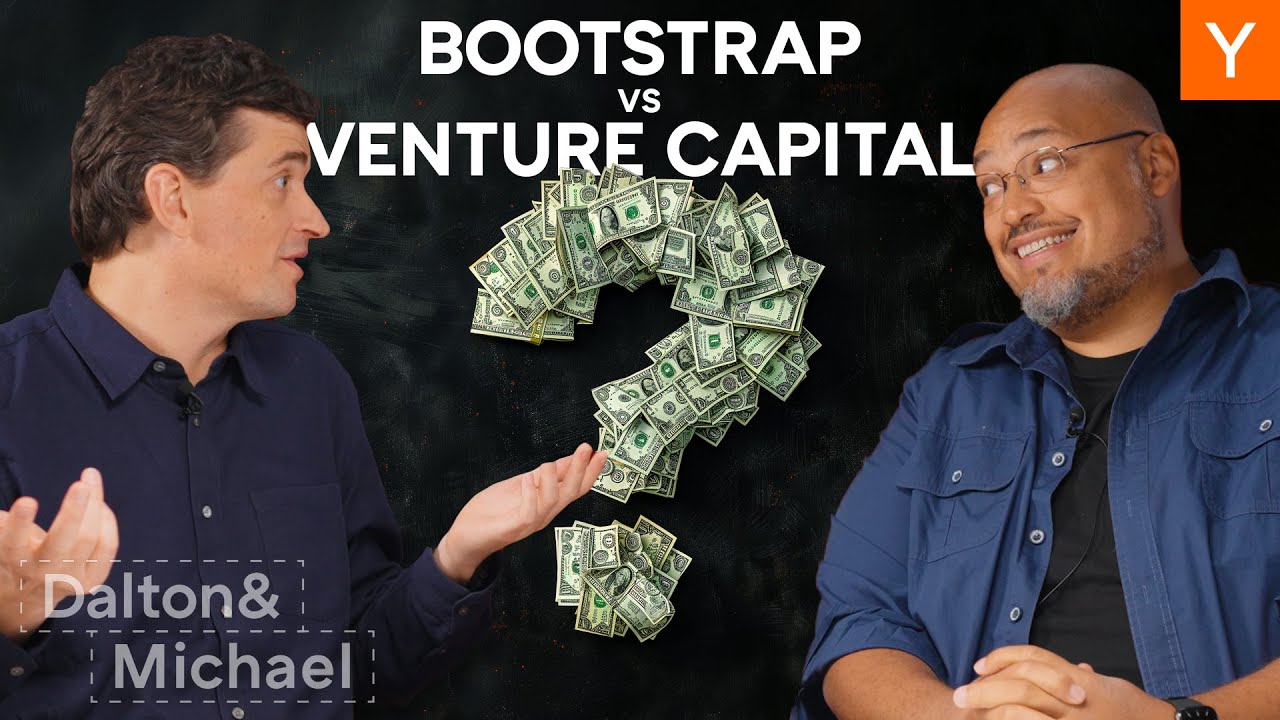
Startup School · 14 min · 218K views · 2024
In short: Most businesses should bootstrap. Raise venture capital only if you need capital upfront and can grow very fast.
An unusually blunt talk from an organization that exists to fund startups. Most businesses should not raise venture capital, and knowing which kind you are running saves years.
Key takeaways
The majority of businesses should not raise venture capital, and VCs are not interested in funding them.
VC fits a narrow case: you need capital upfront and you have genuine potential for very fast growth.
Venture funding enables companies that could not otherwise exist, which is a real but specific benefit.
The choice depends on your business, not on what sounds impressive.
Watch on YouTube · Read the summary and Q&A
9. How to Succeed with a Startup

Sam Altman · 16 min · 2.3M views · 2018
In short: Build something a small group loves enough to share, in a market growing exponentially, with one founder who can evangelize.
The single most watched piece of advice YC has published. Altman compresses a decade of pattern matching into sixteen minutes, and the first point is the one everything else rests on.
Key takeaways
Build something a small number of people love enough to tell their friends about, unprompted.
Target a market growing exponentially, even if it looks small today.
Products that are easy to explain have a structural advantage over ones that are not.
You need at least one founder who can evangelize: recruit, sell, and raise.
Watch on YouTube · Read the summary and Q&A
10. How to Build the Future

Mark Zuckerberg · 25 min · 2.1M views · 2016
In short: Start with a problem you genuinely want solved. The company is a consequence of the mission, not the goal.
Close with this one. Zuckerberg did not set out to build a company, and that is the whole lesson: the mission came first and the company was the consequence.
Key takeaways
Facebook started as a useful tool for Harvard students, not as an attempt to build a company.
The driving force was a real human problem: people want to understand each other.
Growth came from listening to user feedback and expanding where the demand already was.
Start with a problem worth solving rather than with the goal of being a founder.
Watch on YouTube · Read the summary and Q&A
How to use this list
Watch them in order. The sequence follows the real arc: decide, find a problem, ship, listen, hustle, grow, pitch, fund, and build something people love. If you only have twenty minutes today, watch number 9. If you are still deciding whether to do this at all, watch number 1.
Each summary and Q&A page above was generated from the full transcript, so you can read the whole argument in a couple of minutes and decide whether the video deserves your afternoon. For more, browse all Y Combinator video summaries on Glasp.
Frequently asked questions
Which Y Combinator video should a first-time founder watch first?
Start with "Should You Start a Startup?", because it helps you decide whether to commit at all. If you only have twenty minutes, watch Sam Altman's "How to Succeed with a Startup", the single most watched startup talk YC has published.
How long does it take to watch all 10 Y Combinator videos?
About four hours in total. The shortest is Michael Seibel's "How to Plan an MVP" at 14 minutes, and the longest single talk runs under 40 minutes, so the set fits into one afternoon.
Are these Y Combinator talks still relevant for founders today?
Yes. The talks cover durable fundamentals such as evaluating ideas, building an MVP, talking to users, and deciding whether to raise venture capital. These do not change with trends, which is why several of the talks have stayed among YC's most watched for years.
What is the most watched Y Combinator startup talk?
Sam Altman's "How to Succeed with a Startup" is the most watched, with over 2.3 million views. Its core lesson is to build something a small number of people love enough to recommend on their own.
Who are these Y Combinator talks for?
They are aimed at early-stage and first-time founders, but the material on ideas, users, pitching, and fundraising is useful to anyone starting or growing a company.
Do I need startup experience before watching Y Combinator's founder talks?
No prior startup experience is required, because the series starts with the question of whether you should start a startup at all and only then moves into finding and evaluating ideas. Anyone considering founding a company can follow it from the beginning.
What should I do after watching all 10 Y Combinator videos?
The natural next step is to act on the early sections in order: evaluate a startup idea, scope an MVP you can actually build, and start talking to users. The later material on growth, pitching and fundraising becomes useful once you have something real in front of users.
Do I have to raise venture capital to build a startup?
No. Bootstrapping and raising venture capital are both treated as legitimate paths, and the choice depends on the kind of company you are building rather than on one option being universally correct.
Which Y Combinator videos should I watch if I already have a product but no users?
Focus on talking to users, doing things that don't scale, and growth. These cover getting your first users by hand and manually, before worrying about scalable channels or a fundraising pitch.
Related lists
💡 Want summaries and transcripts for any YouTube video? Try YouTube Summary with ChatGPT & Claude.