10 Best YouTube Videos on Sleep

Oct 21, 2026
11 min read
0 views
Last updated: October 2026
This is a curated path through ten YouTube videos on sleep: why we need it, what the brain does at night, and what to change when sleep goes wrong. It is for students and busy adults who want to understand their own sleep and improve it with clear, research-based habits.
The full set takes about 87 minutes, and most videos are under fifteen minutes. It draws on TED, TED-Ed, Andrew Huberman and Therapy in a Nutshell. The videos cover the core topics in order: the purpose of sleep, the costs of losing it, brain waste clearance, memory, teenage biology, light, daily habits, insomnia, worry and rest techniques.
The videos on this list, in the order to watch them, are:
What Happens When You Don't Sleep? (TED-Ed)
How Does the Brain Clean Itself During Sleep? (Jeff Iliff)
How Does Sleep Help You Remember? (TED-Ed)
Why Do Teenagers Need More Sleep? (TED-Ed)
How Does Morning Sunlight Improve Sleep? (Andrew Huberman (Huberman Lab Clips))
How Do You Stop Worrying at Bedtime? (Therapy in a Nutshell)
What Is Non-Sleep Deep Rest (NSDR)? (Andrew Huberman (Huberman Lab Clips))
Total: 10 videos, 87 minutes of watch time, and 43.6M combined views.
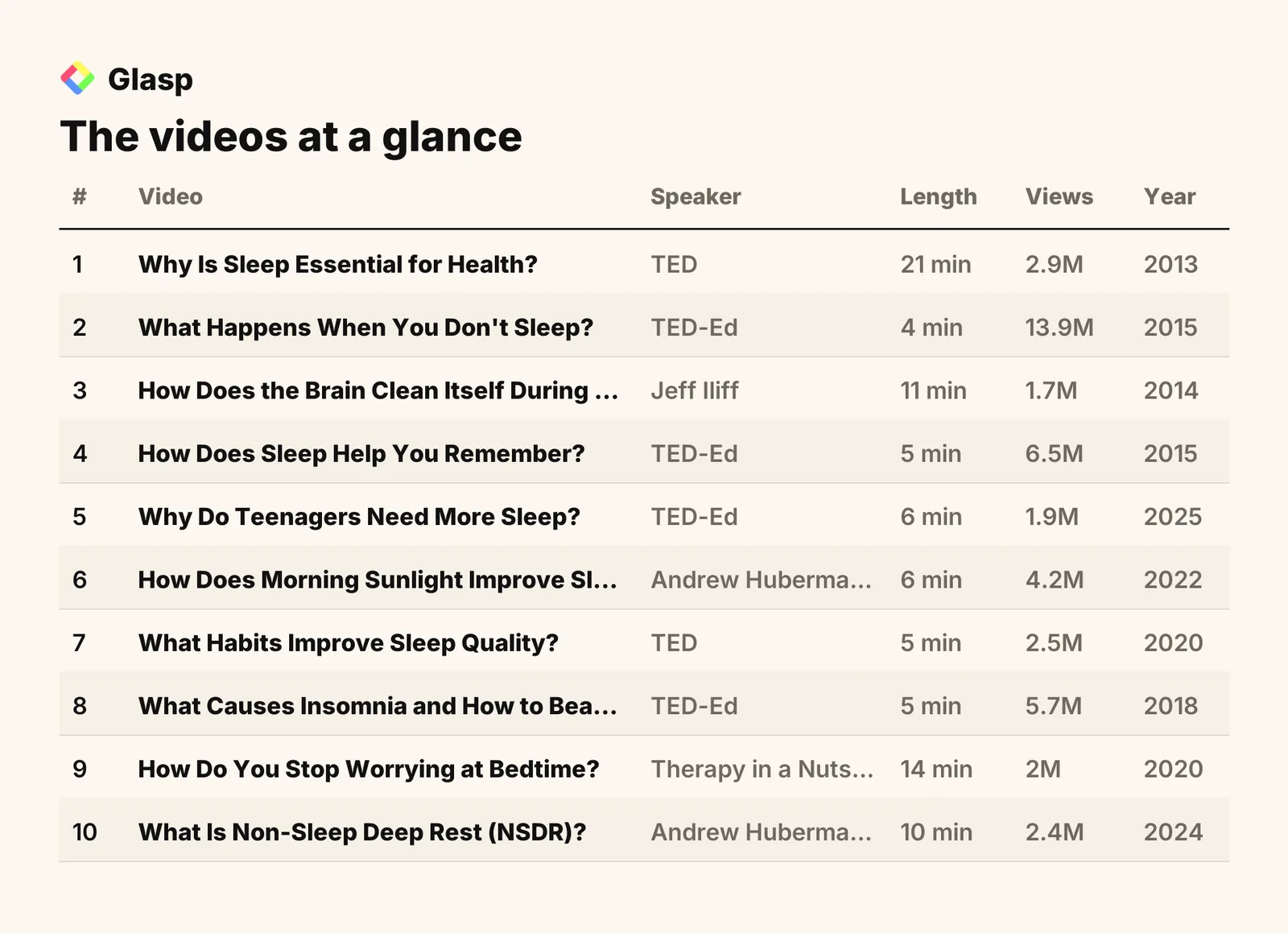
1. Why Is Sleep Essential for Health?

"Why Is Sleep Essential for Our Health and Well-being?" · TED · 21 min · 2.9M views · 2013
In short: Sleep is essential because it supports memory consolidation, creativity and physical restoration, and losing it is linked to health problems and mental illness.
This talk gives the big picture before the details. It explains the biological clock, the main theories of why we sleep, and why sleep problems show up alongside mental health conditions.
Key takeaways
The average person spends about 36% of their life asleep, so sleep should be treated as essential to health and brain function.
The biological clock sits in the hypothalamus and works with other brain structures to control when we sleep and when we stay awake.
Leading theories of why we sleep include restoring the body, saving energy, and helping the brain process information and consolidate memories.
Sleep disruption is associated with depression, schizophrenia and bipolar disorder, and stabilizing sleep can be a target for treating mental health symptoms.
Watch on YouTube · Read the summary and Q&A
2. What Happens When You Don't Sleep?
"What Happens to Your Body When You Don't Sleep?" · TED-Ed · 4 min · 13.9M views · 2015
In short: Without sleep, people experience mood swings, memory loss, paranoia and hallucinations, and chronic deprivation raises the risk of stroke, inflammation and death.
This short animation shows what is at stake when sleep is lost. In four minutes it moves from everyday symptoms to the extreme case of Fatal Familial Insomnia.
Key takeaways
Lack of sleep can cause mood swings, memory loss, paranoia and hallucinations, which shows how much the brain depends on regular rest.
Fatal Familial Insomnia is a condition that shows the extreme consequences of being unable to sleep, and it is presented here as an example.
Sleep is essential for DNA repair and for replenishing the body, which is why chronic deprivation affects health far beyond feeling tired.
Chronic sleep deprivation significantly increases the risk of stroke and inflammation, and it is linked to cognitive impairment and mood disorders.
Watch on YouTube · Read the summary and Q&A
3. How Does the Brain Clean Itself During Sleep?

"One more reason to get a good night’s sleep | Jeff Iliff" · Jeff Iliff · 11 min · 1.7M views · 2014
In short: During sleep, brain cells shrink so cerebrospinal fluid can rush through and clear waste, including amyloid beta, which is linked to Alzheimer's disease.
Jeff Iliff explains one concrete thing the sleeping brain does. His account of brain waste clearance turns the idea that sleep restores the mind into a physical process you can picture.
Key takeaways
The brain has no lymphatic vessels like the rest of the body, so it clears waste through a specialized network that uses cerebrospinal fluid.
The brain repurposes the outsides of its blood vessels as channels for clearing waste, an approach not seen in any other organ.
This waste clearance happens mainly during sleep, when brain cells shrink and allow fluid to flow through and flush waste away.
Amyloid beta is cleared more rapidly from the sleeping brain, and its buildup is related to the development of Alzheimer's disease.
Watch on YouTube · Read the summary and Q&A
4. How Does Sleep Help You Remember?
"Why Is Quality Sleep Important for Memory and Learning?" · TED-Ed · 5 min · 6.5M views · 2015
In short: Sleep consolidates memories in stages: slow wave sleep strengthens declarative memory, and REM sleep supports procedural memory, so poor sleep weakens retention.
This video links sleep to learning, which makes it especially useful for students. It shows which stages of sleep handle which kinds of memory and why cutting sleep short hurts retention.
Key takeaways
Quality sleep is essential for memory consolidation because the brain restructures connections during sleep, especially in slow wave and REM stages.
Slow wave sleep is linked to declarative memory consolidation, while REM sleep helps consolidate procedural memory such as skills.
The hippocampus is crucial for long term memory consolidation, especially for declarative memories of facts and events.
Emotions, stress and the quality of sleep all influence how well memories are retained after learning.
Watch on YouTube · Read the summary and Q&A
5. Why Do Teenagers Need More Sleep?
"How Does Sleep Loss Affect the Teenage Brain?" · TED-Ed · 6 min · 1.9M views · 2025
In short: Puberty delays the teenage body clock, so early school schedules cut sleep that teens need for learning, emotional control, judgment and safe driving.
This video applies sleep science to the group most likely to be short on it. It explains why teens fall asleep later and what changes when schools start later.
Key takeaways
Teenagers need 8 to 10 hours of sleep, but only about 1 in 10 American teenagers get the recommended amount each night.
Puberty delays melatonin release to around 11 p.m., about two hours later than adults or younger children, so teens naturally get sleepy later.
Waking a teenager at 6 a.m. is biologically comparable to waking an adult at 4 a.m., which cuts into memory and emotional processing.
Later school start times have produced more sleep, better attendance, improved test performance and fewer car crashes in districts that adopted them.
Watch on YouTube · Read the summary and Q&A
6. How Does Morning Sunlight Improve Sleep?
"How Does Morning Sunlight Improve Wakefulness and Sleep?" · Andrew Huberman (Huberman Lab Clips) · 6 min · 4.2M views · 2022
In short: Morning sunlight triggers cortisol release that boosts daytime alertness and better nighttime sleep, ideally taken outside within the first hour after waking.
This is the first practical tool on the list, and it is also one of the easiest to try. It shows how the start of your day shapes how well you sleep that night.
Key takeaways
Getting outside within the first hour after waking, for about five to thirty minutes depending on weather, improves wakefulness and later sleep.
Artificial lights are less effective than sunlight for triggering wakefulness, and artificial light used late at night can disrupt circadian rhythms.
Cloudy days still provide useful sunlight exposure, so spending time outside in the morning matters regardless of the weather.
Sunglasses should be avoided during morning sunlight viewing, while corrective eyeglasses or contact lenses are acceptable.
Watch on YouTube · Read the summary and Q&A
7. What Habits Improve Sleep Quality?

"How to Improve Sleep Quality with Science-Backed Tips" · TED · 5 min · 2.5M views · 2020
In short: Keep a regular sleep schedule, a cool bedroom around 65 degrees Fahrenheit, dim lights before bed, and limit caffeine and alcohol.
This five minute talk collects the core sleep habits in one place. It is the checklist to come back to once you understand why each habit works.
Key takeaways
Going to bed and waking up at the same time each day improves both the quantity and quality of sleep by aligning with the body clock.
Keeping the bedroom cool, around 65 degrees Fahrenheit or 18 degrees Celsius, helps the body lower its core temperature to start and maintain sleep.
Darkness in the evening triggers melatonin release, so avoiding screens and dimming lights before bed supports healthy sleep timing.
If you cannot fall asleep within 25 minutes, getting out of bed and doing something else helps retrain the brain to link bed with sleep.
Watch on YouTube · Read the summary and Q&A
8. What Causes Insomnia and How to Beat It?

"What Causes Insomnia and How Can You Overcome It?" · TED-Ed · 5 min · 5.7M views · 2018
In short: Insomnia is mainly caused by stress, and it is best addressed by managing stress, keeping consistent sleep habits and getting an accurate diagnosis.
Once the healthy baseline is clear, this video explains what happens when sleep fails anyway. It covers hyperarousal and why it matters to tell insomnia apart from other sleep disorders.
Key takeaways
Insomnia is predominantly caused by stress and can lead to chronic sleep deprivation with associated health risks.
People with insomnia experience hyperarousal, in which stress hormones disrupt both sleep quality and metabolism.
Managing stress, building healthy sleep practices and keeping a consistent routine and sleep environment are the main ways to combat insomnia.
Telling insomnia apart from other sleep disorders, such as delayed sleep phase disorder, is crucial because each needs a different treatment approach.
Watch on YouTube · Read the summary and Q&A
9. How Do You Stop Worrying at Bedtime?

"How to Sleep Better When Anxiety Keeps You Awake" · Therapy in a Nutshell · 14 min · 2M views · 2020
In short: Schedule a daily 5 to 15 minute worry session well before bed, write worries down, and plan actions so bedtime stops being worry time.
This video tackles the most common reason people lie awake: a racing mind. It treats worry at bedtime as a trained habit and gives a specific daily practice to retrain it.
Key takeaways
Worry based insomnia is a trained response: repeatedly thinking through the day in bed pairs lying down with worrying.
A deliberate worry session of about 5 to 15 minutes, held in the afternoon or after dinner and never right before bed, gives worries a set time.
Writing worries down and sorting them into actionable and hypothetical ones makes them more manageable and shows which need a next step.
Constant distraction during the day blocks the brain's background processing, so unresolved worries tend to surface at bedtime when nothing else competes.
Watch on YouTube · Read the summary and Q&A
10. What Is Non-Sleep Deep Rest (NSDR)?

"What Is Non-Sleep Deep Rest (NSDR) and How to Do It?" · Andrew Huberman (Huberman Lab Clips) · 10 min · 2.4M views · 2024
In short: NSDR is a 10 minute protocol of slow breathing and a mental body scan that restores vigor, partly offsets lost sleep and aids sleep.
The list ends with a technique you can use right away, day or night. It gives you a tool for nights when sleep falls short and for winding down before bed.
Key takeaways
Non-sleep deep rest is a 10 minute protocol done seated or lying down with eyes closed, and it can be used any time of day or night.
The core breathing pattern is a deep inhale through the nose and a full exhale through pursed lips, which slows heart rate and relaxes the nervous system.
The central technique is an attentional spotlight scanned across the body from the feet upward, noticing each sensation without judging or changing it.
NSDR restores mental and physical vigor, can partially offset lost sleep, and helps people fall asleep and stay asleep.
Watch on YouTube · Read the summary and Q&A
Frequently asked questions
Why do we need sleep?
Sleep supports memory consolidation, creativity, physical restoration and DNA repair. The brain also uses it to clear waste through cerebrospinal fluid.
What happens to your body if you don't get enough sleep?
Sleep loss can cause mood swings, memory problems, paranoia and hallucinations. Chronic deprivation raises the risk of stroke, inflammation and mood disorders.
Is lack of sleep linked to Alzheimer's disease?
Amyloid beta is cleared more rapidly from the sleeping brain, and its buildup is related to Alzheimer's disease. Good sleep may help the brain clear this waste.
Does sleep help you learn and remember?
Yes. Slow wave sleep helps consolidate declarative memories such as facts, and REM sleep helps consolidate procedural memories such as skills.
How much sleep do teenagers need?
Teenagers need 8 to 10 hours of sleep. Puberty delays melatonin release to around 11 p.m., so teens naturally get sleepy later than adults.
What is the best temperature for sleeping?
A cool bedroom around 65 degrees Fahrenheit, or 18 degrees Celsius, helps the body lower its core temperature, which helps start and maintain sleep.
How does morning sunlight help you sleep better?
Morning sunlight triggers cortisol release that boosts daytime alertness and supports better sleep at night. Get outside within the first hour after waking, even on cloudy days.
What should you do if you can't fall asleep?
If you cannot fall asleep within about 25 minutes, get out of bed and do something else until you feel sleepy. This retrains the brain to link the bed with sleep.
How can I stop anxiety from keeping me awake?
Set aside 5 to 15 minutes each afternoon or after dinner to write down your worries and plan next steps. Over time, this teaches the brain that bedtime is not worry time.
How to use this list
Watch the videos in the order listed: the first five explain why sleep matters and what the brain does at night, and the last five turn that into daily practice. If you are short on time, start with the TED talk on science-backed sleep tips, which covers the core habits in five minutes. Then add morning sunlight from Andrew Huberman. If you lie awake with a busy mind, go next to the Therapy in a Nutshell video on deliberate worry. Use the NSDR video any time a short night leaves you drained.
Related lists
💡 Want summaries and transcripts for any YouTube video? Try YouTube Summary with ChatGPT & Claude.